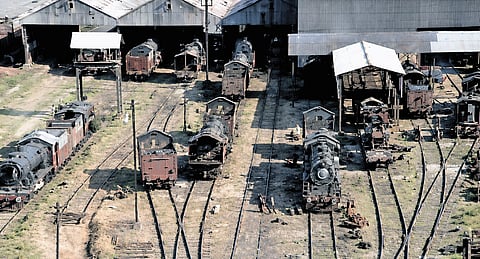

PALAKKAD: Once the beating heart of Kerala’s steam railway era, Shoranur is preparing to relive its glorious past. In a first-of-its-kind initiative in the Southern Railway, the mechanical department of Palakkad railway division is opening a Mechanical Heritage Museum on the Shoranur railway station premises, preserving more than a century of railway engineering history through over 100 artefacts recovered from the old locomotive and carriage yard.
It was while reorganising the old carriage and wagon yard that officials came across a collection of historic equipment, signalling devices, workshop tools and memorabilia. Recognising their heritage value, the mechanical department decided to conserve the items by setting up a dedicated museum instead of allowing them to be turned into scrap.
The collection features over 100 original items, each narrating a chapter of India’s railway evolution. The museum has been set up on the western side of the station premises.
“Among the exhibits are a century-old locomotive bullseye lamp (manufactured in late 19th century) that once illuminated steam engines, a brass steam locomotive whistle (approximately 75 years old), whose unmistakable sound defined the steam era, a porcelain kerosene lamp burner imported from England, heavy-duty grease guns used for locomotive maintenance, workshop machinery from Britain and Germany, and one of the oldest time-office bells that regulated the daily lives of hundreds of railway workers in Shoranur. A national flag supplied to the Railways in 1974, still bearing the official railway property marking, is another unique exhibit,” said authorities.
The museum, authorities say, is a tribute to a station that shaped the railway history of Kerala. Shoranur Junction, which became operational on April 14, 1862, with the opening of the Pattambi-Podanur railway line, quickly evolved into one of South India’s most strategic railway junctions.
The establishment of a steam locomotive shed around 1900 transformed the town into the nerve centre of steam locomotive maintenance, drawing skilled workers and engineers from across the Madras Presidency.
The opening of the Shoranur-Ernakulam line in 1902 further cemented its status as one of the busiest railway hubs in the region. “Several exhibits date back to the late 19th and early 20th centuries, reflecting the period when railway technology, engineering practices and workshop culture introduced by the British laid the foundation for India’s modern railway system.
The artefacts also highlight the remarkable transformation of Shoranur’s railway establishment — from a steam locomotive shed to a coach and wagon repair depot, and later into one of Indian Railways’ leading carriage maintenance centres equipped with advanced technologies,” the officers added.
Today, even Vande Bharat rakes are brought to Shoranur for short maintenance work.
Officials said the museum has been conceived to conserve this legacy for future generations while showcasing the engineering excellence that evolved over more than 160 years of railway history. By converting forgotten relics into a heritage collection, the Palakkad division hopes to connect visitors with the story of Shoranur — a station that not only linked railway lines but also became the cradle of Kerala’s railway engineering tradition. Authorities are yet to announce a date for throwing the museum open to the public.
“Even a century ago, Shoranur was known as a railway town with over 3,000 employees working in the loco shed alone. We have preserved even the silver cutlery, believed to have been used by British officers.”
More importantly, over 90% of items that were used in the loco shed are still in working condition, officials added.
For generations of railway employees and residents of Shoranur, the museum is more than a display of old machinery. It is a repository of memories from an era when the whistle of steam locomotives echoed across the Bharathapuzha, the ringing of the workshop bell marked the rhythm of the day, and the vast locomotive shed symbolised the town’s identity.

TIME OFFICE BELL
Date: 1869
Materials: Cast bronze bell with iron/steel mounting components
Manufacturer: Government Metal Industries, Beypore, Kerala
Dimensions: 45” X 45”
Description: This bell was used in the time office of the Steam Locomotive Shed, Shoranur. It was rung to regulate daily work and alert employees regarding duty timings, shift changes, meal breaks, emergencies, and important announcements. Prior to the introduction of electric sirens and public address systems, it served as the principal time-signalling device for railway employees
Steam locomotive whistle
Date: Early 20th century
Material: Brass
Description: This whistle is fitted to the boiler of a steam engine and operated by a pull cord or lever. When the valve is opened, high-pressure steam passes through the whistle chamber, producing a loud signal. The whistle was the major warning and communication device on steam locomotives and was one of the most distinctive symbols of the steam railway era
Locomotive bullseye lamp
Date: Late 19th century to late 20th century (this example probably dates from the mid-20th century)
Materials: Painted steel sheet body, glass lens, steel carrying handle, brass steel burner fittings, and kerosene fuel reservoir
Description: These are signalling markers, designed specifically for intense vibrations and harsh conditions of a moving system or earth diesel engine. The backing bracket, instead of a bottom socket, on the rear of the lamp features a heavy-duty, tapered steel slot or socket. This allows the lamp to slide onto standard iron brackets (lamp irons) on the locomotive’s smoke box door, running boards, etc...