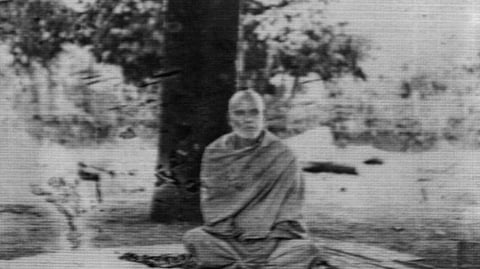

The combination is quite striking. On the one hand is Sree Narayana Guru, a thinker who traversed lofty Advaitic heights while challenging social practices justified in the name of religion, yet whose legacy has remained largely confined to Kerala. On the other is Shashi Tharoor, a statesman and globally renowned wordsmith.
The result is ‘The Sage Who Reimagined Hinduism’, a book that seeks to lift the veil of obscurity surrounding the Guru and take his legacy to audiences beyond Kerala. Tharoor speaks to TNIE about the book and why he felt compelled to write it. Excerpts:

What prompted you to write the book?
I was always struck by the fact that Sree Narayana Guru is so astonishingly well-known in Kerala — he won hands down in a poll on the Malayali of the millennium — yet not many have heard about him in the north. In a random experiment, I asked 20 people about him, and 19 of them went blank. There was an information gap. I felt that if I tackled a subject otherwise deemed not saleable, it would probably attract a new set of readers to learn about the Guru.
However, to be honest, readership has not been what I expected. Sadly, this great man is not attracting the attention he deserves. Part of it could be because I did not have the time to promote the book.
Considering the magnitude of the Guru’s life, authoring a book in a short-biography format would have been challenging…
I had recently done a short biography on Ambedkar. It was a success. The short-biography format is apt for this generation because young readers do not have the attention span for multi-volume biographies. My Nehru and Ambedkar biographies had the merit of brevity. This, too, I wrote in that spirit.
The Guru is quite a well-researched subject academically, yet remains obscure when it comes to mainstream discussions nationally…
Those who wrote about him in English were slightly guilty of hagiography. Some books I referred to were good, but they never thought of making him accessible. That is what I tried to do. I have also looked at what we are today in terms of his teachings. There is no greatness to the work as such, but I feel the life of its subject is so great.
Has the political patronage around him clouded his literary and spiritual legacy?
The title itself speaks about ‘reimagined Hinduism’. I wanted to point out how he resolved the challenges of Hinduism from within in a remarkable way. I do lament in the legacy section of the book that he has been reduced to a caste [Ezhava] leader.
His concept of SNDP Yogam was for everybody, but now it has almost become synonymous with a caste, quite contrary to the Guru’s vision of transcending caste. In fact, people have become more conscious of their caste. So, even while we respect his lessons of going beyond caste, we have not absorbed them.
Do you believe it is necessary to free him from the clutches of politics?
Oh, I agree totally. We need to be discussing him in depth. He needs to be freed from the confines of politics. Somehow, while Ambedkar is discussed nationally, Guru remains confined to Kerala.
How far do you value Guru as a protector of dharma?
In many ways, he saved Hinduism from its worst excesses. Discrimination at that time was so severe that people could have been vulnerable to mass conversion to other faiths. Had Sree Narayana Guru not succeeded in offering an alternative within the existing fold, who knows what might have transpired? So, one can certainly argue that his role was significant in preserving Hindu dharma.
How do you react to writings about him that harp on this point?
There are some communist writings, such as those of E M S Namboodiripad, that describe him as a bourgeois reformer. This reflects the view that he was not iconoclastic enough towards the Hindu faith. I would agree that when you build a temple and consecrate an idol, you are, of course, reinforcing the faith. Yes, he said he did not belong to any religion and so on, but de facto, what he preached and taught was very much within the Hindu fold — reimagined and reinterpreted in a liberal and expansive spirit.
Is that what true Hinduism is — the way he reimagined it?
People do not talk enough about Hinduism free from the shackles of caste prejudice. One of Guru’s early accomplishments, besides consecrating temples, was to hold the very first exhibition for vyavasayis (traders) [from backward castes] in 1904. This is a man who believed that one becomes self-reliant through education and enterprise. That was an important message.
How much do you think the Varnashrama system reflects the essence of Hinduism?
I have argued before that it is not central to Hinduism. I draw a distinction between Hinduism as theology and spirituality, and Hinduism as a social practice that is man-made and has no theological sanction. It does not make me a bad Hindu to reject the notion of untouchability. I grew up with very devout parents who had no faith in discriminatory practices. My father dropped his caste name because he was convinced that it was the
right thing to do. His generation was inspired by Guru and Ambedkar. But I am afraid the next generation lost that idealism, partly because politicians have used caste to mobilise votes.
From whatever you have written so far, there seems to be a gross misunderstanding of Sanatana Dharma...
Yeah, when you hear someone like Udayanidhi Stalin talk about Sanatana Dharma being a disease that must be eradicated, it is clear that he has not understood what Hinduism is. If he had said caste discrimination needs to be eradicated, I would have applauded. When he says Sanatana Dharma should be eradicated, how can I support him? It is my faith, which, in my understanding, does not include caste discrimination.
But Hinduism is often accused of giving sanction to the caste structure…
Caste is very much a practice that is rooted in man-made social behaviour. Historical anecdotes testify to this. One such is of Adi Shankara and his encounter with a Chandala in Varanasi, who was asked to move away to make way for the great saint. The Chandala refused to budge and asked: “What should I move — my body or my atman?” Adi Shankara fell at the Chandala’s feet in reverence. Adi Shankara himself maintained that caste was not central to his teachings. Faults of some Hindus should not be laid at the door of Hinduism as a faith.
How do you read Guru alongside the likes of Adi Shankaracharya?
Unlike Adi Shankaracharya, Sree Narayana Guru did not travel much. But what he did contributed enormously to saving Hinduism. If you look at a comparable story in Indonesia, Hinduism was once the faith of the archipelago. It was then overtaken by Buddhism, and later succumbed to Islam. You could argue the same fate would have befallen Hinduism had it not been for Adi Shankara, who reinvented the faith.
Parallelly, Sree Narayana Guru did something similar, especially in Kerala. His specific target was social inequities. Also, his contributions to education were immense — look at the census figures from 1901 to 1941; the changes were dramatic. Guru had a great sense of humour, was realistic, modern, and scientific in his approach.
What kind of spiritual aura did the Guru exude?
Rabindranath Tagore, for one, was extraordinarily struck by the spiritual aura of Guru. Gandhiji also had a similar view. Ramana Maharshi is said to have come out of his cave to meet him — something he had never done before. So, his spiritual aura was remarkable.
However, what is even more prominent is the human quality in it. When the 1921 Census asked him to name his caste, he said: “Human.” He was the first person in India’s official history to be recorded as ‘human’.