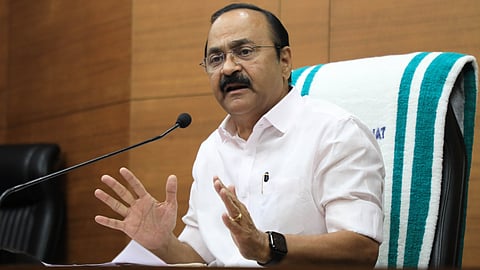

Despite the burden of a huge bill of arrears and unpaid loans of Rs 87,012 crore and a reduction in expected income to the tune of Rs 20,500 crore, Chief Minister-cum-Finance Minister V D Satheesan chose to open a magic world of a new age Kerala with an ocean and maritime economy, an economy of aviation and space, science-led cities and parks for investment and education.
There was something for everybody: Gen Z, the elderly, women as a whole, the low-paid public-service women workers and so on. Though not stated in so many words, the intention seems to attract all kinds of private investment, be it domestic and/or foreign, public-private partnership, or private-public-cooperative. But he also realises, or so it implies, that initial infrastructural investment has to come from the government.
That explains the meagre allocations. Whether there is a master plan for these new vistas of development with feasibility reports and the like are matters of detail that people might expect in due course of time. Given the short time span within which this revised budget had to be presented, it is but natural that some time be given to the new government to work out the details — giving not only feasibilities but also priorities with time frames.
Every government wants to show they are starting new projects that attract plaudits and praise but hardly bothers about sustainability. One may ask why another medical college when many existing ones are starved of funds, functionaries and sound infrastructure.
Why do we want to add to the number of universities based on narrow specialisations with overhead expenditure that could have been avoided if initiatives to encourage new branches of knowledge are located in existing universities? Spreading scarce capital thinly has become a style in Kerala’s governance, whether it is for the numerous public-sector enterprises, universities or institutions of advanced research and development.
Given the stringent financial condition of the government, I expected the vigorous articulation of a strategy for garnering additional revenue, not only to overcome the current unsustainable revenue-deficit trap but also to contribute to capital formation. That was missing. Some measures to strengthen tax collection has certainly been announced but they don’t add up to the seriousness of the situation. The revised accounts given in the budget papers reveal that the low own-revenue-to-state-income ratio couldn’t exceed even 8% during the last three years of the previous government. To be precise it was 7.98% in 2023-24, 7.46% in 2024-25 and 7.18% in 2025-26.
This trend of collecting less than `8 for every `100 of state income has been the lowest in the last 50 years of the record of public finance in Kerala.
The irony of the situation is that it has been during the last 20 years that Kerala emerged as No.1 among the major states in India in per-capita consumption. In Satheesan’s budget proposals he expects to raise this own-revenue-to-state-income ratio to a mere 7.39%. Cynics might be tempted to say that the downward spiral in revenue collection efficiency is here to stay. The same sad story is present when one reads the white paper of the Tamil Nadu government released a few days ago.
Given the pitiable state of Kerala’s public sector, one expected some bold announcements in restructuring, modernising or closing down units, depending on their strategic and non-strategic nature and scope for improvement. There was no announcement of rationalisation of expenditure, no cutting down.
(Writer is a development economist)
