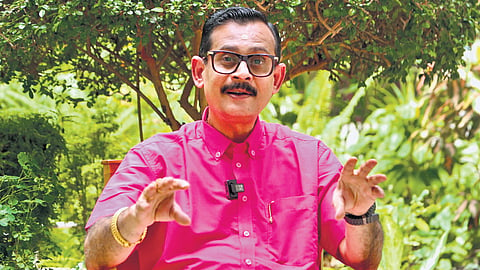

With over three decades of pioneering research in forest genetics, biodiversity conservation and ecological restoration, Dr Kannan C S Warrier is one of India’s leading forestry scientists.
Having served as chief scientist at the Institute of Forest Genetics and Tree Breeding in Coimbatore, he is currently on deputation as the director of Kerala Forest Research Institute (KFRI).
Recipient of the National Award of Excellence for Outstanding Research in Forestry, the Rolla S. Rao National Award for biodiversity research and the Springer Nature Editor of Distinction Global Award 2026, Warrier has authored hundreds of research papers, secured multiple patents and used music as a medium for environmental awareness.
In a freewheeling interaction with TNIE on the sylvan KFRI campus in Peechi, he reflects on his journey, Kerala’s forests, sacred groves, invasive species and the future of conservation
Your academic journey began with securing the state first rank in both your bachelor’s and master’s degrees in forestry. What drew you to the subject?
My interest in nature and science began long before I entered forestry. When I was in Classes 5 and 6 at a school in Haripad, we had an outstanding science teacher, Sukumaran Pillai sir, whose classes sparked my curiosity about the natural world. My childhood surroundings also played a defining role. Our ancestral home was bordered on three sides by sacred groves and had two ponds within the compound. One of my aunts would explain to us children about the different trees and plants growing there. Those conversations nurtured a fascination with nature. Trees were a part of everyday life.

Your specialisations include forest genetics and clonal forestry. Could you explain these fields?
A clone consists of genetically identical plants produced vegetatively from a superior parent tree. Every new plant produced retains the same desirable genetic traits. I also carried out extensive research on Casuarina, known as kaattadi in Malayalam. We developed improved clones, studied their genetic variation and, for the first time in India, established a clonal seed orchard for the species.
This enabled the production of high-quality seeds within six months. Another major focus was reclaiming salt-affected lands. India has nearly 67 lakh hectares of saline and sodic soils. While saline soils can often be reclaimed through irrigation, sodic soils require expensive treatments. Our research led to the release of three productive Casuarina clones suitable for sodic soils, making previously unproductive land economically useful.
Today, monoculture plantations are being criticised for degrading habitats…
Fast-growing species such as eucalyptus, casuarina and acacia were introduced to meet specific needs — supplying raw material for the pulp and paper industry, timber and fuelwood. Forestry has evolved considerably since then. Kerala became the first state in India to adopt ecological restoration as a policy. The forest department has begun replacing low-yielding monoculture plantations with native trees. KFRI provides scientific support for such endeavours.
We have heard experts say exotic species pose a major threat to our forests…
Yes, that’s right. Senna spectabilis is a classic example. It was introduced in the 1980s under social forestry programmes as a shade tree for coffee plantations. It was also planted for ornamentation because its bright yellow flowers resemble those of kanikkonna (Cassia fistula).
No one anticipated it would turn into an invasive menace. In the early 1990s, Senna occupied only a small area in Wayanad. Today, it has spread across nearly 33 to 40 per cent of the Wayanad Wildlife Sanctuary, making it one of the biggest ecological threats in the Nilgiri Biosphere Reserve.
Why is it considered so dangerous?
Species such as Senna create what we call a “green desert”. Its dense canopy blocks sunlight, preventing grasses and native vegetation from growing beneath it. As the undergrowth disappears, the habitat gradually becomes unsuitable for wildlife. The tree also produces sweet fruits that are eaten by elephants and other herbivores. As these animals move through the forest, they disperse the seeds far and wide.
What is the solution?
Controlling Senna requires sustained, large-scale intervention. The forest department has collaborated with Kerala Paper Products Limited to remove hundreds of tonnes of Senna from Wayanad. That work continues. KFRI is also exploring alternative control methods. One approach is girdling or debarking — removing a strip of bark about one-and-a-half metres above the ground, causing the tree to die gradually. We have also identified an ambrosia beetle that appears to act as a natural enemy of Senna. Studies are under way to determine whether it can be safely used as a biological control agent.
Lantana is another name that often comes up in discussions…
Yes. Lantana camara has invaded vast stretches of forests across India. Studies indicate that nearly 40 per cent of habitats are affected by lantana infestation. Its blooms appear attractive, but the weed suppresses native vegetation and reduces food availability for wildlife.
Other invasive plants include Chromolaena odorata, locally known as ‘communist pacha’, and Mikania micrantha, called ‘Dhritarashtra pacha’.
What about using invasive plants to make value-added products? Why haven’t they succeeded on a larger scale?
The main challenge is creating a sustainable market. Institutions, including KFRI, have demonstrated that furniture, handicrafts and other products can be made from invasive species such as lantana. But isolated success stories are not enough. We are now exploring larger possibilities.
There have been concerns that urban forestry programmes are often implemented without adequate scientific planning. Is there a disconnect between planners and research institutions like KFRI?
Our services are always available for the administration. It is up to authorities to decide whether they are needed or not. A good example is the City Biodiversity Index currently being prepared for Thiruvananthapuram. The project, which was launched last week, is funded by the Kerala State Biodiversity Board and implemented with technical support from KFRI. It is a scientific, data-driven framework that helps cities integrate biodiversity into urban planning.
Miyawaki and ‘Nakshathravanam’ (zodiac forests) have become popular in urban and semi-urban areas. How do you view these initiatives?
The Miyawaki method was developed to create dense forests quickly, particularly in urban areas where land is limited. It involves improving the soil and planting native species at close spacing. It is effective for urban greening, although it is relatively expensive because of the intensive site preparation it requires. Nakshathravanam draws upon cultural traditions by encouraging people to plant trees associated with their birthstars.
My father (NMC Warrier) was a college professor and also a scholar in astrology. Many prominent figures would consult him. His first instruction would be to go and plant based on the person’s birthstar. It was his way of enriching nature (smiles). Any initiative that motivates people to plant and protect trees is valuable.
The Kerala State Biodiversity Board recently launched a pilot project focusing on conservation of groves, which is an area in which you have done extensive research in…
Sacred groves are among finest examples of community-led biodiversity conservation. These are patches of native vegetation protected for generations through religious beliefs and cultural traditions. They exist across the country under different names. In Kerala they are known as kaavu; in Karnataka as Devarakadu; in Madhya Pradesh and Jharkhand as Sarna; in West Bengal as Devavan; and in Meghalaya as Law Kyntang. India is estimated to have more than one lakh sacred groves. These are biodiversity reservoirs, with rare medicinal plants and several threatened species.
Could you elaborate on your study?
We have done an extensive study in Alappuzha, which has virtually no natural forests. Yet our survey documented 1,128 sacred groves across the district. During the study, we recorded 687 species of flowering plants. For comparison, around 960 flowering plant species have been documented from the much larger Silent Valley National Park. This shows the extraordinary biodiversity preserved within these small, isolated patches. We also documented two critically endangered tree species. One was found in a grove measuring about five cents. Without proper protection, such species could easily disappear.
Many sacred groves have disappeared over time. Some were replaced by big temples…
Unfortunately, yes. We call it Sanskritisation — the conversion of sacred groves into temples. As religious practices change, vegetation is often cleared to make way for buildings and other infrastructure. Moreover, in many cases, privately owned groves have been destroyed for small economic gains. I remember one grove in Cherthala that was cleared for cane worth a paltry sum. Such losses are painful.
Since most sacred groves are privately owned, how can they be protected?
An effective approach will be to notify them as Local Heritage Biodiversity Sites. This will provide legal recognition and institutional support.
Kerala’s groves are closely associated with serpent worship. Is that unique?
There are regional variations. In Kerala, sacred groves are broadly associated with four traditions—Sarpa Kavu, Bhagavathi Kavu, Yakshi Kavu and Ayyappan Kavu. Serpent worship is especially common in southern Kerala, while northern Kerala has groves dedicated to other local deities. Traditional beliefs played a vital role in conservation. There is an old saying in north Kerala: “Kavu theendalle makkale, kudi vellam muttum” — if you disturb the sacred grove, even your drinking water will disappear.
Films such as ‘Kantara’ have renewed interest in sacred groves and ancient rituals. Can popular culture aid conservation?
Absolutely. Sacred groves have survived largely because communities valued them. If films, festivals, Theyyam rituals or other cultural expressions strengthen that connection, they can certainly contribute to conservation. Ultimately, people protect what they value.
There has long been a debate on green cover and biodiversity. Which should receive greater emphasis?
Both are important, but biodiversity must remain central. Green cover can be increased through plantations. However, if all the trees are genetically identical, they become more vulnerable to pests and diseases. Genetic diversity is essential. A mosaic of different clones and species creates far greater resilience. Every plant contributes to green cover. However, natural forests offer far greater ecological benefits because of their rich biodiversity.
Every year, lakhs of saplings are planted during Vanamahotsavam and World Environment Day, yet survival rates remain low. Where are we going wrong?
Planting is only the first step. The real challenge is ensuring that saplings survive through regular monitoring. When I was at IFGTB in Coimbatore, we distributed saplings to schoolchildren and encouraged them to photograph and geo-tag their trees every year on World Environment Day. They eagerly tracked the growth of their trees, and we acknowledged the efforts. That sense of ownership significantly improved survival rates. We can promote such initiatives here as well.
Beyond research, how does KFRI contribute to afforestation and conservation?
We maintain a large nursery with more than 400 species of indigenous, ornamental, shade and rare trees. These saplings are supplied to farmers, educational institutions, local self-government bodies and government departments across Kerala. We also have a Forest Seed Centre, maintaining around 80 tree species and distributing high-quality seeds annually. We are equally known for our work on bamboo. Our regional centre at Veluppadam houses one of Asia’s largest bambuseta, conserving nearly 80 species, while KFRI maintains planting material for around 28 species for large-scale distribution. Every year, lakhs of bamboo saplings are supplied for planting programmes.
Can common people also reach out to KFRI for guidance?
Of course, anytime. We have a tree health helpline (0487-2690222 / treehelp@kfri.res.in) People can get in touch with us, and we will be glad to provide any assistance.
To what extent is KFRI working with tribal communities?
We have implemented several projects aimed at improving tribal livelihoods while preserving traditional knowledge. As part of our Golden Jubilee initiatives, KFRI spearheaded efforts to secure a Geographical Indication (GI) tag for Kannadippaya last year. It is Kerala’s first tribal product to receive GI recognition.
Work is also under way to obtain GI tags for Marayoor sandalwood and the Killimangalam grass mat. We have been working closely with the Kadar community in Thrissur and Cholanaickan community in Nilambur.
With Central funding, a Tribal Resource Hub is being established in Nilambur to promote the sustainable utilisation of forest produce. We are also helping ensure that traditional skills are passed on to younger generations. Recently, a child from Idukki won a national prize for making a Kannadippaya.
Is it being marketed effectively?
We are moving in that direction. A GI tag significantly enhances a product’s value and market potential, but sustainable production is equally important. At present, the availability of reed bamboo (Teinostachyum wightii), the raw material used for Kannadippaya, is limited. Reed bamboo has been planted in several forest areas in Idukki to ensure a steady supply.
Is KFRI involved in the Thrissur Zoological Park project?
Yes. We provided scientific guidance for recreating habitats suited to different groups of animals. The proposed zoo includes landscapes modelled on ecosystems such as Silent Valley, mangroves and African habitats.
KFRI comes under Kerala State Council for Science, Technology and Environment, which is headed by the chief minister. Have you discussed priorities with V D Satheesan?
Yes. During the pre-budget consultations, I highlighted the growing challenge posed by invasive alien species. A coordinated scientific response is top priority. One of our key recommendations is establishing a Centre of Excellence in Biological Invasions at KFRI. This will strengthen research, policy support and on-ground management of biological invasions.
Human-wildlife conflict has become one of Kerala’s biggest challenges. Has KFRI done any study on this?
This is a complex issue that requires sustained scientific research alongside long-term management by the forest department.While measures such as solar fencing, physical barriers and habitat management are already in place, KFRI is focusing on research that can strengthen these interventions. One promising area is behavioural profiling of wild animals.
Using camera traps, we can identify individual animals and monitor their movement over time. Understanding these movement patterns could improve conflict management and support early-warning systems. A major issue is crops that attract animals like elephants. Switching to options such as turmeric or ginger has been found effective in keeping them away.
How many scientists does KFRI have now?
Earlier, KFRI had around 65 scientists. Following a large number of retirements over time, that number has dropped to about 25. Recruitments stalled.
This sounds ironic…
Unfortunately, that’s the case. Research institutions depend on continuity. Ideally, recruitment should begin before senior scientists retire so that expertise can be transferred smoothly to the next generation. Governments should ensure this. No nation or state can progress without sound scientific research. However, there is a ray of hope. The chief minister has acknowledged this issue and assured support for strengthening research capacity.
Could you tell us about KFRI’s butterfly garden?
Many institutions have sought KFRI’s guidance in establishing butterfly gardens, and our scientists recommend suitable host and nectar plants for each project. We also maintain a butterfly garden on our campus. At Nilambur, alongside the world’s first Teak Museum, KFRI has developed the 40-acre Bio-Resources Nature Park, which includes an excellent butterfly garden. As part of our Golden Jubilee celebrations, we established an insect museum displaying nearly 1,00,000 specimens collected by KFRI scientists since 1975. It reflects decades of arduous research. The public is welcome to visit these.
What about collaborations outside Kerala?
Our ecological restoration work has attracted national attention. The Odisha forest department has sought our technical support for forest restoration. The Chhattisgarh forest department approached us for expertise in bamboo tissue culture. We also collaborate internationally. This includes projects with top universities. Recently, we did a joint study with the University of Oxford. It was published in ‘Nature’ journal. We analysed functional traits of tropical forest canopies across sites such as Chinnar and Sholayar.
Besides research, you are also known for your environmental awareness songs. Could you tell us about this side?
Music helps carry that message to people in a simple and engaging way. Every World Environment Day, we release a song. So far, I have done eight. A popular one was ‘Kadarivu’, which I composed five years ago. It was sung by P Jayachandran. This year, I composed and sang a song titled ‘Oru thai vaykkam, our thanalekam’. I have also presented a performance titled ‘Music From Wood’ for a UN programme. I played the mridangam and my son chipped in with the tabla. A personal favourite, however, is a hymn from the Yajur Veda that I rendered for the Union environment ministry. It was titled ‘Prakriti Vandana’.
(Sings) Mahendro Malayah Sahyo Devatatma Himalayah … (Meaning excerpt): ‘May peace radiate in the atmosphere and in the vast ethereal space. May peace reign all over the earth… May there be peace in forests, trees, divine energy presiding over the various elements of nature and Brahma, the absolute consciousness. May there be peace everywhere and always… May peace grow within us. Peace, Peace, Peace!’