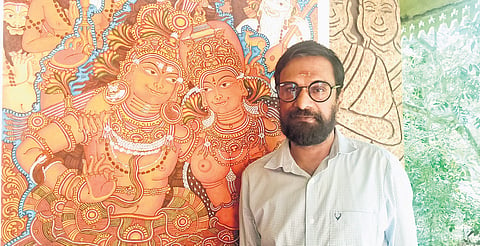

THRISSUR: Red, yellow, green, black and white. The five colours at the heart of Kerala’s traditional mural painting have inspired vibrant creations that have adorned temples and homes of aristocrats over the ages.
With its emphasis on the use of natural paint, the art form has attracted the attention of connoisseurs at home and abroad. Among its few remaining proponents is Ajith Anamika, of Meloor, Chalakudy, who is fighting to keep alive a tradition that is on the verge of going extinct.
At 53, Ajith is a widely respected mural artist whose work on portable panels have been sold to institutions and enthusiasts in 15 countries including Germany, the United Kingdom, Japan and Australia.
His creations are unique for their use of the five earthy tones, known as ‘panchavarna’, which he makes at home. As an artist, Ajith is diligent — refusing to compromise on the time-honoured techniques and conventions associated with the traditional art form.
“The panchavarna colours are unique. They are soothing to the eye and last longer, if prepared and applied the right way,” Ajith tells TNIE. “Though it may seem simple to extract natural colours, it is a long-drawn process. “It needs a lot of patience, but the results can be magnificent,” he notes.
Red is made from the red laterite bricks sourced from Rajasthan. He extracts yellow from the yellow laterite bricks from the banks of the Souparnika River in Karnataka. Lime is used to draw out white, while black is derived by burning cotton threads, on which certain medicinal plant extracts are applied.
Green is made by grinding the leaves of the true indigo plant. “The extracted colours are ground into fine powder after being dried in the sun. The sap of neem trees in Tamil Nadu is used as a binder,” Ajith adds.
The prepared colours must be applied within days, after which they start to lose texture. From preparing the surface to the kind of brush used, painting with natural colours is a science.
Sand and lime are mixed at 2:1 ratio. And to this is added 100g of kadhali banana, 100g of jaggery, uzhinjal, a creeper plant’s extract, and water boiled with kadukka, an ayurvedic fruit. This mixture is kept for 41 days and then applied to the wall as the first coat.
As this dries, another coat of the mixture, now ground with cotton, is layered multiple times. The brush is made from arrow grass boiled in milk and tied to a bamboo stick.
“The deities are drawn in keeping with the descriptions in the Dhyana Slokams. There are specific instructions for painting each deity. These days, however, artists use acrylic colours which are cost effective and easy,” says Ajith.
As a teacher, Ajith also uses acrylic colours. “When using natural colours, at least five coats of paint are required to get the right consistency. The detailing work is also very intricate,” says Ajith.
Ajith first took up to mural painting around 25 years back. He received training under K K Suresh, who later established the mural painting department at Kalady Sanskrit University. He also took lessons from acclaimed artist Appukkuttan Kottappadi in making and painting with natural colours.
