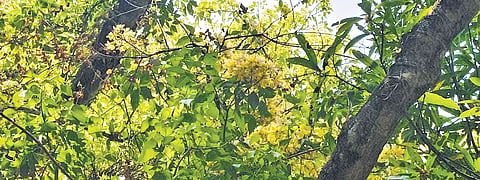

GURUVAYUR: The neermathalam tree at the Kamala Surayya Memorial, maintained by the Kerala Sahitya Akademi in Punnayurkulam, has come into full bloom. More than just a flowering plant, it feels like a revival of memories from a bygone era.
The memorial space, where the serenity of nature blends with the depth of literature, has always attracted visitors. During the blooming season of the neermathalam, however, its charm becomes even more captivating. The delicate flowers, with their subtle beauty, offer not just a visual treat but also a soothing experience.
Nature and emotions intertwined deeply in the works of Kamala Surayya. The neermathalam tree at her memorial is more than a medicinal plant -- it stands as a symbol of her creative world. Each flower seems to echo her poetry and memories.
The neermathalam is a medicinal plant commonly found across India, especially along river banks. It can grow up to 9m tall and is known variously in Sanskrit as varunam, pashugandha, tikthashaka, and asmarighna. In English, it is called the three-leaved caper, and its scientific name is Crateva religiosa.
In ayurveda, the plant is widely used for treating urinary disorders and conditions like kidney stone, highlighting its importance as a natural medicinal resource.
During the blooming season, the memorial at Punnayurkulam transforms into a vibrant cultural space. Photographers, literature enthusiasts, students, and researchers are among those who visit in large numbers. Many visitors describe the experience as feeling the presence of Kamala Surayya.
This is not just the story of a tree -- it is a reflection of the deep connection between nature and literature. The blooming neermathalam at the memorial reminds us of how closely creative expression is tied to the natural world.
