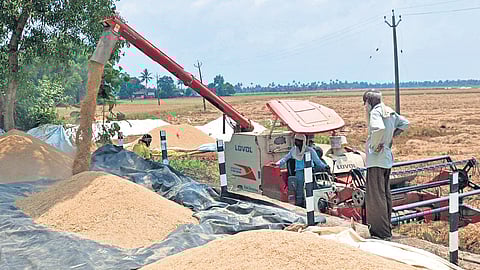

The Garudakarai paddy polder in Ramankari panchayat of Kuttanad offers a sizzling landscape. The intense heat spares neither humans, animals, nor the greenery lining the village road that connects Muttar to the Alappuzha–Changanassery road.
Across the vast paddy fields, harvesting machines crawl steadily, reaping the puncha crop that defines this region’s agrarian rhythm.
Farmers wait patiently on the narrow bunds separating their plots, shielding themselves from the scorching sun with small pieces of cloth tied around their foreheads.
Among them is 72-year-old Ramachandran. He stands by the roadside, waiting for the harvesting machine to arrive so that the paddy can be unloaded onto a plastic sheet spread nearby.
“The government has improved things considerably,” Ramachandran says. “Procurement payments are credited to our bank accounts without much delay. Agriculture department officials are also actively supporting farmers. However, exploitation by the mills entrusted with paddy procurement remains a big issue.”
He explains that the harvested paddy is often drier than the prescribed moisture limit, yet mill agents demand excessive deductions. “For every 100kg of paddy we supply, they reduce up to 8kg citing moisture content. They also delay procurement to increase deductions further,” he says.
Ramachandran points to another pressing issue. “Roads in the constituency have improved, but drinking water scarcity is severe in many areas,” he says.
“Even after 10 years in power, the local MLA and government departments have failed to address this issue. A water supply project — prepared two decades ago — has still not been implemented.”
Another farmer, Manu, also shares a mixed opinion. He believes the Pinarayi Vijayan government’s performance has generally been good, but slams the leadership style. “The harsh language and attitude have not changed,” he says. “That remains a drawback for the ruling front.”
As our vehicle moves along the vast paddy fields of Kuttanad, an announcement vehicle of the sitting MLA Thomas K Thomas passes by at Muttar. K P Santhosh, a local resident, observes that the constituency has long been dominated by Thomas and his late brother Thomas Chandy.
“Despite winning multiple elections, development in the panchayats has been limited. Roads and bridges have been constructed, but basic needs like drinking water remain unresolved,” he says.
Baiju Martin, a native of Parumala in Tiruvalla, tries to defend the failure by highlighting development in Upper Kuttanad over the past decade.
“The Upadeshikadavu bridge across the Pampa River has brought great relief to people,” he says.
“Several such bridges have improved connectivity in the region, and this will reflect in the upcoming election.”
At Pandanad, memories of the devastating 2018 floods still linger. Watermarks on the second floor of buildings stand as silent testimony to the scale of destruction.

Sarasamma, a 62-year-old resident of Mithramadam, requests not to be reminded about the “nightmare”. “We survived the most horrible days of our lives,” she says.
As the journey continues to Perunna, the headquarters of the Nair Service Society, the political tone shifts sharply. Johnson, a local resident, slams the government. He accuses it of hurting religious sentiments, referring to controversies surrounding the Sabarimala temple. Harish, another resident, echoes the sentiment.
Travelling further along the MC Road through Changannassery, the landscape changes. Rows of high-rise commercial buildings line both sides, standing as visible markers of development. Yet, at Vadakkekara near Thrikodithanam, marginal farmers gathering by the roadside present a different reality.
K T Babu, a poultry farmer, voices a story of struggle. “Government support for poultry farming is minimal. We are forced to sustain ourselves,” he says. “Poultry sheds are taxed at commercial rates. If they are classified under small-scale industries, the tax burden would be reduced. Such small policy changes could transform our lives, but the government seems reluctant.”