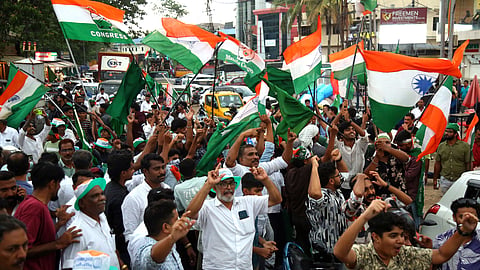

THIRUVANANTHAPURAM: Ending a decade-long wait, the Congress-led UDF swept to power in emphatic fashion, securing an unprecedented 102 seats in the Kerala Assembly. Riding a powerful anti-incumbency wave — sharpened by a clear anti-Pinarayi sentiment — the UDF reduced the incumbent LDF to a humbling 35 seats, down from 98. The front fell just short of clinching a three-fourth majority. The Congress registered its best-ever performance, surging from 22 to 63 seats, while the CPM suffered a sharp decline, falling from 62 to just 26.
The BJP, too, carved out a moment of its own, reopening its account with an impressive three seats. Beyond reclaiming Nemom, the party wrested Kazhakkoottam and Chathannoor from the Left.
With the UDF’s emphatic victory, attention now turns to who will be the next chief minister. The Congress Legislature Party, to meet on Wednesday or Thursday, is expected to elect its leader. Leader of Opposition V D Satheesan and senior leader Ramesh Chennithala are frontrunners, though there are indications that AICC organisational general secretary K C Venugopal could also be in contention for the top post.
With its crushing defeat in Kerala, the CPM has now lost its last remaining citadel in the country. It’s the first time in the last 49 years that the party is not in power at least in one state in the country. In an election where the Left pinned its hopes on development and welfare to secure a third consecutive term, a surge of public anger—compounded by discontent within its own ranks—proved decisive.
Thirteen of the 20 ministers in the fray were defeated, and even Chief Minister Pinarayi Vijayan saw his winning margin shrink sharply, from over 50,000 in 2021 to just 19,247 votes. The verdict has also left several LDF allies in an unenviable spot. The Kerala Congress (M)—which switched sides ahead of 2021 polls—drew a blank.
Other Left allies, including Janata Dal (Secular), Nationalist Congress Party, Congress (Secular) and Kerala Congress (B), also failed to open their account.
Satheesan credits victory to united effort of allies
What clearly worked in the UDF’s favour was a potent mix of anti-incumbency and minority consolidation—fuelled in part by allegations of a CPM–BJP understanding. Campaign narratives centred on economic distress, social concerns, and Sabarimala further sharpened the edge. At the ground level, Satheesan anchored an aggressive, ideologically assertive campaign, projecting himself as a leader willing to take on Pinarayi Vijayan head-on.
The UDF’s strategy of accommodating Left detractors—and capitalising on dissent within the CPM—also paid rich dividends. The Indian Union Muslim League, the front’s second-largest constituent, won 22 of the 27 seats it contested, while the Kerala Congress secured seven of the eight seats it fought.
On the other hand, the Left’s strategy of relying heavily on its development plank and projecting Pinarayi for a third consecutive term appears to have backfired. A series of perceived anti-minority positions triggered visible consolidation against the front. Voter anger was evident as the Left suffered reverses even in traditional strongholds like Kozhikode, Kollam and Kannur. Adding to this was a growing sentiment that a third term could weaken the CPM itself, further tilting the scales against the front.
As for the BJP, the party not only reopened its account in the assembly but also signalled its emergence as a distinct force in state politics. By winning all three seats at the expense of the LDF, the saffron party sent out a clear message that the NDA has arrived in Kerala’s political landscape. Notably, the UDF has squarely blamed the LDF for the BJP’s gains.
Hours after the verdict, Chief Minister Pinarayi Vijayan, through a messenger, tendered his resignation to Governor Rajendra Arlekar who accepted it and requested him to continue until alternative arrangements are made.
Satheesan credited the victory to the united effort of alliance partners. He recalled that when he took up the role of the leader of the opposition, he had assured Sonia Gandhi and Rahul Gandhi of a strong UDF comeback, and said he was satisfied to have fulfilled that promise. Calling it a “family-like” collaboration, he described it as a model of effective coalition politics.
Crucial Cong meeting
T’Puram: All eyes are on the Congress leadership as the first legislature party meeting is set to
be held on May 6 or 7 to elect the parlia-mentary party leader, who will be next CM.
