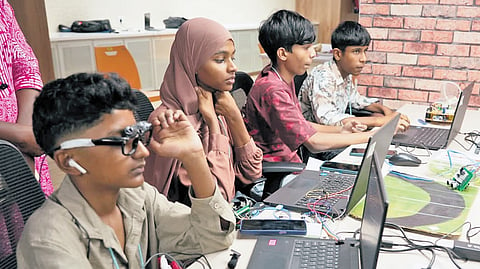

KOCHI: The Little KITEs IT Clubs are expanding. The clubs, which were until now open to high school students of state syllabus schools, will now be expanded to the upper primary and higher secondary sections, giving more young minds the opportunity to bridge textbook knowledge with cutting-edge technology to create solutions beneficial to society.
There are currently 2,248 Little KITEs Clubs in the state with 78,336 students as members.
“The expansion will be done in the coming years,” said Kerala Infrastructure and Technology for Education (KITE) CEO K Anvar Sadath. “Expenses for the expansion will be sourced from the `38.5 crore plan fund allocated to KITE for various purposes.”
Anvar said the project will piggyback on existing infrastructure in schools. “However, Little KITEs for higher secondary will be allotted on the basis of screening and selection. We will shortlist members based on the interest shown by students and teachers who will act as mentors. So, only select schools will get the units.”
As for eligibility, only Class VII students will be eligible in upper primary section, while in higher secondary section, Class XI students will be given prominence since Class XII students will be busy with preparations for the board exams. “For the Class XI students, Little KITEs will not be a new experience as they have been its members,” Anvar said.
As for infrastructure, Anvar said the labs have already been set up in schools. “Students can use the laptops in the laboratories when those are not in use. KITE has distributed around 2 lakh laptops since 2018.”

Camp showcases students’ brilliance
Highlighting the importance of the KITE’s expansion was a two-day Little KITEs camp organised at the KSUM in Kalamassery last month. The camp featured the creations by members from 2,248 schools, underlining the remarkable progress students achieved in programming, robotics and animation.
A KITE coordinator said the exhibition’s primary attractions were innovative projects designed to solve challenges faced in daily life and manage major disasters.
These included the ‘Robo-Arjun,’ an underwater submarine created by students from Malappuram in the memory of Arjun, who lost his life in the Shirur landslide in 2024. Other notable safety projects were the ‘Tunnel Robo-X’ for inspecting hard-to-reach tunnels, and an ‘Accident Prediction System’.
There were also projects for persons with disabilities, like ‘Sonar Pulse’, which helps visually-impaired people detect obstacles through vibrations, and ‘V-Glove,’ which converts sign language into speech.
In healthcare and agriculture sectors, high school student-members introduced several revolutionary tools. While the ‘Care Bot’ aimed at assisting the elderly by providing instructions in Malayalam and delivering medicine or water, the ‘Smart Pill Dispenser’ allowed managing medication schedules from anywhere using a mobile app. There was also the ‘Medi Rush’, an application that would facilitate rapid hospital transport for ambulances by coordinating with traffic authorities.
“The two-day camp also featured nearly 50 animation films created by students covering themes such as the tragedies of war, organ donation, the Pulwama terror attack, traffic congestion at the Thamarassery Ghat Road, the Mundakkai-Chooralmala landslides, anti-drug awareness, forest conservation, the Artemis II lunar mission and the future of Earth,” the KITE coordinator said.