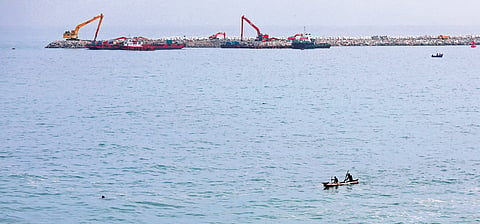

KOCHI: Operating at full capacity and witnessing vessels queueing outside during the height of the West Asia crisis, Adani Ports and Special Economic Zone (APSEZ) has moved to fast-track the phase II expansion of the Vizhinjam International Seaport, highlighting the port’s rapidly growing strategic relevance along global shipping routes.
The accelerated expansion comes at a time when disruptions in the Gulf region and congestion across parts of West Asia are reshaping maritime trade flows and pushing shipping lines to scout for alternative transshipment hubs. Vizhinjam, located barely 10 nautical miles from the busy international East-West shipping corridor connecting Europe, the Gulf and Asia, has emerged as a major beneficiary.
During the company’s Q4 FY26 earnings call, Adani Ports CEO Ashwani Gupta said the firm had decided not to wait for the originally planned timeline for the second phase after the port handled heavy transshipment traffic during the regional crisis.
“We are at 100% capacity at Vizhinjam already,” Gupta said while responding to an analyst. “In the West Asia crisis, we had many vessels waiting outside. So we are not waiting for phase 2, and we have kicked it off.”
Gupta said the port benefited from “transshipment overflow” during the crisis even as operational disruptions affected some regional facilities. “So we are accelerating the Vizhinjam space too, and soon we will also start working on the exit cargo as there’s a huge potential in the catchment area,” he said.
The second phase is expected to expand the port’s annual capacity sharply from the current 1.6 million TEUs to around 5.7 million TEUs. Under the expansion, the existing container berth will be extended to a continuous 2-km-long berth, making it the longest in India. The breakwater will be expanded to 3.88km while additional container yards will be created through large-scale sea reclamation works.
The project will also strengthen Vizhinjam’s capability to handle next-generation mega container ships. Additional ship-to-shore cranes and yard cranes are planned, enabling the terminal to accommodate vessels carrying up to 28,000 TEUs. Once completed, the port will be capable of simultaneously handling five mother vessels.
During the company’s Q3 and nine-month FY26 earnings call in February, Gupta had outlined the scale of the proposed investment. “This Rs 16,000 crore is as a Phase II development. This will take the capacity (to) more than 5 million because with the technology and with the efficiency, we are delivering 20% to 30% more than the nameplate capacity,” he had said.
In a major strategic move, Adani Ports has already signed an MoU with Bharat Petroleum Corporation Ltd to launch India’s first ship-to-ship LNG bunkering operations at Vizhinjam. “Today, the LNG bunkering at Jebel Ali and Colombo is still struggling,” Gupta noted earlier.
“Because on this international channel, there are not many competitive LNG bunkering facilities, shipping lines are not bringing their LNG-capable vessels on this channel. The ship-to-ship bunkering facility in Vizhinjam, which is just 10 nautical miles from international waters, is boosting shipping lines and motivating them to bring their LNG-capable vessels.”
While Vizhinjam is currently positioned largely as a transshipment hub, the company is also preparing for future EXIM cargo growth.
Chief financial officer D Muthukumaran in the Q3 conference call said the port already has road connectivity for cargo evacuation and plans for rail connectivity are under evaluation. “As the market develops, we’ll be able to handle EXIM cargo quite easily,” he said, indicating that hinterland connectivity would gradually strengthen the port’s role beyond transshipment operations.
