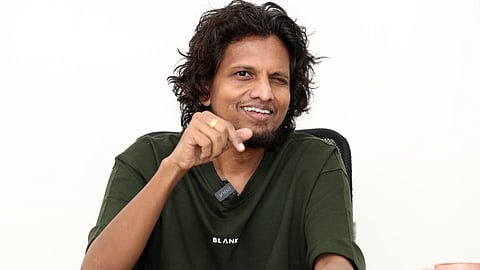

Composer Manikandan Ayyappa’s latest chartbuster ‘Ithino Aadame’ is a celebration in every sense. His Afrobeat-tinged reworking of the classic for Ullas Chemban’s ‘Disco’ has got people grooving and brought in requests for remixes.
Close to a decade after his smashing debut with ‘Kalippu Katta Kalippu’ from ‘Oru Mexican Aparatha’, his discography runs from the warmth of the Kerala State Award-winning ‘Kanave’ from ‘Pallotty 90s Kids’ to the widely popular folk-fusion dance number ‘Thumbi’ from ‘Anchakkallakokkan’.
Having grown up amidst ritualistic artforms in a Thrissur village named Kollanoor, Manikandan is often boxed in as a folk composer. Yet his musical journey began with singing, and Carnatic music formed the foundation of his training.

He says classical music remains what he loves most. In this conversation, Manikandan reflects on a career built on versatility, stage fright, the melodies he wants to compose, the identity he is working towards and more. Excerpts:
Can we start with your entry into the world of music?
My father was a Panchavadyam artist. He passed away when I was two, but I grew up hearing about him. My mother, too, is a singer.
Folk music and traditional instruments were part of my upbringing. I come from a village named Kollanoor, where rituals such as Malavazhiyattam, Muthappan Kalam Pattu, and Theyyam puja are performed every year. My uncle’s house had several folk instruments. I grew up experimenting with them. I guess I had an innate sense of rhythm.
What initially motivated you to pursue music professionally?
My elder sister first inspired me to sing. Then, my maternal uncle, who was a thavil vidwan, encouraged me to learn Carnatic music. He would push me to explore challenging, classical songs. My sole ambition at that time was to become a singer — like K J Yesudas or P Jayachandran (smiles).
So, how did you transition into music production?
I was quite weak at stage performances. I sang confidently at home and did well in early competitions, but before a crowd I would get nervous. Anxiety would ruin my performance.
Later, I joined music composer Mohan Sithara sir’s music school. There, I discovered I was far more comfortable off the stage.
Meanwhile, a friend introduced me to music production software. At Mohan Sithara sir’s school, I was selected for recording sessions. My first film experience was singing in a chorus for the Vijay Yesudas song ‘Kadha Kadha Kilipennu’ in ‘Rappakal’. He later involved me in other chorus recordings and occasionally asked me to record tracks. I gradually learnt recording techniques from him and later sang in the film ‘Yugapurushan’. I also worked as a sound engineer on its background score.
You also got an opportunity to accompany Mohan Sithara during composing sessions. What was that experience like?
He would take me along during composing. He would have about five tunes for a lyric. I would sing the cover for the producer and director to choose from. Accompanying him helped me understand the process.
Did you also learn to play instruments as well?
Mostly self-taught… I was primarily a singer. My mother would ask me to sing like Yesudas and Jayachandran… and later Madhu Balakrishnan. I would imitate them. Vidhu Prathap was a villain in my youth. He excelled at playback singing and live shows. My mother would prod me to be like him. I envied him! Now, I see the same versatility in singers such as K S Harisankar and Sooraj Santhosh.
Do you still have stage fright?
Singers such as Sai Abhyankkar handle composing and performing, and I would like to do something along those lines. People have been approaching me for live shows. But, I would like to work on more films and release more independent tracks first.
Was there a point when you began questioning yourself?
When singing opportunities remained limited, I began working as a storyboard artist. I had sung in a few films, but the assignments were small.
I later set up a recording studio in Thrissur with a friend and began composing group songs for St Thomas College, which gave me confidence as a composer. But those projects offered little income, so storyboard and animation work became my main support.
A friend once told me over a meal that I should quit music ambitions.
And that was a time when I would criticise Malayalam cinema, comparing our films with foreign ones… a case of sour grapes (laughs).
How did your first big hit, ‘Kalippu Katta Kalippu’, in ‘Oru Mexican Aparatha’ happen?
Tom Emmatty, the director, approached me with lyrics and asked me to compose something in one night. This was after the release of ‘Kabali’. I have been a big fan of its composer, Santhosh Narayanan. Tom wanted a similarly aggressive, powerful sound.
My friends, who knew I had a classical music background, laughed at the opening line given to me: ‘Kalippu… katta kalippu’.
I, however, took it up as a mission, and through the night, repeated the lines set to different tunes. Finally, I sent one to Tom, and he liked it.
I then told him I had two big ideas: recording the track at A R Rahman sir’s studio and getting Arunraja Kamaraj (Kabali Da singer) to sing it. Within a couple of days, the team confirmed the studio and Arunraja’s availability. It was like a dream come true.
The song was shot well, and the team was excited about the visuals. I still remember someone calling me and saying, “This new guy named Tovino Thomas has done well”. (Laughs)
Are you a rock music fan? ‘Kalippu Katta Kalippu’ has some heavy riffs…
Classical music is what I love most. In fact, I told my guru, Narayanan ‘Maash’, not to listen to ‘Kalippu Katta Kalippu’. I wanted him to first listen to ‘Ivalaaro’ from the same film. It was composed in the Vrindavan Sarang raga and sung by Vijay Yesudas.
But he was open-minded. He enjoyed it. Imagine a Carnatic guru listening to ‘Kalippu’ on headphones!
Tom played in giving a new name too — he suggested that I change my surname from Ayyappan to ‘Ayyappa’. Initially, many assumed I was a Telugu musician (laughs). I made some friends in Hyderabad.
Your songs also have a heavy folk influence…
I grew up around folk music. Later, a friend’s extensive music collection introduced me to different genres.
While composing college group songs, I began incorporating folk elements. They blended beautifully with beats and rhythms. I had also noticed how Mohan Sithara sir brought folk and rhythm together.
These influences came together in indie projects such as ‘Poothan’ and later ‘Instagramam’.
I earned the ‘folk man’ tag. My earlier belief that Carnatic was the purest form of music gave way as I discovered other traditions. Folk instruments lying unused at my uncle’s house became treasures.
‘Poothan’ was interesting…
We used Edassery’s ‘Pootha Pattu’ and the chenda percussion by Aattam Kalasamithi. Jakes Bejoy, whom I greatly admired, called it a work of “international quality”. That was a big boost.
I also got to collaborate with Jakes chettan. In the film ‘Kumari’, he credited me as co-composer. He still calls me whenever folk music is involved. Jakes chettan has been instrumental in my growth.
Then came the big bang with ‘Thumbi’, which continues to enjoy a cult following…
I wanted to explore my village more deeply. Every Onam, the women in my neighbourhood perform Thumbi Thullal. These are ordinary labourers with no formal training, but I recognised a beautiful rhythm in their singing. I secretly recorded them performing naturally, then edited the recordings, fixed the tempo and put them together as an album.
Initially released on YouTube, the track got only around 10,000 views. That changed when Ullas Chemban used the song in ‘Anchakkallakokkan’. I barely altered the original recording — you can even hear my child crying in one portion!
Ullas trusted me with ‘Anchakkallakokkan’. I handled the programming, arrangements, editing and mixing of all 11 songs, besides pre-mixing the background score.
How was the response to it back in your village?
Until then, the only songs that appealed to my family were classics. This one stunned my mother. The women who worked with her had become playback singers! This is their song, something they have sung for years.
Seeing the name of Malu chechi from the village on international platforms was historic for the community. Nattakam Yuva Samithi, the local club that had supported me since childhood, celebrated the song. I became a local star. Such moments have a unique feel-good factor. Recently, I again collaborated with Malu chechi for a song in ‘Disco’.
Do you go explore rare instruments?
Yes. I recently used instruments such as the cuica drum of Brazil. Then there is izhara, a traditional instrument used in ritual arts of Keralam. It is similar to the parai drum of Tamil Nadu.
What about offers from other languages?
I am working on a Telugu film, and have committed to a Tamil web series.
Tracks in ‘Disco’ have gone viral. ‘Ithino Aadame’ has crossed two crore hits
Once again, thanks to Ullas Chemban. He wanted ‘Ithino Aadame’. I was initially against remixes and had even turned down two projects for that reason. One was ‘Olluleru’ in ‘Ajagajantharam’, which my friend Justin Varghese later remixed to great success. I closely track Justin’s music. And I tend to hire the singers he works with.
Do you still have an aversion to remixes?
Not anymore!
People have been remixing ‘Thumbi’...
Yes, and it makes me quite happy now. I often get requests for permission. I am more than happy to share the files.
Tell us more about ‘Ithinno Aadame’…
We intended it only as a wedding song, with Chemban (Vinod Jose) chettan’s character leading the celebrations. His name getting associated with the track added to its impact. During dubbing, Ullas recorded his vocals and sent them to me. Once I placed them with the music, everything came together. I also wanted to experiment with Afro beats. I never expected it to become such a huge hit. More such tracks from the Disco album are being released.
What about collabs outside cinema?
Some leading independent music companies approached me to make folk-fusion songs. I am currently working on an independent project along those lines, a blend of folk and rap.
You did a track with Vedan as well…
We know each other, and wanted to do something together. We received an enquiry for the Super League project, which turned out to be the perfect opportunity. I enjoy making independent music.
Tell us about your friendship with Sooraj Santhosh...
I used to audition for almost every music reality show, but was mostly rejected. The only show I got selected for the finals was Ragalayam. That’s where I met Sooraj Santhosh. We looked quite similar back then because we had almost the same hairstyle!
Singer Kapil Kapilan won the State Award for your song ‘Kanave’ in Pallotty 90s Kids. The track was quite different…
It was unexpected. Director Jithin Raj had initially rejected the song because the production team was unsure where to place it. We explored other options but eventually came back to it. I was originally
supposed to sing it myself, but later decided to get another singer. Destiny has its ways.
Is there any song of yours that you feel deserved more recognition?
‘Madhuradhari’ from Karl Marx Bhakthanayirunnu, sung by Sooraj Santhosh, remains one of my favourites. Sadly, it hardly got any views on YouTube. On the other hand, ‘Theythaka’ from Kudukku became a huge hit, much bigger than we expected. I composed that over a single night. The algorithm always amazes me.
So, are you more of a melody man?
I have always enjoyed making melodic music. I got to work with Chithra chechi on Uyir, and there is a melodious song in Dheeram sung by Vijay Yesudas. Unfortunately, many of these haven’t reached a wider audience. It’s always a mystery. Even established music directors have compositions they consider among their best that aren’t their biggest hits.
Popularity of short-form videos and reels could be a reason…
Definitely. Not many people have the patience to listen to a full song. We seem to have an attention span of 30 seconds or less. If a song has a hook that catches attention, it can encourage people to discover the entire composition. ‘Thumbi’ was originally seven minutes long. Initially, it didn’t attract much attention. Things changed when a Nigerian dancer used a
portion of it for a short video. Sometimes a song finds its audience in ways you never anticipate.
Since you mentioned Uyir, tell us a bit about working with K S Chithra…
It was surreal. The song was a lullaby, and since it was a tharattu paattu, I felt Chithra chechi would be the perfect voice. When she came on board, I couldn’t believe she had agreed to sing a song composed by me. She doesn’t distinguish between juniors and seniors. She respects the position of the music director, not the person. After the first take, I was so overwhelmed that I couldn’t respond. Seeing me silent, she asked whether I didn’t like it. She insisted that I tell her if any changes were
needed. I replied that even if she intentionally sang at her personal worst, it would still be far better than what I had intended (laughs).
Personally, which side do you identify more with: the melody singer or the folk composer?
I have always liked melodic songs. My friends, colleagues and teachers know I sing such songs. They often request ‘Oru Rathri Koodi’, ‘Sangeethame’ and ‘Sreeragamo’. (Sings ‘Sreeragamo’) There is a lot more to my musical interests than what people associate me with. I don’t want to be confined to one image or genre. People may associate me with ‘Thumbi’ or ‘Ithinno Aadame’, but that’s not the entirety of who I am as a musician. Deep down, I am still that child who wanted to sing like Yesudas and Jayachandran. However, the transition has been necessary. If I am considered good at folk fusions and peppy songs, why not capitalise on it? I have come to see the stereotyping as a compliment.
What kind of identity would you like to establish as a music director?
I want people to recognise my music when they hear it. When you listen to Ilaiyaraaja sir, you can often recognise his musical signature. I want to develop something similar while continuing to explore
different genres. I also want to bring more artists into independent music and create platforms for them.
Who are some of your favourite composers and musicians?
Among film composers, I like Daniel Pemberton, Ludwig Göransson, Hans Zimmer and John Williams. I listen to a lot of African music, particularly from Senegal and Nigeria. Baaba Maal is someone whose work I enjoy. In India, I admire Pradeep Kumar and Santhosh Narayanan, and I enjoy Sean Roldan’s independent albums. Sharreth is another legend. I doubt if anyone can be placed above him. Among contemporary composers, I have been impressed by Vishnu Vijay’s music. He called me after listening to ‘Ithinno Aadame’. I don’t think musicians of this generation have ego clashes. We appreciate each other’s work. Everyone has something different to offer. It’s like a big music club.
Can we expect an indie album featuring your work?
A project involving two Tamil rappers is already in the works. There are also a few songs I composed for ‘Disco’, including ‘Shankara Nayadi’, based on Nayadi Kali ritual art from the Palakkad region. I went there and recorded it with the original performers. These will be released soon.
You are not very active on social media either. Do you think that has affected the visibility of your work?
I don’t like being out there all the time. I didn’t become popular because of the media. People may have heard ‘Thumbi’ without knowing who composed it. Not many identify me in public even now. After ‘Ithinno Aadame’ was released, I booked an Uber while returning from Nedumbassery. The person who opened the door looked at me and asked if I was Manikandan. I was shocked!
Any plans to travel for musical exploration?
I would love to. Nigeria is the first place I want to visit. For now, I am discovering their music through the internet. The internet has helped me a lot. There was a time I used to work at an internet cafe. That was a major turning point — I could access the internet for hours without paying. That’s when I learnt about software used for composing and recording. YouTube has also been one of my gurus.
We are now in the age of AI. Do you see it as a useful tool for music-making, or is it something that worries you?
It is both useful and dangerous. Some friends send me songs made using AI. Recently, I got one with a ‘good morning’ message, joking that my days in the industry were numbered. There are music aspirants who send me samples made using AI, claiming that it’s their original. I believe there is still an element of raw beauty in the work we are making now. Let’s see how it goes.