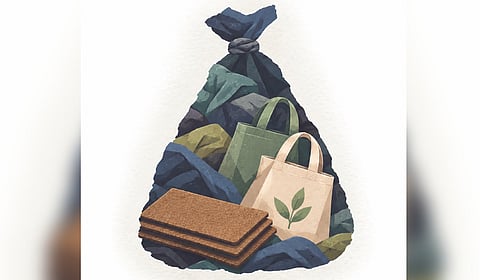

THIRUVANANTHAPURAM: Clothes discarded by pilgrims after taking a dip in the Pampa river could soon end up as doormats and reusable bags as the Clean Kerala Company Ltd (CKCL) looks to undertake an ambitious upcycling initiative in Sabarimala.
The Travancore Devaswom Board (TDB) has signed an agreement with CKCL to clear the mounds of clothes that piled up on the banks over the years, especially during the pilgrimage seasons. The plan is to set up a 3,000 sq ft material collection facility (MCF) at Nilakkal for the segregation and handling of the tonnes of textile waste. The initiative is also expected to generate jobs for around 100 people daily during the pilgrimage season.
The move follows mounting concerns over the indiscriminate dumping of clothes by the pilgrims despite repeated awareness campaigns and judicial intervention.
“Upon receiving the wet clothes at our facility at Nilakkal, we will wash them thoroughly and dry them before segregation. The clothes will be shredded to extract the fibre, which can be repurposed as industrial cleaning material for plumbers and painters, or turned into doormats. For garments in good condition, we are examining an upcycling model to convert them into reusable cloth bags and other utility items,” CKCL MD G K Suresh Kumar told TNIE.
The company estimates that around 40 workers will be required for collection at Pampa, while another 10 will be needed for segregation and transportation to the processing facility.
“Only completely unusable material will be sent to cement factories for co-processing. The initiative could also generate considerable employment during the pilgrimage season. Considering the need for round-the-clock operations in day and night shifts, the total manpower requirement could touch 100 workers daily. Additional employment opportunities could emerge in textile processing, fibre extraction and the production of upcycled goods,” Suresh said.
The CKCL has already initiated efforts to remove around 20 tonnes of discarded clothes that have accumulated at Pampa. TDB president K Jayakumar said CKCL’s entry has helped address long-standing shortcomings in waste management at Sabarimala. He also claimed that the intervention has put an end to the earlier system of waste collection, which had drawn flak for alleged irregularities and lack of accountability.
“There was fierce opposition to allowing Clean Kerala (CKCL) to operate in Sabarimala as it disrupted an unholy nexus between contractors and vested interests.
That entire system has now collapsed. I am facing plenty of backlash for dismantling it, which is fine, because ending that exploitative setup was necessary,” he claimed. Jayakumar said there was no point in calling the place a “sacred hill” when it was burdened with “so much filth”.
The board, he said, would install dedicated collection bins along the banks of the Pampa river along with signboards asking pilgrims to discard their clothes at the designated points. Jayakumaar said around 10 to 15 workers would be deployed to ensure that the bins are cleared as soon as they are full to prevent additional accumulation of textile waste.
