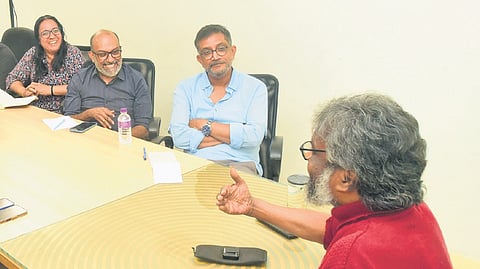

You began your musical journey in the film industry with ‘Onnu Muthal Poojyam Vare’ (1986). How did that happen?
I was a student at Tharangani Music School, run by (K J) Yesudas sir. We had a musical troupe called Sithara Music Club, for which I played the violin. By then, Das sir had also started Tharangini Studio. Gradually, I began working as a conductor and assisting several musicians with orchestration. Whenever musicians like Dakshinamurthy Swami or Shyam sir visited the studio, they would call me to assist them. T K Rajeev Kumar noticed my involvement and eventually approached me on behalf of Navodaya.
Initially, I didn’t take the offer very seriously because I was more interested in performing with musical troupes. I took part in stage programmes regularly. But Rajeev told me they were waiting for me. I was a little apprehensive. Although I had experience in orchestration, I had never composed songs for a film. I wondered why I should take up the assignment without any such experience.
So I stayed back. A week later, Rajeev called again and asked me to come. Eventually, I went to a hotel in Ernakulam, where Jijo (Punnoose) sir, son of (Navodaya) Appachan sir, was waiting. He asked me whether I could compose melodies. I told him I had experience in orchestration but wasn’t sure about composing tunes. He arranged a room for me, and a harmonium. I started composing and somehow managed to come up with a tune. Rajeev sat beside me and offered suggestions. I initially created a tune with a few humming phrases.

They liked it and asked me to compose another one. After several attempts, I eventually came up with the tune for ‘Raari rariram raro’. They liked it. As I was a newcomer, they wanted an established and renowned lyricist to write the song. So they approached O N V Kurup sir. He came to Ernakulam, where I played the tune for him. He then wrote the lyrics beautifully. In fact, it was his lyrics that made the song even more special.
What’s the inspiration behind such songs, especially the lullabies?
During my childhood, there were nights when my younger sister and I would lie beside our mother—or I would rest my head on her lap—while she hummed little tunes to put us to sleep. I composed those lullabies drawing directly from those memories. Honestly, I never imagined I would become a music director.
Even today, I don’t really see myself as one; I consider myself just an ordinary person. To me, the title of a ‘music director’ feels like something belonging to a completely different world. I never consciously sit down to create a tune—it just flows out naturally. When a director explains a situation, I simply try to absorb what the scene demands. Being a deeply religious person, I leave the rest to God and trust that the right melody will come to me and turn out well. Tunes come naturally to me—it isn’t a conscious effort.
Is Sithara your real surname?
No, Rajeev and Appachan sir gave me that name. I had no idea about it until then (laughs). I was in Thiruvananthapuram at the time. One morning, my brother and I went to a hotel for tea, and that was when I first saw my new name in the newspaper. They had published photographs and names of newcomers being introduced to the industry—including actors like Suresh Gopi and myself as a music director. That was actually how I found out I had been named Mohan Sithara.
You have composed several lullabies since then. You seem like someone who carries a heart full of lullabies...
When I compose for a film, I look at the situation. If a scene calls for a tender, lullaby-like mood, I compose accordingly—that’s how songs like ‘Unni Vava’ came about. Then there were songs like ‘Karuppinazhaku’—I don’t know if you’ve heard it, it was a big hit—and ‘Sukhamaanee Nilavu’.
For ‘Sukhamaanee Nilavu’, Kamal told me the subject was something youngsters would connect with, right around the time people were starting to talk about ‘New Gen’ cinema. So I tuned into that vibe and composed it accordingly. As for ‘Karuppinazhaku’, I drew from the mood of my own schooldays—there was a phase when I was quite carefree and really enjoyed myself, and I simply recreated that feeling in the music.
Did you have a musical background in your family?
Yes. My father used to sing and my brother Subramanian is a sitar player—he was actually among the first sitar players in Keralam and also taught at the Tharangini School of Music. That was how I got introduced to music. Before entering the film industry, I had also worked extensively on amateur plays.
You were once considered part of the ‘new generation’ of music directors. Do you still see yourself that way, and how has today’s music changed?
Audiences today have different expectations, though there are still plenty of people who love melody—those who grew up with my old songs continue to listen to them. I obviously can’t compose today the exact way I did in the 1980s. I have to understand the mindset of today’s youngsters and adapt to their tastes.
Being an old-generation composer can sometimes be a challenge, so I’m still learning a lot and am always willing to experiment. Growing up listening to all kinds of music has helped me immensely in trying different styles—I’ve even experimented with rap in a film, though the movie didn’t do well. Rap isn’t particularly difficult; you just need to get the lines right, deliver them effectively, and set the right rhythm.
After a successful debut in films, it is reported that you had periods with no work before making a comeback with ‘Deepasthambham Mahascharyam’...
My career has always moved in cycles like that. I would work on several films for a stretch and then stay away from the industry for a year or two before returning to work again. During one such break, I had to take up violin assignments to get by. Around that time, I went to Madras for the recording of an Anil Babu film—I don’t recall its name now.
During a session, I got a phone call from K G Sathar’s son, who asked me to call him once the recording wrapped up. When I did, he said he was producing a film and offered me the music, which I agreed to take on—even though he had initially given an advance to Bombay Ravi. That film was ‘Deepasthambham Mahascharyam’.
The songs became huge hits, marking the second major milestone in my career. Until then, I had been living in Thiruvananthapuram, but around that period, I moved back to my parents’ house in Thrissur, which became the base for most of my work. After ‘Deepasthambham Mahascharyam’, I got so busy that I hardly had time to return to Thiruvananthapuram—I had to work continuously for six or seven days at a stretch, often going without sleep for 24 hours.
Have there been instances when a song you worked very hard on went unnoticed?
Yes, plenty of times—though I don’t remember all their names now. Some of those films never even got released, and several good compositions simply didn’t get the recognition they deserved. In fact, people have probably heard only around 40% of the songs I’ve composed. The remaining 60% have gone completely unnoticed.
Is it easier to compose when the lyrics are already available, like a poem? What do you prefer—lyrics first and then the tune or the other way round?
Both approaches work equally well; it really depends on the kind of song. For instance, I composed the music for a poem by Madhusoodanan Nair sir--which begins with the lines ‘Irulin maha nidrayil ninnunarthi nee chirakulla’--after receiving the verses. It is easier in its own way when the lyrics are already in hand because you can grasp the essence of the poem and give it the exact musical treatment it deserves. On the other hand, some songs turn out better when the tune comes first—especially lively, energetic, or peppy numbers. ‘Kuttanadan Kayalile’, for example, was composed with the tune first. So, while existing lyrics help shape poetic depth, setting the tune first usually works best for upbeat songs.
And what about the quality of lyrics today?
If you look at today’s songs, they are mostly about conveying a situation directly and moving on—people don’t seem to look for poetic elements anymore. Many youngsters today aren’t as familiar with the finer nuances of Malayalam, so they naturally prefer conversational language. That is why contemporary lyrics sound the way they do.
With changing times, has melody lost its place in Malayalam music?
Certainly. The very concept of melody has undergone a major transformation. Earlier, melodic songs found a permanent place in people’s hearts, whereas today, songs rarely linger in the mind the same way. A big reason is that we largely compose from the director’s point of view—we have to understand what the director wants and work within that vision. When a director has a genuine passion for good music, memorable songs still happen.
How did the song ‘Jugnu re jugnu re’ from ‘Kaazhcha’ come about?
It was composed in a rather unusual way. The lyricist, K J Singh, brought me the lyrics, but since I wasn’t familiar with Hindi, I couldn’t understand what they meant. Blessy was sitting right next to me at the time and the lyricist knew a little Malayalam. I asked him to explain the meaning of each line, closed my eyes, and simply listened. He described images of fireflies glowing in the dark and other vivid visuals. As I listened with my eyes shut, those pictures began taking shape in my mind—I pictured a village in Gujarat, its surroundings, and its way of life. The tune emerged naturally from those visuals. I just switched on the tape recorder and started singing, “Jugnu re, jugnu re...”
‘Annarakkanna Vaa’ was another hugely popular song, particularly among children. How did you compose it?
It was loved especially by children when it first came out, and even today, so many people remember it fondly. While composing that track, my mind went back to my own childhood—I remembered playing with the children from neighbouring houses and those carefree early days. Those memories inspired the song. Ultimately, our own minds and personalities are reflected in the music we create.
Can you recollect a memorable incident from your association with Yesudas?
There’s a song called ‘Aalilakkanna...’. After composing and arranging it, I sent the track to Dasettan (Yesudas) for playback singing and travelled to Chennai to meet him. By the time I reached there, I hadn’t slept for nearly 48 hours. Dasettan took the musical notes, went into the recording booth, put on his headphones, and was about to start singing.
Meanwhile, I was sitting in the control room, completely exhausted and barely able to keep my eyes open. Suddenly, Dasettan took off his headphones, rushed out, and woke me up—he even splashed water on my face because I had practically lost consciousness. A doctor was called in to examine me and I explained that it was sheer exhaustion from going 48 hours without sleep. I rested there for two days, and then we completed the recording.
You had a long association with Yusufali Kechery as well...
His songs are very simple on the surface, yet the lyrics are poetically rich. That rare combination made him such a beloved lyricist.
You started composing for films around 1985–86, yet state-level recognition, like the Kerala State Award, came only in 2009...
I’m not really bothered about awards or recognition. An award is simply a process where two or three people review our songs and assign marks. To me, acceptance and love from the public is the biggest award of all.
The background score of ‘Innale’ was truly haunting...
In my view, the background score plays a vital role in a film’s success. Composing a background score is actually the hardest part of filmmaking because some scenes can feel flat right after editing, and music has to lift them. Take the climax of ‘Innale’, where the heroine fails to recognise her husband—it was a deeply emotional moment. Director Padmarajan sir called me and said, “The scene I shot has gone a bit flat, you need to elevate it through your music.” Music director Ouseppachan played the violin solo for that sequence. Once we finished recording, Padmarajan sir walked over and gave me a tight hug. That moment remains unforgettable.
When you compose a song, do you usually have a singer in mind? Mohanlal sang for you in ‘Thanmathra’...
In ‘Thanmathra’, Mohanlal sang ‘Ithaloornnu veena’. Initially, I had Jayettan (P Jayachandran) sing it, though Blessy felt that bringing in Dasettan might add an even deeper intensity through his signature voice. Eventually, however, we decided to have Mohanlal sing it himself, and he rendered it beautifully, adapting to the very best of his ability. Any doubts about whether the track would do justice to the scene vanished completely during re-recording when I watched the sequence on screen—my eyes welled up with tears. Had Dasettan or Jayettan sung it, it would have been just another wonderful song. But when it is the voice of the actor living that character, it hits differently—it felt like a punch to the chest. And he sang it wonderfully too.
With the advent of artificial intelligence (AI), what changes do you foresee? And how will it affect music?
Creating a song has become easier today because AI can generate music, yet it has a fundamental limitation: AI does not think or feel like us. It can only work within the patterns and data fed into it. True music emerges when we work independently and create something from our own imagination. AI-generated music often carries an artificial feel, and I worry that genuine originality could eventually be lost.
Have you ever experienced a creative block after spending hours composing?
Yes, working continuously for long stretches naturally affects creativity. There was a phase when I was working on five or six films simultaneously—I would feel completely drained and reach a point where I felt like giving up and going straight to bed. Usually, a good night’s sleep was all I needed to regain my energy and get back to work.
Allegations often surface that one composition is copied from another. How do you view such claims?
Sometimes, similarities happen quite unintentionally. As far as I am concerned, I compose songs strictly around the situation in the film—I don’t need to listen to another track to create a new one. My tunes emerge purely from what a specific scene demands.
When it comes to singers, you have worked with legends like Yesudas, Jayachandran, M G Sreekumar and Chithra, while also introducing many newcomers. How has your experience been across different generations?
To be honest, I don’t even sit in front of Dasettan out of sheer awe and respect. I owe all my opportunities to him because I studied at his music school for four years completely free of cost, and I still carry that deep love and reverence for him. Even when we work together, he treats me like a son or a disciple. During recordings, he gently asks how his rendering sounds, and if any changes are needed, I convey them with the utmost respect. With other singers—whether it is M G Sreekumar, Chithra, or anyone else—they have to sing exactly what the song demands (sings a sangathi). At the same time, every singer brings a distinct signature... Chithra has her own style, Sujatha has hers... every voice has its own character.
Who’s your favourite composer?
There are three composers in Malayalam whom I admire deeply: Devarajan Master, Baburaj Master and Dakshinamoorthy Swami. Among the three, I love Devarajan Master’s songs the most for their sheer simplicity. His style is like gently underlining a word—for instance, take ‘Sangamam Sangamam’ (sings the simple original version, then demonstrates a version with added stress). He avoided unnecessary emphasis, giving his compositions a clean, straightforward flow. That simplicity is what draws me to his music.
Whose music in the current generation do you listen to the most?
Many composers are doing wonderful work in their own distinct ways today. Sometimes, when I listen to their tracks, I genuinely feel I wouldn’t be able to pull off something like that quite so well—the youngsters are doing remarkable work. I enjoy listening to M Jayachandran, Bijibal, and several others. Many of them are crafting very stylish songs these days, and I try to compose like them too (laughs).
Many composers say that music comes from God and that they are merely instruments. Do you feel the same way?
Frankly, I don’t claim to know much about the technicalities of music myself. When I sit down to compose, the tune somehow just comes to me. I approach music the way I approach an everyday conversation—once I get the lyrics or hear the situation explained, things simply fall into place on their own. Tunes come naturally to me; it is not a conscious effort.
When you look back, do you feel you have achieved everything you once aspired to?
To be honest, I feel I haven’t composed enough good songs yet, I often think I could have done much better and created many more beautiful melodies. Also, I haven’t managed to save much money. I have worked on a lot of films, but there is one thing about me: whenever I see people struggling, I forget everything else and end up helping them. There was a quiet happiness in doing that. Later, when film offers dried up and the calls stopped coming, I found that I had saved nothing for myself. I truly realised the weight of that when I was hospitalised around five or six years ago. Seeing the financial pressure my wife faced and the burden of looking after our children made me wonder if things might have been easier had I saved some money earlier. I come from a family that once struggled even to afford food. Having been born into poverty, I could never look away when I saw others going through similar hardships—their suffering moved me deeply and I always stepped in to help.
You still feel you could have composed many more memorable songs?
Absolutely. Whenever I listen to songs composed by Johnettan (Johnson) and Raviyettan (Ravindranath), I often marvel at how exquisitely they were crafted. I feel I too could have created songs like those, yet I haven’t quite been able to.
What are your plans and aspirations for the future?
I don’t have any particular plans for myself; all I want is for my children to do well. My daughter runs a boutique and my son—who genuinely loves music and is quite talented—has already composed for around 10 films. I want to see him make a name for himself. As for me, I hesitate to approach producers and directors asking for work. Everyone is busy with their own commitments and I don’t want to trouble anyone, so I rarely call people, seeking opportunities.