
KOCHI: A spiderweb hanging in a corner may look like little more than a nuisance waiting to be swept away. But those delicate strands could be collecting evidence of what is floating in the air around us, including pollutants too small to see. Researchers at Bharata Mata College in Kochi have found a way to turn these webs into pollution monitors. In a first, the team has developed a solid-phase analytical method that can detect heavy metals and identify different types of microplastics trapped in spiderwebs.
The idea rests on a simple observation. Spiderwebs are sticky and remain exposed to the surrounding air. Dust, tiny plastic particles and other substances floating around can settle on their strands and remain trapped. Instead of collecting air samples using specialised monitoring equipment, researchers can study what’s in the webs.
The team tested this approach at several locations across Kochi. Samples were collected from traffic-heavy MG Road, the industrial belt of Eloor, coastal locations like Cherai and Fort Kochi, residential areas including Vennala, and suburban locations such as Kanjiramattom and nearby areas. The aim was to examine a cross-section of environments rather than focus on a single type of location.
But how does a cobweb reveal what it has collected? The researchers developed a method that turns the web into a small, solid pellet that can be examined using a scientific instrument.
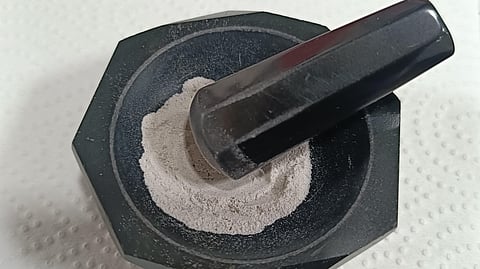
“The collected webs are first ground into a fine powder and mixed with potassium bromide. The mixture is then compressed using a hydraulic pellet press to turn it into a button form. This pellet is placed under a Fourier Transform Infrared (FTIR) spectroscope, which analyses how the material interacts with infrared light,” explains researcher Mathew M J.
Every material produces a distinct chemical signature. The instrument records this signature as a set of values, which researchers compare against a reference library containing known values for different substances. This helps them identify the types of microplastics present in the sample.
A researcher in arachnology, Mathew, who led the project with Sindhu Joseph, a professor with the college’s chemistry department, says the achievement lies in the use of a solid sample rather than a liquid-based process.
“All types of microplastics can be identified using this technology. This solid-phase technology is being successfully used for the very first time, not only in spiderwebs but also in other creatures. It is non-invasive, as it does not require capturing or harming an animal to obtain a sample. Hence, we have applied for a patent for the process.”
Earlier studies have detected microplastics in the tissues of fish and other animals, but these generally involved liquid-based analytical methods. Spider silk itself makes the idea interesting.
“There is no other material that can match the properties of spiderwebs. We call it the wonder material of nature as it has the density of steel and the elasticity of rubber,” he says.
Another advantage is the possibility of studying pollution over time. A spiderweb does not remain chemically unchanged. Fresh particles continue to settle on it as it hangs in the same surroundings.
“The Kochi study was a preliminary assessment rather than a continuous monitoring exercise. Samples were collected over a period of two to three months as part of a single round of collection. A covered location would be ideal for collecting samples, as rain can wash away particles and affect results,” says Mathew.
The samples were handled under sterile conditions, avoiding direct hand contact and plastic materials that could introduce unwanted particles into the analysis. The study has so far established the presence and types of pollutants, making it qualitative in nature. The next step is to determine their concentrations and compare pollution levels across locations.
The team now hopes to extend the research beyond Kochi to urban ecosystems across South India.
