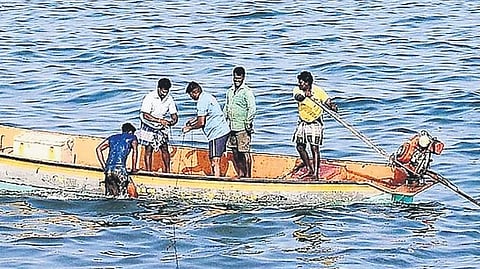

KOCHI: India is literally feeding its seafood competitors at the cost of its own marine wealth. Rampant illegal fishing of juvenile fish in Indian waters is not only depleting the country’s marine resources but also helping competitors such as China and Turkey, which import fishmeal produced from the catch.
Alarmed by the growing threat to marine ecosystems, the Seafood Exporters Association of India (SEAI) has demanded an immediate ban on fishmeal exports as a first step towards curbing the indiscriminate harvesting of immature fish.
The association is preparing to submit a memorandum to Prime Minister Narendra Modi, seeking urgent intervention to protect India’s marine resources from illegal, unreported and unregulated fishing, particularly the large-scale diversion of juvenile fish to the rapidly expanding fishmeal and fish oil (FMFO) industry.
“We are planning to submit a memorandum to the Prime Minister on safeguarding Indian seas from rampant illegal and unregulated juvenile fishing,” said Alex K Ninan, vice-president of SEAI.
Manoj T Varghese, chairman of SEAI’s Ocean Catch Committee, was more forthright.
“Juvenile fishing is a criminal act affecting the future of our fisheries and playing with fishermen’s future livelihoods. We are supplying fishmeal produced from juvenile fish caught in our oceans to our aquaculture competitors, including China and Turkey,” he said.
Ironically, the FMFO industry, which once played a useful role in recycling fish waste and leftovers from fishing harbours, has now emerged as a major consumer of marine catches, including commercially valuable immature fish.
“Once upon a time, this was a scavenging industry. It collected leftovers from fish landings and recycled them into fishmeal and poultry feed. But as aquaculture expanded from the late 1990s, fishmeal factories grew rapidly. Today, marine catches are increasingly becoming raw material for aquaculture feed,” said another industry official.
The consequences could be disastrous for India’s marine fishing industry, which has already been struggling with stagnant catches, climate change and rising operational costs.
According to officials, India produced 19.77 million tonnes of fish in 2024-25, of which aquaculture and inland fisheries accounted for 76.65%, while marine catches contributed just 23.35%.
The association said the unchecked removal of juvenile fish before they attain reproductive maturity could cripple future fish stocks. The problem is compounded by the fact that producing one kilogram of fishmeal requires approximately four to five kilograms of wild fish.
India has over 50 fishmeal plants, producing more than 3.5 lakh tonnes annually, primarily in coastal states including Keralam, Karnataka, Tamil Nadu and Maharashtra.
Citing studies, officials reckoned that nearly one-third of India’s marine landings were being diverted to the fishmeal industry. They also claimed that a substantial proportion of fish used by the industry could otherwise be consumed by humans.
The economic losses could be enormous. An official cited instances from Gujarat where juvenile pomfrets weighing just 10-20 grams were sold for Rs 20-30 per kg, though the fish could have fetched at least Rs 1,200 per kg had they been allowed to grow beyond 500 grams.
Peru, a major global fishmeal producer, has repeatedly restricted fishing to protect its anchoveta stocks.
“Across the world, fishing is increasingly regulated to protect specific species. Peru has imposed fishing bans when stocks declined. We cannot continue destroying our marine resources to feed competing economies,” an official said.
The industry officials warned that juvenile fishing creates a dangerous statistical illusion: even as immature fish are removed in huge quantities, the landings contribute to overall production figures, concealing the depletion of future stocks.
With India’s seafood exports valued at $8.28 billion, or approximately Rs 72,300 crore, in 2025-26, officials said the stakes extend far beyond the fishing industry. The sector supports nearly 28 million livelihoods. They have called for stricter regulation of fishmeal factories, particularly their raw material procurement, alongside an immediate ban on fishmeal exports.
Unless juvenile fishing is brought under control, India risks sacrificing tomorrow’s marine wealth for today’s fishmeal profits, the seafood industry officials warned.
Fishmeal is a growing industry in India, but one that leans heavily on the sea. Producing a single kilogram of fishmeal takes four to five kilograms of wild fish, and the country now has more than 50 plants making it.
Together they turn out about 3.5 lakh tonnes a year, a modest share of the 19.77 million tonnes of fish India produced in 2024-25, yet fishmeal exports have been growing at an average of 21.3% annually.
