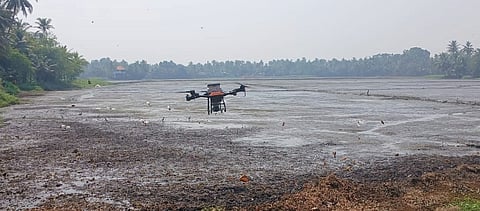

ALAPPUZHA: “We normally take up to three days of backbreaking work to sow the 34 acres of paddy polders in Chirakkakam,” said local farmer Thomas Vazhakoottam. “This time, however, the work was completed in a single day, thanks to drones.”
In a first for a paddy field in Pulinkunnu panchayat, Kuttanad, farmers joined hands to use drone technology for sowing ‘puncha’ cultivation across the 34 acres. A polder is a low-lying tract of land reclaimed from a body of water.
“Individual farmers have experimented with drones for sowing, spraying manure and pesticides. However, this is the first time that all farmers of a single padasekharam have collectively adopted the technology in Kuttanad. This marks a significant step towards mechanisation of farming in the region,” said Thomas, secretary of the Padasekhra Samithi.
“A total of 650 kg of ‘uma’ paddy seeds, supplied through the agriculture department, were sown using a drone with a carrying capacity of 30 kg. The equipment was made available on the initiative of the Dr M S Swaminathan Rice Research Centre in Mankombu,” Thomas said.
“Apart from saving us time and labour, the technology offers considerable financial benefits. While conventional sowing requires around 40kg of seed per acre, drone-assisted sowing can reduce the requirement by nearly half.

The cost of manual sowing is approximately Rs 1,250 per acre per worker, whereas drone-based sowing costs only Rs 650 to Rs 700 per acre,” Thomas said.
“The technology also ensures greater precision. As the drone can be programmed to release a specified amount of seeds across a predetermined area, it helps achieve more uniform distribution. This, in turn, facilitates uniform germination and crop growth, while preventing seeds from sinking too deep into the soil or accumulating in heaps,” said Joseph Jefri, assistant director, agriculture department.
“The initiative is part of efforts to promote mechanisation in agriculture. This is the first time farmers of a padasekharam in Kuttanad region have come together to adopt drone technology for sowing,” said A S Ancy, agriculture officer, Pulinkunnu.