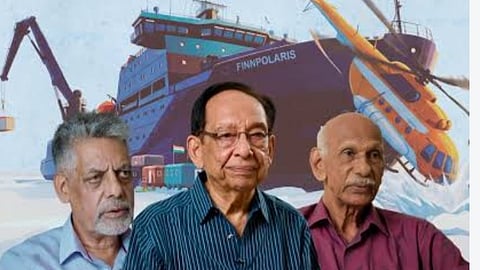

India’s story of establishing a presence in Antarctica was nothing short of a miracle. A remote, ice-cloaked continent governed by the 1959 Antarctic Treaty, it has since become a hub for scientific research, with around 70 permanent and seasonal stations operated by dozens of countries.
Filmmaker Santosh Saligram believes India’s achievement in 1983 deserves greater recognition. “There were many countries which set up permanent wintering bases there, but none had done it in under 60 days during an Antarctic summer. And that too at a time when the world wasn’t as connected as it is now,” he says.
Santosh, along with his wife Saurabha Rao, has documented this feat in ‘Miracle in Antarctica: The Forgotten Story of Dakshin Gangotri’.

The expedition comprised 81 members and was led by
Dr Harsh Kumar Gupta, then a seismologist at the Centre for Earth Sciences in Thiruvananthapuram.
Among the team was Dr K J Mathew, a Kochi-based scientist at the Central Marine Fisheries Research Institute (CMFRI). It also included two women scientists: oceanographer and marine biologist Dr Aditi Pant and structural geologist Dr Sudipta Sengupta.
Dr Gupta chronicles the mission in his book, ‘Building Dakshin Gangotri at Antarctica: A Miracle’. Against a tight summer deadline, the team arrived on December 26 and completed a 620-sq.m, two-storey prefabricated facility in time to celebrate Republic Day in 1984.
The film came about after Santosh and Saurabha, both engineers-turned-filmmakers, sought a subject that combined technical complexity with human endurance. They wanted to convey the arduousness of the mission without resorting to sensationalism.
“The story of Dakshin Gangotri, however, is not without all the elements of adventure, which put the Indian team in near-death situations,” says Santosh.
He recalls an Mi-8 helicopter crashing into the freezing waters and the dramatic rescue of those aboard. “One can feel the chill even from the footage in the movie,” Santosh adds.
Dakshin Gangotri was decommissioned in 1989 after being buried under snow. India subsequently established Maitri in the Schirmacher Oasis, followed by Bharati. A fourth base, Maitri II, is expected to be up by 2029.
The filmmakers relied primarily on Dr Gupta’s book and interviews with expedition members, including Dr Mathew, along with archival material, animation and graphics. Family members of the scientists are also featured.
Dr Mathew, now an emeritus scientist at ICAR-CMFRI, recalls working alongside the Army and other personnel to establish the Antarctic base, 15km from the coast. “The stay was gruelling, but we set up the base in record time on an ice shelf in the Queen Maud Land region,” he says.
“This was the third expedition. The earlier two were short-term and did not involve setting up any facility there. I was the second person from Keralam to be part of a research team to the poles.”
For Mathew, known as the ‘Krill Man’ for his research on euphausiids in Indian and Antarctic waters, the growing interaction between scientists and the public is encouraging.
“Back in the 1980s, we were often prohibited from speaking about our research, perhaps due to internal security concerns,” says the 86-year-old.
“But now, we have understood the need to be understood, especially by those who will grow up to take our places and continue research to unearth the ‘miracles’ of science.”
The screening of the film was held at Platinum Jubilee Hall, ICAR-CMFRI, Kochi, on November 27.