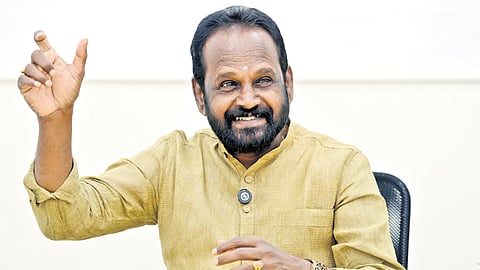

He’s the man behind the famed Jatayu sculpture which has gained renewed interest after the release of the Bollywood blockbuster ‘Ramayana’. Sculptor and filmmaker Rajiv Anchal who made a mark with his philosophical take through the 1997 film ‘Guru’ – India’s Oscar entry that year – chose to dedicate 15 years to sculpt Jatayu. In a freewheeling conversation, the master craftsman, also an award-winning art director, shares with TNIE the challenges he faced en route, why he considers ‘Guru’ his masterpiece, the influence of Karunakara Guru in his life, and his thoughts on the film ‘Ramayana’.
Excerpts
The sculpture of the mythical bird Jatayu has become all the more fascinating after the release of ‘Ramayana’. Where did it all start?
Jatayu entered my mind during my journeys along the MC Road during my college days. Once you pass Ayoor (in Kollam district) and cross a bend, you can see Jatayu Para (rock). We would think about the story of Jatayu, and it stayed with me that way. Later, I thought of creating Jatayu at Ponmudi and submitted a model to the tourism department. The upper sanatorium was in my mind; a wing down at Kallar and the wingless Jatayu up above – that was my concept.
And then?
Due to inter-departmental issues, forest land couldn’t be given to the tourism department. Much later, the then ecotourism director K G Mohanlal, along with the then MLA Prayar Gopalakrishnan, felt something had to be done at Jatayu Para. They wanted me to sculpt Jatayu there. Back then, it was a hangout for antisocial elements. Kanayi (Kunhiraman) sir had planted the seed of large sculptures in my mind.
The first time I went to the top of Jatayu Para, I felt a strong sensation because that rock itself is a huge pedestal. I called it Jatayu Earth’s Center as it feels somewhat like the centre of the Earth. Such a beautiful place!
Can you share the experience of materialising the project?
Making the sculpture there meant hauling all the materials up to the top, which was no small task. Having worked in art direction, I had immense patience. Bringing everything up to the top of the rock and waiting through it didn’t feel like an issue to me. I spent around 15 years for this project. The construction of the sculpture began around 2008-09. The rock has a kind of egg-like shape, and concrete is built around it as if slicing and carving it out, forming a shape all the way from the bottom.
What were the major challenges you had to face?
Bringing materials up was the main challenge. A bucket weighing around 750 kilos travelled up and down. Through that bucket, Jatayu came up trip by trip—as stone, sand, and steel rods. Pointing to the massive sculpture, I joke that Jatayu arrived through that bucket. There was also the wind. We learnt how to make it strong enough to withstand that wind over the years. I stayed up there and worked. Staying up there in those conditions was a great experience. During that period, I left the outside world and cinema behind—almost living in isolation – because creation was happening; there was a high, an excitement in that.
You didn’t necessarily have to go through all that trouble... you could have just stuck to cinema. Did you ever feel like giving up?
No, I did that after making a conscious decision. I knew it back then that if I could bring the project to fruition, it would be a huge achievement.

There are stories about Kummanam Rajasekharan protesting there in the past...
That is not true. Rajettan wasn’t there at the time. The stories sprang up using AI. The person who worked behind protecting the rock was Swami Satyananda Saraswathi of Chengottukonam. He installed an idol of Sri Rama and brought it into focus as a temple. People felt there was a sacredness or belief attached to it. Another thing is that there’s an imprint said to be that of Lord Rama’s foot on the rock and a pond formed where Jatayu’s beak is said to have struck, which never dries up.
Was there a government decision to hand over this rock for quarrying?
Yes. A Malaysian firm wanted rocks. They prepared a yard there and erected full machinery. The plan was to blast and quarry the rock from behind, process it, and transport it as a tar mixture. That proposal was real. Later, based on a study, the government decided against quarrying.
Isn’t it revenue land? Has your company taken it on lease?
The 65 acres originally belonged to the revenue department. It was later transferred to the tourism department. They gave it to my company on a BOT (build-operate-transfer) basis for 30 years. The company has my family members as directors; we have the responsibility to return it.
Weren’t there complaints raised against your company by its promoters?
We have several subsidiary companies. In the company for sculpture, I brought in some investors after funds ran out. After a while, they wanted to run the operations without me. When a situation arose where they tried to oust me, I terminated their contract based on legal advice. They went to court; the case is still going on.
What was the total cost of the project?
The cable car company has cost around Rs 35 to Rs 40 crore. Further, including the sculpture and everything else, I think the project cost has come to around Rs 80–85 crore. All of this is private investment. The government built a good road, which cost around Rs 8 crore. Under BOT, we have to give a revenue share to the government, and that share increases once every three years. In GST alone, we have paid around Rs 15 crore from 2020 until now. For the government, it is like a lottery. Though governments changed in between, everyone understood the scale of the project and supported it.
With ‘Ramayana’ in the limelight, there is a renewed interest in Jatayu…
I created it because I liked the significance of Jatayu. When I heard the story of Jatayu standing up to Ravana and fighting him, I felt a heroism in that. But how many people know who Jatayu is? I have mentioned the words ‘Dedicated to Women’s Safety and Honour’ there. People would then enquire about it and we would get an opportunity to tell the story. It was a trigger. However, that trigger has happened now with the film ‘Ramayana’ coming out, and people understood who Jatayu is.
Now, many claims have been made for Jatayu in Karnataka’s Lepakshi, in Maharashtra, and many other places...
It is something that gives them joy. The difficulty comes when we try to connect it with history. Ramayana is beyond our comprehension – it’s a story from the Treta Yuga, thousands of years ago. It’s a story, after all. So, for me, the story is what matters, the message is what matters. Ramayana and Mahabharata are things meant to awaken our inner selves – they are messages. There is no harm in that message awakening anywhere. What matters is that the message is generated. When we read a story, do we notice the paper? The medium is not the issue. For ages, Ramayana has existed in various parts of the world. I don’t think we need to scientifically prove that Rama went to all places. Rama travels through all of our minds.
Comparing the two versions of Jatayu, yours and the one in the film, how do you see them?
In the film I watched, the episodes/scenes I liked most were the beginning and the ending. Otherwise, in the VFX and all, I felt there were too many issues in the middle. However, at the beginning, it had an Avatar-level presentation of the galaxy. It was excellent. The VFX was good too. But where it really clicked was the Jatayu–Ravana fight. In their promotions, they themselves declared that there is a Jatayu sculpture in Kerala and that they were inspired by its claws and wings.
While making the sculpture, from where did you get a reference?
That’s how we sculpt – we make drawings, models in clay, break them down, and so on. In this case, to be expressive, birds only have legs and a beak. If we want to feel pain, how do we make the viewer feel it? If Jatayu—fallen and lying tilted after being struck—didn’t have the leg exposed, how could we show that pain? We sculpted Jatayu trying to rise from there, without one wing. I thought the pain and that struggle should be expressed. That is why I raised the legs upwards like that.
You are a well-know filmmaker. Which is your biggest work: Jatayu or the film ‘Guru’?
They are two different things. As for the sculpture, I don’t think I would get enough time to make another sculpture this big. If I hadn’t done it then, it wouldn’t have happened. So I set aside time from cinema and did that. It stands out and it satisfies us because it reaches people. Cinema and the film ‘Guru’ is like that. It is a socially eye-opening attempt; it doesn’t have to open everyone’s eyes, but for some who have a spiritual inclination, being able to show that perspective is another kind of joy.
When you look back, which is your greatest creation?
The greatest creation is the film ‘Guru’. Not because ‘Guru’ was an Oscar entry or anything like that.
What’s the link between the film and the guru in your life? You are a devotee of a guru and is that what inspired your cinema?
Certainly, guru is guidance for us. Through a message of the guru, what I said loosely was that it is within us. The spiritual vision of the guru has deeply influenced us; it has influenced our life. It is from an HG Wells work, ‘The Country of the Blind’, that I got the idea for this film. When I became close to the guru, I realised that visionary people coming into the valley of the blind are our great gurus.
As far as they are concerned, it is their wish that we should also open our eyes. We dealt with all such people and sent them away. After dealing with them, religions were formed based on their names, like Christ, Krishna, Buddha, or Muhammad. We understood neither their language nor mission. Our blindness is blindness in our social perspectives. Then, when great gurus come to us as light, we are unable to recognise them; we stone them, we harm them. So, in that way, if a guru comes, how would it be? Karunakara Guru gave me this idea.
Was Mohanlal your first choice for that?
Yes. Mohanlal transforms into any character. Even without knowing kathakali, he can transform into a kathakali character; he has that immense ability. So, he could do it with great ease. And he liked the story too.
How much of acceptability did you anticipate for the film from the public?
If you don’t want to task risks, you can stand in the queue waiting for your turn. But those who stand away will have a queue forming behind them. I am someone who doesn’t like standing in a queue; meaning I am someone who wants to go my own way, whether it succeeds or not. Being able to give the Guru’s message is a success for me personally.
How was the film received in your community?
I didn’t see filmmakers reacting much to it. Even in film festivals, it wasn’t taken seriously. The Film Federation of India selected it for that year’s Oscars.
You once mentioned about going to many people telling this story, and they thought of it as insane...
(Laughs) That was pretty much how its reception was. But we must expect that. When we get a certainty inside us about something, that certainty is our courage. We just have to walk and reach that certainty. The reason I think this way is the training I got from the Guru. After a few films, Guru asked me to do art direction again. Usually, after directing films, going back to art direction doesn’t bring a great reputation, but I did it after Guru said so. I won the state award for ‘Njan Gandharvan’. That’s when he passed on the secret in the guru-shishya tradition... that energy shifted towards me.
The films you made before ‘Guru’ had almost no connection to Guru. Why was it so?
That is what we must understand: how much a Guru can transform a human being. When ‘Butterflies’ and ‘Kashmeeram’ became hits, Guru told me to take a break for a while. So I didn’t make any film for three years. During those years, I stayed at the ashram like a disciple. That give-and-take with the Guru completely transformed me. After that, Guru told me to go ahead and make a film. That is the film ‘Guru’.
Can you recall the making of ‘Guru’?
The valley of the blind was my curiosity. I insisted that nobody should have seen any of the props anywhere before. The biggest challenge was with the musical instruments. I purchased some rain-soaked items, took various pieces, and made combinations. I attached small strings that created a percussion look for some.
Taking photos of these instruments, I went to Ilaiyaraaja. He couldn’t recognise the instruments. I told him I had come to him to get unheard music from non-existent musical instruments. He was completely bowled over. To get the ideal location for a valley, we went to places like Sikkim. Finally, I found it in Salem — an abandoned magnesite mine. We went to places like Halebidu and Belur, where there are old ruined and broken sculptures for the set. It was a mammoth task.
Did the film succeed in cinemas?
Considering its cost, there were some issues. But isn’t it still relevant today? There are plans for a re-release.
What exactly were you trying to convey through ‘Guru’? Philosophically and socially, how does it connect to today’s society?
It’s about how enlightened souls with vision come into the midst of humanity that has lost its vision — that’s the story. It begins with a communal riot, the trigger for which was an innocent act by two children. The message of Santhigiri ashram is that it sees everyone equally. The protagonist gets an inner vision. I was portraying things humans do in a blind world where they do not recognise the enlightened ones.
You are a devotee of Guru. Are you a believer in God?
I believe in a divine power or God which is like air or water, without which we wouldn’t exist—that is what I call God. Our temple worship and beliefs are all paths toward this. If guru and God came together, like Saint Kabir Das said, I would bow to my guru. It was the guru who led me to the path of God. If someone asks me whether I am a believer in a guru or a believer in God, I would say I am a believer in a guru.
In ‘Guru’, you portray how beliefs are blindly followed…
I was showing how people manipulate beliefs. It’s easy to manipulate beliefs because it cannot be seen. It is a virtual feeling. As long as it remains a virtual feeling, as long as it cannot be seen or recognised, anyone can manipulate it. As I said, without oxygen and water, humans cannot survive here. I didn’t come here with oxygen; so there is something here before me. That is what my guru taught me. He cleared my doubts. The guru who says everything is right to its own extent, right in its own measure... that is the guru for me.
The influence of a guru existed among writers like O V Vijayan. How do we see him influencing people who used to speak of communist philosophy?
Going through communism is also part of a search. When you see one extreme and see that there is something beyond it, isn’t that a realisation?
During a certain period, young people felt deeply depressed due to O V Vijayan’s shift towards spirituality; they felt disowned...
The guru-disciple relationship has a special nature... it’s a personalised experience. The guru and the disciple are distinct individuals, and the guru gives something different to each person. Vijayan sir received that. When Vijayan sir shares it, those who followed him by reading his books may not have the same experience. Our true quest begins when we search for the reason behind our existence. I received it from my guru. Spirituality is like that; don’t even try to explain it. We must experience it ourselves.
Can you share the experience of working as an art director in the award-winning film ‘Njan Gandharvan’?
Pappettan (director Padmarajan) would pat us on the shoulder when we successfully execute something he wrote. That was like an award to me. He told me right at the beginning of that film to make the fantasy as realistic as possible. If it were made today, we could do it easily in VFX. Back then, it was a major work. Everything was done like poetry... in an era before VFX, we were able to pull it off.
Nowadays, people use VFX to extend sets. As an art director who started this journey many years ago, how do you view that?
I look at whether it brings quality. Cinema is something we experience—it is not about what happens behind the scenes. I look at the end result. A set can be built in any way or done without a set, but the result has to be good. For an art director, that’s the only thing that matters.
What about your next project... is there any film in the works?
Another film is now taking shape; we have almost locked the script. We haven’t announced it yet because we haven’t cast anyone. It is one I’m going to direct... on a large canvas. It’s a story about the hidden mysteries of sculptors. The film revolves around sculptures—their beauty, their lives, emotional moments they go through, and a big surprise within it.
You mentioned being deeply influenced by Kanayi Kunhiraman...
I couldn’t bring Kanayi sir yet to see Jatayu Para. Hope I’ll soon be able to do so.
TNIE team: Cithara Paul, Anil S, Aparna Nair, Aswin Asok Kumar Albin Mathew (photos)