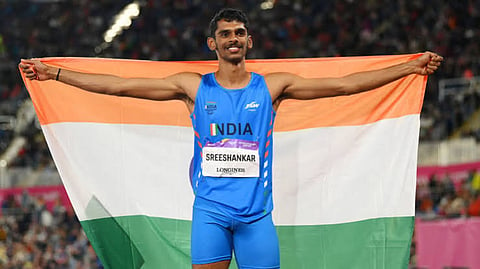

PALAKKAD: Keralam’s failure to recognise and adequately support its elite athletes has come under sharp scrutiny, with international long jumper Murali Sreeshankar, who won silver medal in the long jump category at the recently concluded Asian Games in Japan, alleging that the state government has virtually ignored him despite his performance at the Asian Games.
Sreeshankar told media on Saturday that the absence of a proper reception by the state government to the athletes who excelled in the Asian Games reflected the lack of institutional recognition for athletes who represent the state at the highest level.
The contrast with other states has further exposed Keralam’s shortcomings in sports administration. Sreeshankar said states such as Tamil Nadu had already disbursed the cash rewards announced for their athletes, while he had received no communication from the Keralam government regarding any reward or assistance. He also pointed out that Keralam’s cash awards and benefits for sportspersons were comparatively meagre, claiming that Manipur was the only state offering lower rewards than Keralam.
The discontent has now raised the prospect of Keralam losing one of its prominent athletics talents to another state. Sreeshankar confirmed that he had received offers from the Tamil Nadu government and said he could consider switching states, particularly with the next Olympic cycle approaching.
“They have clearly offered him that once he gets the No Objection Certificate (NOC) from Keralam and joins the Tamil Nadu team, he will get the best possible facilities and due recognition from there,” said a close associate of Sreeshankar.
Tamil Nadu has established a more structured support system for athletes through its Sports Development Authority, implementing schemes aimed at strengthening their training and competitive prospects, while the athletes in Kerala had no comparable support mechanisms to fall back on.
“For elite athletes, competing internationally involves substantial expenditure on training, travel and other preparations. Without sustained financial backing and institutional support, even accomplished sportspersons are forced to shoulder expenses that should form part of a state’s long-term investment in sporting excellence,” the associate said.
Sports policy under lens
Keralam’s apparent indifference raises a larger question about its sports policy: whether the state is prepared to invest in the athletes it celebrates when they win medals, or whether recognition begins and ends with public applause.
The absence of meaningful support, Sreeshankar’s allegations suggest, risks turning sporting talent into a resource that other states can attract through better incentives and more systematic assistance.
With Tamil Nadu extending offers and the Olympic cycle drawing closer, Keralam faces the prospect of losing not merely an athlete but also the opportunity to retain and nurture a talent developed within its own sporting ecosystem.
