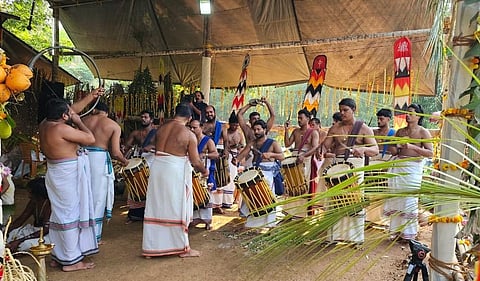

MALAPPURAM: As the sun rose over the ground near Sopanam School of Panchavadyam at Kandanakam in Edappal, Malappuram, on Sunday, a group of men and women began a collective effort to save a rare ritualistic art form, an effort that would continue until the next sunrise.
For the next 24 hours, the artists immersed themselves in an elaborate sequence of songs, ceremonies and dance, bringing alive Pallippana, one of the rarest traditional ritual art forms of Valluvanad region that is rooted in the worship of Goddess Bhadrakali.
Organised by the Sopanam School of Panchavadyam in association with the Thanjavur South Zone Cultural Centre, the performance was held as a Desappana, a ritual seeking the prosperity and peace of the region. A group of nearly 50 men and women artists helmed the various aspects, from preparation to performance.
“Pallippana demands extensive preparation and coordination. Every stage has to follow the prescribed ritual sequence, and sustaining the performance for 24 hours requires considerable dedication from the practitioners.
This is why presenting it in its complete form — from one sunrise to the next — is significant,” said Santhosh Alankode, director of Sopanam School of Panchavadyam.
The ceremony revolves around Darikavadham Thottam Pattu, a ritual song cycle comprising 4,444 lines narrating the slaying of the demon Darika by the goddess. The performance includes Thiriyuzhichil (fire dance), Guruthi (ritual) and Valathu, or Pana Pidutham (dance by men) along with chenda melam and other musical events.
Traditionally associated with Bhadrakali temples and sacred groves (kavu), Pallippana survives in fewer than 10 temples across Valluvanad region, where Malappuram, Palakkad and Thrissur meet. It is considered an important offering to the Goddess, performed to seek the fulfilment of wishes and the well-being of families and communities.
‘Pallippana practitioners need greater support and recognition from public’
Tradition attributes the origin of Pana Yogam to Mezhathol Agnihothri, who is believed to have brought together priests from four Namboodiri households in Mezhathoor. Mezhathoor Adishiri Namboodiri is credited with composing the Pana Pattu.
The ritual later became associated with the Pallishan Nairs, giving rise to the name Pallippana.
The Alankode Pana Sangham, led by Alankode Ramakrishnan, Alankode Manikandan, Alankode Unnikrishnan, Alankode Santhoshkumar and Alankode Girish Kumar, is presenting the ritual at Edappal.
The group carries forward a legacy associated with distinguished practitioner Alangode Govindan Nair and his kinsmen and disciples, including the late Alangode Kuttan Nair, Alangode Raman Nair and Alangode Gangadharan Nair.
“Learning this art takes years, but performing it does not provide a dependable livelihood. We need greater public recognition and support for the practitioners if the tradition is to remain a living practice rather than become something known only through history,” Santhosh said.
The Edappal event is also being visually documented with the support of the South Zone Cultural Centre, creating a record of the complete ritual, including its songs, ceremonies and performance traditions.
“We want the documentation to capture Pallippana as it is practised, in its full ritual context. It should be useful not only to people who wish to understand the art today, but also to future generations who may want to study it,” he said.
