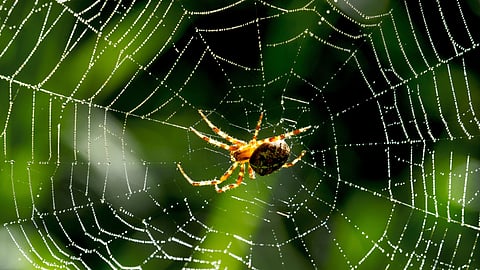

Spiders have for long had bad PR. Their eight legs, sudden movements and cobwebs have made them creatures of unease. Many cringe at the mere mention of one.
For Keralam’s growing community of spider researchers, however, these much-maligned arachnids are anything but repulsive.
The state is well-placed for spider research, thanks to its rich biodiversity and the Western Ghats. “Did you know there is also a spider variant in the Ghats stock that can go fishing?” asks Kannan Warrier, director of the Kerala Forest Research Institute (KFRI).
“There are at least 600 species in Keralam alone of the half a lakh identified species across the world.”

Yet, spider research remains one of the least-invested areas of biodiversity studies.
“There is a lot of glamour associated with research on large mammals, like the tiger and elephants. Why should anyone throw even a glance at the teeny-weeny spider? And then, add to it its ‘eeriness’ conferred upon it by myths and movies,” observes Mathew M J, one of the pioneers of spider research in the state and former head of the zoology department at Sacred Heart College, Kochi.
But the scene is changing. From the fishing spider in the streams of Wayanad to venom being studied for its potential against cancer, Keralam’s researchers are revealing the many lives of the spider.
Research began gaining momentum here in the 1980s, when young researcher P A Sebastian took up spiders as part of his wider biodiversity studies. He found the state to be a repository of some of the country’s most remarkable spiders.
Sebastian’s work inspired a generation of researchers. Today, Keralam has a formidable community of arachnid researchers, with three of the four centres in the country devoted exclusively to arachnid studies.
They include the PA Sebastian Centre for Arachnology Research at Sacred Heart College and the Centre for Animal Taxonomy and Ecology (CATE) at Christ College, Irinjalakuda.
Here are some of the studies that may change the way we look at spiders.
The fishing spider
Around the streams and water sources of Lakkidi and Wayanad in the Western Ghats, a remarkable fishing spider can be found perched on leaves, branches and rocks jutting into the water. The species, the first of its kind recorded in India, has been named Dolomedes indicus. The study by Dr Jithu Unnikrishnan and C K Arjun of KFRI, conducted in the Wayanad, has been featured in ‘Nature’.
“The 12cm-long spider places its specialised hair-like spikes into the water, sensing the approach of prey. Its target can be fish measuring 4 to 5cm,” says Jithu. “Its perch is linked to a nearby web. Once a fish comes within reach, the spider clasps it with its legs and sinks its fangs into the prey. It then hangs on to the web and climbs towards the treetops. ”The specialty is that the spider fishes in streams. “It has mild venom, which paralyses its prey,” says Jithu.
The web as an archive
Spiders are accomplished silk-craft artists. Their webs, however, may be more than remarkable structures. Dr Jithu of KFRI describes the web as a repository of information, much like the World Wide Web.
“This is one reason spider webs are being studied for environmental DNA, or eDNA — a technique that can reveal the biodiversity of a region without individually studying its flora and fauna,” he explains. “The spider web has sticking agents that allow anything that passes by to get glued to it. So, in all likelihood, the spider web will have ample traces of the habitat remnants. This is like a study into the ecosystem.”
Elsewhere, researchers are studying how materials that make up their webs could inspire new engineering solutions. “But here, we still have to go that long way, as it is more about inventory that is being done,” he says.
Venom against cancer?
The venom that makes spiders frightening could also hold therapeutic possibilities. A team led by Dr Ajaikumar AP of Pattambi Sree Neelakantha Government Sanskrit College studied the venom glands of the colonial spider Stegodyphus sarasinorum, found in Attappadi. The spider weaves complex webs on bushy plants, jamun trees and the higher branches of giant trees.
“The same venom that scares humans from spiders is what could help them from diseases like cancer. Venom is a cocktail of proteins, peptides, and enzymes,” he says. “Researchers have identified compounds that could trigger a strong immune response. The venom also contains antioxidants that can deactivate free radicals.” But Ajaikumar is careful about the findings.
“This is not a medical intervention or a cancer treatment, but an in vitro study conducted on cancer cell lines at a molecular level,” he says. “Onco researchers can take cues from this for the development of their invention or therapy.”
Social spiders
Spiders are generally solitary creatures. But some live in colonies. Hema Somanathan of IISER, Thiruvananthapuram, and her team studied the behaviour and evolutionary ecology of social spiders. Their research focused on Stegodyphus sarasinorum, commonly known as the Indian social spider. These spiders live in large nests, share web-building work and hunt prey together.
Hema and her team have also documented how their behavioural responses vary depending on the prey they are trying to capture.
“Social spiders work as a unit: they build webs, rear young and plan prey-catching strategies. They are also ecologically important — as predators, they help control pests and may even serve as indicators of climate change,” says Hema.
“Current research is focusing on the structure of their webs and, more importantly, on what makes these few spider species social.”
The spider farmer
At Kerala University, Dr G Prasad and his team have been steadily building an inventory of the state’s spiders, particularly in the Western Ghats. Their work combines taxonomy with ecological studies. Surveys in Shendurney have identified new species and distribution records. More recent work has examined spiders in specialised habitats such as Ochlandra reed breaks. But perhaps the most practical strand of their work is taking spiders from the laboratory to the land.
The idea is to rear social spider species in controlled conditions, allow them to multiply in farms and use them as natural pest controllers. “Spiders feast on pests, thereby reducing the need to use harmful pesticides. We tried this model in the Kuttanad farms and it has been a great success. The model is active, and the farmers can still make use of it if they want,” says Prasad. The project also highlights spiders’ value as bioindicators. “One must remember that spiders can reflect the health of ecology. Even the vagaries of climate change can be sensed from the cobwebs.”
The Rameshwaram ornamental
Poecilotheria hanumavilasumica, or the Rameshwaram ornamental, also known as the Rameshwaram parachute spider, is a critically endangered tarantula. Locally, it is also called the tiger spider. The species was first spotted in 2004 near a sacred grove and tamarind plantation surrounding the Hanumanvilasom temple in Rameshwaram. “There were about 400 of them then, putting them under highly endangered species. When we studied it last year, the figure was just 150. This species cannot be found anywhere else in the world,” says Prof. Mathew. “It is called the parachute spider because it is a tree-dwelling tarantula that sails down like a leaf as it descends from trees. Rampant urbanisation and cutting down of tamarind trees, its primary habitat, are among the main threats.”
Malayali names
Keralam’s researchers have also left their mark on spider taxonomy. CATE researchers have identified several species, including Draposa sebastiani, a wolf spider named after Dr P A Sebastian, who mentored many researchers. A jumping spider from Wayanad was named Hindumanes wayanadensis, while another was named Habrocestum swaminathan, after the late agricultural scientist M S Swaminathan. The CATE team has also rediscovered rare spiders. Micropholcus fauroti was found after 134 years, while Tetragnatha cochinensis, presumed extinct for a century, was rediscovered on the Christ College premises. Their research on social spiders has also provided insights into regional climate change.
Kochi to be the first Indian venue for global meet on spiders:
The 23rd International Congress of Arachnology will be held from November 15 to 21 at Gokulam Park Hotel and Convention Centre, Kochi. This is the first time the congress is being hosted in India and is being organised by Bharata Mata College (Autonomous), Thrikkakara, in association with Devamatha College, Kuravilangad.