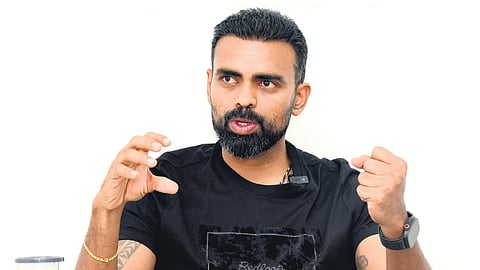

Former India captain P R Sreejesh, who helped end the country’s 41-year wait for an Olympic hockey medal, has a blunt assessment of Indian hockey. Having played 336 matches for India across four Olympics and four World Cups, for nearly 16 years, he questions the continued dependence on overseas expertise.
In this wide-ranging interview with TNIE, Sreejesh, who now works as a joint director with the Keralam general education department, argues that India is a lucrative market for foreign coaches while its own coaching talent struggles for opportunities.
Excerpts
You initially wanted to pursue athletics before switching to hockey. How did it all begin, and what has your journey been like so far?
I was a village boy with no exposure to scientific training methods. In Class 7, my physical education teacher told me about G V Raja Sports School and encouraged me to attend the selection trials. Since the government would take care of almost everything, I saw it as an opportunity. I joined Class 8 in 2000 as an athlete. Most of the other athletes had already received professional training, and I felt left behind. I tried volleyball and basketball before noticing students learning hockey. A senior told me that hockey offered a better chance of making the state team and earning up to 60 grace marks in board examinations. That’s how I took up hockey (smiles).
When did you realise you had the potential to compete at a higher level?
Back then, if you were a hockey player from Keralam, you weren’t encouraged to dream big. What was the ultimate goal? You wanted to represent your state, earn 30 or 60 grace marks through participation in national-level competitions, complete your education and secure a government job.
That was considered the highest achievement you could aspire to. Dreaming of becoming an Olympian was a different matter. When I joined G V Raja, we organised a reception for athlete (K M) Binamol, who had competed at the Sydney Olympics. She told us, “I trained here at G V Raja Sports School. If I can become an Olympian, you can become an Olympian too.” Hockey player Dinesh Naik also visited the school and told us that hockey offered a relatively accessible route to the national team. Yet, the Olympics seemed a distant dream because we lacked the facilities and pathways to reach that level. I realised that I could either go through the process or work hard to excel. I chose to give it my best.
How did you become a goalkeeper?
When I started playing hockey, I found it difficult to control the ball with a stick while running and bending. I struggled with the basics and had to stop frequently to stretch my back. Then I noticed the goalkeepers standing in a corner, seemingly doing little beyond kicking the ball around. I thought goalkeeping was the easiest option. I imagined saving a few shots, conceding a couple of goals and winning if our forwards scored enough. That lazy mindset initially drew me to the position.
You’re being modest here. How demanding is goalkeeping at the highest level?
It is extremely demanding. A goalkeeper is like the CEO of a company. Your decisions can affect the entire team. One mistake can hurt its performance, while one excellent decision can help it win a medal.
That brings us to another question: what’s the big problem affecting Indian sports?
Psychology. It’s all about psychology. We don’t give enough importance to it. Mental skills must be developed at the grassroots and integrated into training, rather than introduced only when athletes reach the elite level. International exposure alone cannot address the problem because an athlete’s mindset and outlook may already be deeply ingrained by then. I believe physical and mental fitness contribute equally to winning medals at the highest level.

Now, you have the responsibility of being the Chief Sports Organiser in Keralam. Perhaps this gives you an opportunity to start working on it...
Don’t jump into that topic just yet! That’s a completely different arena (resigned laugh). My current work is more focused on the grassroots level and schooling.
Keralam once dominated athletics, football and volleyball. Why has the state fallen behind?
Several factors are responsible. Kerala once had more than 3,000 physical education teachers in schools, but the number has fallen to around 1,800 despite having more than 30 lakh schoolchildren. Our training methods also need to keep pace with the changing sports science. Our trainers have sound fundamentals, but they must update their knowledge and techniques regularly. Another major problem is the lack of accessible playing fields.
India won an Olympic hockey medal at Tokyo in 2021 after 41 years, which was followed up by another bronze at the Paris Olympics in 2024...
Olympic success takes time, experience and exposure. Earlier, we rarely played European teams and struggled to adapt our traditional style to astroturf. We also lacked physical fitness in certain areas and sometimes had a mental barrier against stronger teams. Foreign coaches, beginning with Ric Charlesworth in 2007, helped us learn the European style of hockey, from stick handling and receiving the ball to one-touch passing and tactical positioning. Subsequent coaches from Australia, the Netherlands and other countries added to that knowledge.
Over the past 10 to 15 years, international exposure through the Pro League and the Hockey India League helped us learn from top players. Sharing dressing rooms with them taught us about match preparation, nutrition, recovery and team motivation. Most importantly, playing alongside foreign players helped us overcome our inferiority complex.
While hockey is basically an Indian game, isn’t it ironic that we need to learn from the West?
The difference is that we used to play on a natural ground, which had normal natural grass turf, not the polygrass one. The skills we require and what it takes to play on natural grass are totally different from synthetic grass turf. The astroturfs demand a lot of physicality that grass turfs do not require. On the other hand, natural grass turf requires more skills. The great names like Dhyan Chand, Ashok Kumar and Balbir Singh that we had in those days are primarily known for their skills and their qualities, not for their speed or one-touch abilities. So when the Europeans introduced the astroturf, they also made the rules that demand more physical strength.
You were associated with the Indian junior team as a coach. Hockey India replaced you even after you guided India to a bronze medal at the FIH Junior Men’s World Cup in 2025. What went wrong?
I had a healthy discussion with the Hockey India president. The chief coach of the national team wanted a foreign coach at the junior level so that they could work together to develop more players for the senior squad. He said this would also help him select players for the senior team. I could not understand why he could not work with me. Maybe because it was Sreejesh, or perhaps he was more comfortable working with foreigners. Ultimately, Hockey India had to make the decision, and it opted for foreign coaches. I said, “Okay, thank you very much,” and left.
Are you still associated with Hockey India?
My only connection with hockey now is through a franchise in the Hockey India League. I have played hockey my entire life and know nothing else. So, when I joined my new job in Thiruvananthapuram, I was completely blank. I didn’t know what to do with files, how to open them or how to e-sign them. For the past three to four months, I have been trying to learn the job. I have realised that the hockey association can kick me out at any time. This is my bread and butter, and I need to excel here to feed my family. Family is more important than anything. People say hockey has given me everything, but I gave 25 years of my life to hockey. That’s why hockey paid me.
It’s tough to hear that from you. Sanju Samson has said that it requires something special for a player from Keralam to establish himself in the Indian team. You made it because you were brilliant, but is it more difficult on the coaching side?
Look at the Indian men’s senior and junior teams. All the chief coaches are foreigners. This is not just a Keralam issue; it is a national problem. The senior teams have foreign chief coaches and assistant coaches. There is only one Indian coach in the squad, and his job is to handle administration. He is not much involved in the coaching set-up. That is where we are lacking as a country. Even at the junior level, where we could give Indian coaches opportunities, we are appointing foreigners. Why?
Is that the mindset of the association?
Yes. Perhaps nobody has asked why Indian coaches are ignored, neglected and denied sufficient opportunities. Shivendra Singh has been the only Indian coach with the national team since 2019, I believe. Why can’t we appoint three or four Indian assistant coaches to the senior men’s hockey team? We don’t have a goalkeeper coach for the senior men’s, senior women’s, junior men’s or junior women’s teams. Foreign experts come here, train our goalkeepers for a couple of weeks and leave.
There is no consistent training. The same applies to drag-flickers. In the process, we fail to develop our own coaches and continue depending on foreigners. I believe the foreign lobby may be preventing Indian coaches from growing because India is a lucrative market for them. Indian hockey spends around Rs 1.5 crore a month on coaches alone. Just imagine how many Indian coaches could benefit and gain valuable experience if we invested that money in them.
You are also a product of foreign coaching. How do you explain your criticism on the entry of foreign coaches?
I started training under Ramesh Patania at the U-16 national camp, followed by Harendra Singh and then A K Bansal. So, my entire junior career was under Indian coaches. It was only when I joined the senior squad that I was exposed to foreign coaches.
None of the Indian coaches I trained under had the opportunity to work with foreign coaches either. I have now spent approximately 16 years playing hockey under foreign coaches. I have played 336 matches for my country, competed in four Olympics and four World Cups, and spent countless hours on the field. I don’t know what difference it makes. I have never said foreign coaches are not good. My question is: how long will India continue to depend on foreign coaches?
How can you break that barrier?
I am not in a position to break that barrier. Let me tell you one thing: I am an Indian coach working with the national team. Tomorrow, if my federation sends me back, where will I go? I will return to my state, train players and produce more talent for the country.
What happens with foreign coaches? Just imagine, my chief coach has gained considerable experience in India, working with the national team, travelling around the world and interacting with top people in the sport. Tomorrow, if he leaves, he will simply return to his country. We are spending a lot of money to develop their coaching capabilities, but that investment is not benefiting us in the long run.
How can India develop its own coaches and support staff instead of depending so heavily on foreign experts?
Why can’t the government or the Sports Authority of India require foreign coaches to learn Hindi, or another Indian language relevant to the team, as part of their contracts? Communication is crucial, and not every player understands English. Foreign coaches often bring their own assistants, trainers, video analysts, goalkeeper specialists and psychologists. Where does that leave Indian professionals? We have capable coaches and psychologists, but we do not give them enough opportunities to develop. If India wants to become a major sporting power by 2036, we must build our own expertise and give Indian professionals experience alongside international coaches.
Is this becoming a vicious circle for Indian coaches?
Yes. We need to follow the example of countries such as China and Japan, which are developing their own coaching systems.
Would you accept the senior Indian team’s coaching job if offered?
I don’t yet have the expertise for that role, which is why I chose to coach the junior men’s team. During my nearly 18 months with them, we played five tournaments and won all five. I wanted another two years to gain experience, but you cannot gain experience without being given an opportunity. Coaches also need time.
Does being a goalkeeper give you an advantage as a coach?
Yes. A goalkeeper has a good view of the entire field and constantly analyses the game. You must guide defenders and midfielders, track the ball and anticipate what will happen. In many ways, a goalkeeper has to act as a coach on the field.
What was the highest point of your career? Is it the historic bronze medal in the Olympics or the various awards you have won?
My injury. Until 2017, hockey was everything to me. Hockey was my life. I was away from my family. I didn’t care about that. I thought hockey would take care of me a lot. Until I got injured; until then, people called me the ‘Wall of Indian Hockey’. In the very next tournament, they started calling someone else by the same name. It was easy for everyone to forget me. That was a realisation for me. Then I started to understand that hockey is a part of my life. It is not my life. That realisation helped me make more decisions. Before that, I never knew what I would do after hockey. I was a big zero. But after that injury, I realised that there is life after hockey. There comes a time when hockey will kick you out. What do you do then? I started preparing myself for that. So, I value that injury more than anything else.
Coming to the recent controversy regarding the change in jersey colour, from blue to orange, what’s the psychology behind it?
There is no psychology. I won two Olympic bronze medals (with the team) wearing that blue jersey. I never wore that blue jersey. I always played in yellow and red T-shirts. That has never changed. What changed was the statements made by politicians and Hockey India. Hockey India, as an association, has the right to change the colour of the jersey. Just mention that for the World Cup, we want to change to a new colour. We asked the players, and they said these were the choices we could have. Why do you need to compare that with performance or ball visibility?
What can Keralam do to recognise its athletes better? Recently, long jumper M Sreeshankar publicly criticised the Keralam government for a lack of recognition, support, and communication following his silver-medal-winning performance at the Asian Games...
The government should identify athletes representing Keralam at major events and assign officials to keep track of them. When they achieve something, someone should call and congratulate them. A call from the sports minister or education minister saying “Sree, you have done a wonderful job” would mean a lot. Recognition from the government and the public matters to athletes.
Does the disparity in prize money affect athletes from Keralam?
It can be frustrating. In Keralam, gold at the Asian Games brings Rs 50 lakh and silver Rs 30 lakh. In Haryana, gold brings Rs 3 crore and silver Rs 2 crore. Athletes put in the same effort and spend the same time training, yet the rewards differ enormously.
Has public recognition of hockey players improved over the past 10 to 15 years?
It has changed a lot. After winning two medals, if nobody recognises me, that is no longer my problem.
Has Kerala hockey changed as well?
I don’t think so. There is a lot of talk about Kerala hockey, but everything eventually becomes political. Some people genuinely want to improve the game, while others pull them back. It is like crabs in a bucket: when one tries to climb out, another pulls it down.
Do you revisit your old matches, including the Olympic bronze medal match against Germany?
No. That chapter is closed. If you keep living in your glory days, you expect people to treat you as they did when you were at the peak of your career. That never lasts. Wherever I go now, I introduce myself as P R Sreejesh, Joint Director of Education.
Why does the hierarchy in international hockey change so often?
It depends on the quality of players and the nature of the game. Some teams have exceptional individual skills, others excel through tactics, teamwork or fitness. Argentina have produced skilful players, with Gonzalo Peillat’s drag-flicking helping them win Olympic gold in 2016. Australia dominated for years through fitness and physical strength. Belgium built an experienced core that won the European Championship, World Cup and Olympic gold.
The Netherlands have also succeeded through their skills and style of play. India’s problem is that our coaching keeps changing. We have had South African, Australian and Dutch coaches in succession. We have become a ‘khichdi’, mixing different approaches without enough continuity. Players need time to understand a coach’s system.
TNIE team: Kiran Prakash, Rajesh Abraham, Krishnakumar K H, Manisha V C S A Sanesh (photos) Harikrishna B (Video)