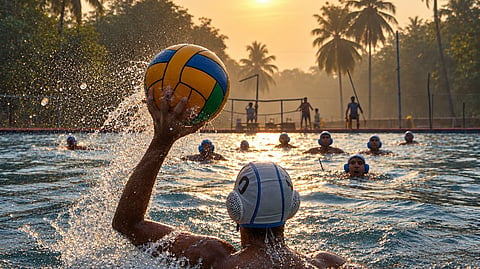

Theirs is an amphibian life. Without a daily dip in the water, Madhurima S M and Ambady N S feel like fish kept out of water for too long.
“We feel suffocated unless and until we splash around in the local temple pond where we grew up playing, swimming and then learning the basics of water polo,” they say.
The two 19-year-olds from Pirappancode in Thiruvananthapuram are the captains who led Kerala to gold medals in the men’s and women’s categories at the 52nd Junior National Water Polo Championship, held in Indore last month.
They also represented Kerala at the National Games in 2023 and 2025, and have led the state at the Junior National Water Polo Championships on several occasions, winning gold medals in most of them.
Their achievements extend beyond the national championships. Madhurima and Ambady have represented India at the Asian Championships in October 2025, the BIMSTEC Aquatics Championships in 2024 and the Indo-Sri Lanka Under-21 Water Polo Championship in 2025.

“At the national level, we compete against teams from states such as Karnataka, Bengal and Maharashtra, where professional infrastructure for aquatic sports is far better. They bring in some sophistication that way, yet we hold an edge,” says Madhurima, a second-year undergraduate sociology student at MG College in Thiruvananthapuram.
“Our training has been hands-on, right from the time we were in kindergarten, under the aegis of Dolphin Club. Our crucible is the Pirappancode Sreekrishna Temple pond. The edge we have is this natural ruggedness, where we swim in the pond with vegetation brushing against us.”
Madhurima began training at six, while Ambady took to the water at five. For both, swimming lessons came almost as a matter of course.
“It is more or less a ritual in our village, where most of the children are taken to the pond and get initiated into the sport,” says Ambady, a second-year undergraduate political science student at University College.
Both remember being woken up at 5.15am and taken to swim in the chilly pond. “I used to cry initially, and would wonder why I was being made to bathe in such cold water,” Ambady laughs.
“But by the time I was seven, I began to look forward to it. The pond gave me brothers and sisters, friends, mentors, and now, several laurels that come through the championships. I hope it will fetch me a good government job as well, like it did for my brother, who works with the Railways now.”
Madhurima shares that aspiration. “Our seniors, who trained here over the six decades of the club, coached us as kids and now help us groom the next generation. We have no professional coaches other than them, who now serve in the Railways and the Armed Forces. This includes my brother, Siddharth S M, who is now in the Air Force. Many of them have played in international tournaments, too,” she says.
Dolphin Club secretary Anilkumar A is one such mentor. Trained at the pond from a young age, he went on to lead teams in national competitions and now works as chief superintendent with the Railways.
He mentors the youngsters alongside other club alumni. “Some even take breaks from their jobs to spend time here,” says Anilkumar.
Training now takes place from 4.30pm to 8pm daily. Spread over more than 1.5 acres, the Pirappancode pond has nets for water polo and rope partitions for swimming practice. “The club was founded in 1952 by Parameswaran Nair, who wanted to groom local youngsters in water polo, a sport that originated in Britain in the 19th century,” says Anilkumar. “The club has since touched the lives of generations of youngsters in the village, encouraged the formation of similar clubs modelled on it in other temple ponds in the region, and produced over 2,000 sportspersons. In a way, this is a quaint sports powerhouse of Keralam.”
In fact, taking note of this ‘powerhouse’, the state government chose Pirappancode to set up the Dr B R Ambedkar International Aquatic Complex.
Anilkumar, however, believes more needs to be done to boost the sport regionally and nationally.
“India’s prospects in water polo were evident after a spectacular run at the Asian Games of 1951, 1970 and 1982, as well as the two Olympic appearances in 1948 and 1952,” he says. “Were we able to capitalise on that momentum?”
In Pirappancode, he adds that reports of epidemic breakouts elsewhere have dampened the josh to an extent. “Some parents get wary when they see health alerts,” he says.
“We are now trying to find an alternative spot to set up a professional aquatic pool to hold classes. None can match the expertise our club offers. It is sad that our alumni do not get to train children at the International Aquatic Complex due to red tape.”
For Madhurima and Ambady, meanwhile, no sophisticated pool can match their temple pond. This is not merely where their sporting journeys began. It is at the core of a longstanding sporting tradition that’s ingrained in them.
Both now train youngsters following in their footsteps. “It is like handing the torch to the generation next. My father trained here, my brother too, and now, it is my turn to give back,” says Madhurima.
Ambady shares her sentiments. “This is where our memories are moored. This is where our lives were shaped. This pond as well as the sport are gifts I will cherish and nurture forever,” he smiles.