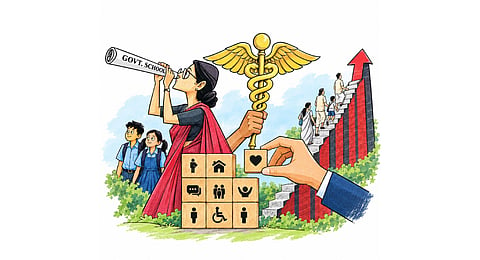

THIRUVANANTHAPURAM: Keralam has all through its history invested in people, building a development model anchored in education, healthcare and social welfare. Its achievements are reflected in high literacy, longer life expectancy and low multidimensional poverty. But sustaining these gains is the next big test. Educated unemployment, gender disparities, population ageing and persistent social inequalities pose challenges as the state marks 70 years of its formation on November 1.
The foundations of the human development story predate the formation of the state in 1956. Social-reform movements, struggles against caste discrimination and the spread of educational and healthcare institutions helped widen access to basic services. Successive governments built on these foundations through investment in education, healthcare, land reform, food distribution and social security. Together, these interventions helped make health and education central to the state’s development experience.
The results are reflected in indicators that measure people’s well-being, rather than economic output.
According to the 2011 Census, Keralam’s literacy rate stood at 94%, against the national average of 73%. The Kerala State Planning Board’s Economic Review 2025 reported life expectancy at birth of 75.1 years, compared with 70.3 nationally, based on Sample Registration System (SRS) life tables for 2019-23.
Maternal health offers another measure of progress. The economic review assessed a maternal mortality ratio of 30 deaths per 1,00,000 live births in Keralam, against 88 nationally, based on SRS estimates for 2021-23. Such outcomes reflect the cumulative contribution of healthcare access, maternal and child health services, trained personnel, education and public awareness.

Progress in reducing deprivation is equally significant. The Niti Aayog’s National Multidimensional Poverty Index 2023, based on the National Family Health Survey, estimated that the state’s multidimensional poverty headcount ratio declined from 0.70% in 2015-16 to 0.55% in 2019-21. The index measures overlapping disadvantages in health, education and living standards, including nutrition, schooling, sanitation, housing and access to basic amenities.
Explaining Keralam’s achievements, C Veeramani, director of the Centre for Development Studies (CDS), traces their roots to a combination of historical factors.
“Keralam’s human development story goes back centuries. The rulers of Travancore and Cochin emphasised education and healthcare, followed by the contributions of Christian missionaries, social reformers such as Sree Narayana Guru, and land reforms. These factors shaped Keralam’s progress even before the Gulf boom. Migration later enabled greater private spending on education and healthcare. So, Keralam’s success is the result of several factors, not any single intervention,” he said.
The development trajectory has also been shaped by overseas migration, remittances and the expansion of the services sector. These helped improve household consumption and living standards, complementing social advances that began much earlier. The experience underscores the role of public investment and social mobilisation, alongside household spending, in expanding access to education and healthcare.
However, the model has not eliminated economic vulnerabilities. The Planning Board’s 2025 economic review, drawing on the Periodic Labour Force Survey (PLFS), put Keralam’s unemployment rate at 7.2% in 2023-24, against 3.2% nationally, among those aged 15 and above under the usual-status measure. The figures point to the challenge of translating educational attainment and social development into adequate employment opportunities.
The Kerala Development Report 2026 highlighted a persistent challenge: educated unemployment among women. In 2023-24, the jobless rate among educated women was 11.6%, compared with 4.4% among educated men. Among postgraduates, the rate declined from 36.5% in 2019-20 to 23.7% in 2023-24. The figures underline the gap between educational attainment and suitable employment opportunities, particularly for women.
Demographic change presents another test. Longer life expectancy and declining fertility rates are contributing to population ageing, increasing the need for healthcare, social security and elderly support. Keralam must meet these needs while generating productive employment and sustaining the public services underpinning its achievements.
Aggregate indicators can also conceal inequalities affecting marginalised communities, while advances in education and health have not eliminated gender disadvantages in economic and social life.
G Vijaya Raghavan, member of the state Planning Board, said the state must look beyond maintaining its development indicators. “Keralam needs to create more aspirational jobs to retain its young workforce, which migrates in search of opportunities. This can help revive the economy and strengthen key social sectors. The state must also tap the potential of its growing elderly population, many of whom can contribute to its development for at least a decade after retirement,” he said.
As Keralam turns 70, its human development legacy presents both an achievement to protect and a model that must adapt. The next challenge is to ensure that education translates into opportunity, longer lives into healthy ageing, and social progress into greater economic security. This will require more than preserving the indicators that have defined the progress.
Its ability to address these pressures while protecting access to healthcare, education and social support will shape the next chapter of its development story.
Human development journey
1951: Literacy rate stood at 47.2%
1956: State formed on earlier social reform foundations
2011: Literacy reached 93.9%, Census data show
2019-23: Life expectancy reached 75.1 years
2015-21: Multidimensional poverty fell from 0.70% to 0.55%
Source: Census of India 2011; Kerala Economic Review 2025; NITI Aayog, National MPI 2023.