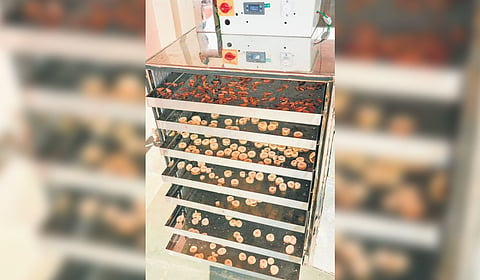

KOLLAM: From mangoes and jackfruit to ginger and nutmeg, a little sunshine can help rural communities preserve their harvest longer and turn perishable produce into value-added products. Solar-powered hybrid-drying systems developed by the Humanitarian Technology (HuT) Labs at Amrita Vishwa Vidyapeetham are helping address the challenges of traditional food preservation in rural Keralam.
“In rural areas of Idukki, farmers grow a wide variety of fruits and traditionally dry and preserve them. However, the produce sometimes gets damaged by insects and other factors. To address this problem, we created the project, which has been ongoing for the past year,” said Dr Rajesh Kannan Megalingam, professor of electronics and communication engineering at the university.
The project, named ‘Solar Drying System for Year-Round Sustainable Fruit and Vegetable Preservation’, was implemented with Rs 8-lakh in funding from the IEEE Tech4Good Programme of the Institute of Electrical and Electronics Engineers (IEEE) in New Jersey, United States.
Solar-drying units have been deployed in Kollam’s Alappad panchayat, Kanjiramattam, Thodupuzha; Erumpupalam, Adimali; and Kochuthovala, Kattappana. Three fruit dryers were handed over to the Jan Shikshan Sansthan (JSS), Idukki, which works with farmers, to facilitate the implementation of the project at the community level.
“More than 100 families are currently benefitting from the solar system, which is free of cost. We have mainly considered people who are below the poverty line for this initiative and areas where commercial dryers are less,” said Lalprasad S, secretary of JSS Idukki.
The systems have been tested on a range of agricultural produce, including cardamom, mango, jackfruit, papaya, banana, gooseberry, carrot, beetroot, bitter gourd, ginger, chilli, copra and nutmeg, as well as medicinal plants and other locally available products.
“We had cardamom dryers very far from our house. So we had to dry the cardamom in sunlight, which was not properly done. Now we are able to dry the cardamom and fruits like jackfruit using the nearby solar dryer, which has increased store life,” said Jyothilakshmi, an Adimali resident.
The technology aims to extend the shelf life of agricultural produce, minimise post-harvest wastage and enable farmers, women entrepreneurs and self-help groups to develop value-added products throughout the year.
JSS, an institution sponsored by the Union ministry of skill development and entrepreneurship, supported community coordination, beneficiary engagement, training programmes and field-level implementation. By combining renewable energy with food processing, the initiative seeks to offer rural communities a sustainable way to preserve locally available produce and strengthen livelihoods.
