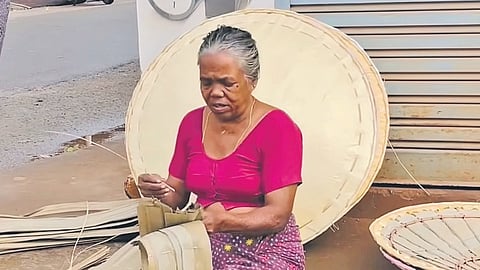

MALAPPURAM: Once an indispensable accessory for farmers working on the fields, the palm-leaf head umbrellas, or thoppi kudas, are now relics of the past, serving as a nostalgic memorabilia of a rural agrarian life.
Not for Chandravathi, though.
In Wandoor, the 70-year-old continues to keep a disappearing tradition alive, her skilled hands weaving palm leaves together into umbrellas that once protected generations of farmers from the scorching sun and monsoon rain. It is also a means of livelihood for the septuagenarian, who learned the craft from her paternal grandmother at a very young age.
“Childhood was full of poverty. Earning enough money to buy rice was one of the biggest aims in life. That is why I learned the techniques of making palm-leaf umbrellas,” says Chandravathi.
Back when she was young, the family collected palm leaves from nearby trees and sourced bamboo and palm fibres from their surroundings. Chandravathi would make umbrellas alongside her father, Raman, and her grandmother, Kali. After marriage she continued, this time with her husband who was also named Raman.
“There was huge demand for palm-leaf umbrellas back in the day. People would come to our house to buy different varieties, including the thoppi kuda, veeshi kuda and kaa kuda,” recalls Chandravathi.

Thoppi kuda and kaa kuda were head umbrellas used by farmers and labourers while working outdoors. Veeshi kuda was used for rice winnowing.
As technology replaced traditional agricultural practices, many objects, including the ‘thoppi kuda’, gradually lost their purpose. “Technology replaced tradition, and many of these umbrellas became unnecessary,” says Chandravathi.
Raman, her husband, died two years ago, leaving her as one of the few remaining artisans in her family and neighbourhood who continues the craft. Her children now help her collect palm leaves and other materials required.
The work begins in April with the collection of kodappana leaves. These leaves are dried. Then, bamboo is collected to make the frame. The bamboo segments are tied together using palm fibres. Palm leaves are then woven into the frame. By the time monsoon arrives, the umbrellas are ready for sale.
Chandravathi also makes customised umbrellas according to the size of a customer’s head. The upper portion is woven and stitched, while old plastic sacks are used as protective covering, giving the umbrellas greater durability. The head peace is made after taking measurements of the customers and is stitched to the upper portion.
“Plastic sacks provide durability and prevent leakage. In earlier times, we did not have this option,” says Chandravathi, who makes and sells the umbrellas at Wandoor junction. Some customers also visit her home to place orders. However, the demand is only a fraction of what it once was.
Monsoon Ready
The work begins in April with the collection of kodappana leaves. These leaves are dried. Then, bamboo is collected to make the frame. The bamboo segments are tied together using palm fibres. Palm leaves are then woven into the frame. By the time monsoon arrives, the umbrellas are ready for sale