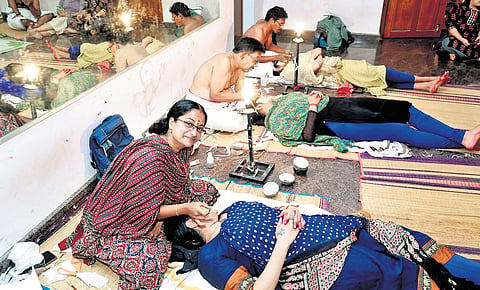

KOCHI: Even before they start performing, kathakali artists manage to capture the audience attention with their flashy makeup. Specifically, it’s the distinctive white border framing their faces that grabs eyeballs first.
‘Chutti’, as these borders are called, are one of the most recognisable elements of the traditional art form. They are also complex, taking around two to three hours to apply. Not surprisingly, applying them requires utmost patience, both from the performer as well as the makeup artist.
Abhidhanath B believes she has the patience. The first woman faculty (guest lecturer) in chutti department at Kerala Kalamandalam Deemed to be University, Abhidha’s journey towards becoming a chutti artist began 19 years ago, that too, by chance. Interested in dance, she sought admission in Kalamandalam. However, since the seats were full, she took up chutti course in Class 8 at Kalamandalam Arts School in 2007.
“I was the only female student in the course. Koodiyattam artist Margi Sathi guided me into opting chutti,” recalled the 33-year-old Thiruvananthapuram native. She said unlike now, girls were not allowed to take up kathakali in Kalamandalam back then. “After I joined, three more female students took up chutti course. However, one dropped out while the other two didn’t pursue it as a career,” she said.
After graduating from Kalamandalam, Abhidha took up MA in Theatre Arts from Kalady Sanskrit University, before pursuing a second PG degree in Kathakali Aharya (aka chutti). She is pursuing PhD in performing arts at Kalamandalam, focusing on Kathakali Aharyam.
A professionally trained Chutti artist, Abhidha is an integral part of the Vanitha Kathakali Sangam in Tripunithura. “In my initial days as a chutti artist, I found it a bit difficult to travel and spend hours at venues as facilities were limited.

However, since my husband is an artist, too, we later travelled together,” said Abhidha, adding that things are much different now. “We get all the facilities and our safety is assured at the venues,” she said. Her husband, Prasanth A, is a madalam artist.
While kathakali artists themselves apply the rest of the makeup, framing the face is the chutti artist’s duty. “Earlier, a mixture of rice paste and limestone was used to prepare the structure and fix it on the face. In 1929, famous kathakali artist Ramakrishna Panicker created a model using paper, but it was not received well. Around 45 years later, the model made a comeback and is now used widely,” said Abhidha.
Kathakali’s recent return to popularity has worked in the favour of chutti artists who were otherwise always behind the stage. Senior artists are making efforts to impart kathakali lessons to the younger generation, she said. “Chutti artists, too, are getting platforms to demonstrate their talent. I have been providing chutti classes to art enthusiasts coming to Kalamandalam. We hosted a group of fashion design students and introduced them to chutti.
Similarly, an exchange session was held for tribal students recently, where we learned their art and taught them chutti and various dance forms,” said Abhitha, who has presented research papers in national and international conferences, taking kathakali, Kalamandalam and Keralam’s heritage to a wider audience. She said she wants more women to pursue Kathakali Aharya studies.
Kathakali makeup and some of the characters they depict
Pacha (satvik): Nalan, Krishnan
Kathi (rajugonam): Duryodhanan, Ravanan
Chuvanna Thadi (cruel): Dushasanan, Bali, Sugreevan
Kari (cruel female): Nakrathundi, Hidimbi
Vellathadi (simple, calm): Hanuman, Nandhikesan
Nedumkathi: For unimportant characters
Kurukathi: Mainly Ravanan
Kattalan: Wild or tribal characters, Siva
Minukku: Women characters and others Masked characters depict Angad, ox, goat, etc
Kalamandalam Barbara
Kalamandalam Barbara, from the UK, is the first non-Indian chutti artist. She pursued a short-term course in chutti in the 1970s. Following her teachers to stages across the state whenever she could, Barbara excelled in the field at a time when the idea of women taking up chutti was unacceptable to the kathakali fraternity.