
A Rhodes Scholar and economist, Sanjeev Sanyal has helped prepare six editions of the Economic Survey of India as a member of the Economic Advisory Council to the Prime Minister.
But history may remember him as much for his work as a researcher and storyteller who brought to light facets of India's past that have remained outside popular understanding --- from the geography of its land and rivers to its rich maritime history.
His recent book 'Revolutionaries: The Other Side of How India Won Its Freedom' turned the spotlight on the men and women of the revolutionary movement.
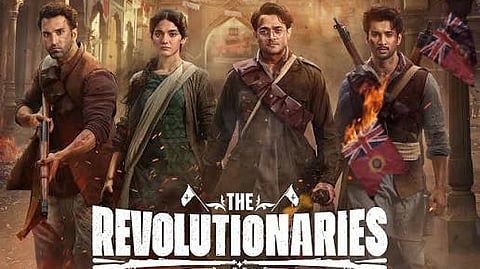
This work has now been adapted into an Amazon Prime series titled 'The Revolutionaries', set to release on September 11.
In an engaging interaction with TNIE, Sanyal who traces his roots to revolutionary Sachindra Nath Sanyal --- his grand uncle --- speaks about sidelined heroes of India's freedom struggles and the need to revisit the country's history through a more holistic lens. Excerpts:

Q: You are an economist by career. How did you get interested in history?
A: I did not start out writing about my own or my family’s history. I got into writing about economics, geography and maritime history. It was only in 2023 that I wrote about my family history.
Q: You have been revisiting history from a different lens from the usual. How did that come about?
A: Partly because, growing up, I did not find the history in my textbooks relating to the world I saw around me. For example, I lived in Singapore for many years. It bears a name that clearly has Indian roots. But nothing in my school textbooks had ever explained this, or why there would be a country called Indonesia, which again has a link to India.
Similarly, why is the world’s largest Hindu temple in Cambodia, and not in India? So, I went down the path of exploration and discovered that the history taught to us was not really the history of India at all.
Q: Could you give us a glimpse into the upcoming Amazon series based on your book?
A: It is not a documentary, but is presented as a thriller. The idea is to get people interested in the story. They can always read my book for the facts.
Q: There has long been an allegation that Indian history was in the clutches of a particular school of historians. Such a monopoly sounds contradictory to the Indian tradition of dialogue and debate…
A: If you read the history narrative as it has been presented so far, you get the impression that our history is simply a sequence of foreign invasions and occupations. As if we Indians had no particular agency in any of this.
When you flip history around, we did have agency. India was a great place precisely because ancient mariners were sailing across the Indian Ocean, exploring, trading and doing all kinds of interesting things. This history was not told.
Our freedom struggle was also viewed in the same manner. Besides the non-violent movement, there were other streams that also contributed. This is not adequately taught. My book, ‘Revolutionaries’, was an attempt to provide an alternative view.
Q: But allegations of ‘propaganda’ crop up whenever the other side of history is told...
A: My response is: take a look at the facts. To call the Mughals ‘Indians’ is certainly absurd because they themselves said they were not Indians and were very proud of their Central Asian links. Babur clearly stated in his records that he came to India for the gold.
Absurd eulogy of foreign invaders happened because of the colonial history that was taught. Obviously, the British wanted to show that their conquest of India was not a big deal because its history was always about somebody else conquering it. The colonisers told a similar history in every country they colonised.
But in India, why was their version of history perpetuated even after Independence? That is the question to be asked.
Q: How careful does this revisiting of history have to be?
A: The purpose should not be to replace colonial and Marxist lies with a new set of lies. The idea should be to replace them with the best understanding of our history based on primary evidence. Oddly enough, if you are honest about it, it is not difficult because there is a great deal of evidence.
Q: The revolutionary movement’s role in India’s freedom struggle still remains a hazy picture…
A: Yes. It has not been properly told. Knowing about the revolutionary movement is absolutely critical to understanding the history of our freedom struggle. Even to understand the Congress.
For example, Subhas Chandra Bose won against the moderates in an open election within the Congress. So, it is not that the Congress did not have strong support for armed resistance. You had people like Bal Gangadhar Tilak, Lala Lajpat Rai, Sri Aurobindo, and Bipin Pal, but they were presented as ‘extremists’. I understand the British using that term, but why are we still using it?
Q: Did the Congress sideline the contribution of the revolutionary side? If so, why?
A: It suited a certain Nehruvian narrative. But now, after 80 years of Independence, the fact is that we simply do not know enough about it.
Other streams of the freedom movement also need to be celebrated, and that is what the book and the Amazon Prime series are trying to do.
Q: Could you elaborate on the argument that India’s spiritual roots laid the foundation for a nationalist movement?
A: The spiritual roots of the country definitely fed into the revolutionary movement and, more widely, the freedom movement. There were obviously the ideas of people like Bankim Chandra Chatterjee and Swami Vivekananda, both of whom Sri Aurobindo embodied. Aurobindo was both a spiritual leader and a revolutionary.
Hindu revivalism had a vital role, particularly the Shakta school. This shows through even in ‘Vande Mataram’, which contains a lot of Shakta imagery. The influence is also seen in the way many revolutionaries took their oaths when inducted into the movement. The oaths would be taken to a form of Shakti — such as Durga, Kali or Bhavani —- while holding a revolver in one hand.
There were also foreign influences — the ideas of Italian nationalist Giuseppe Mazzini and revolutionary Giuseppe Maria Garibaldi, Irish Republican ideals, the revival of Japan after the Meiji Revolution, and so on.
Q: Ironically, did Macaulayan education end up creating many nationalists?
A: Yes. That is true of Sri Aurobindo, who was sent to England by his father because he did not want him to have any Indian influence. But while preparing for the civil service examination, Aurobindo rediscovered his roots and became a nationalist.
So, sometimes Western education had exactly the opposite influence. The same happened with Veer Savarkar and Subhas Chandra Bose.
Q: What was the influence of India's War of Independence in 1857?
A: All of them were influenced by the uprising. In fact, the revolutionary movement was about trying to cause a rebellion within the British army here.
The 1857 uprising failed, but the Ghadar movement followed. Rash Behari Bose and Sachindra Nath Sanyal also tried the same with the Canadian Sikhs. The Indian National Army (INA), too, tried to create unrest during the WW II.
Rash Behari Bose was instrumental in setting up the INA in Singapore — it was not Netaji Subash Chandra Bose, as people often assume. Netaji took control of it later. Rash Behari Bose formed the Azad Hind Fauj during WW II.
And finally, you had the Naval Revolt in 1946. So, in the end, the revolutionaries were successful in what they were trying to do. The Naval Revolt is a crucial part of the story, but it has not been adequately covered in our textbooks. Hopefully, the new textbooks are beginning to talk about it.
Q: Are you arguing that the revolutionary events during the freedom struggle should be viewed as a spectrum?
A: Yes. It was not a series of individual heroic acts, as it has often been presented. The purpose of my book is to show that this was a movement. The people involved had clear goals and were trying to achieve them over generations.
You have the first generation of Savarkar and Sri Aurobindo, followed by the second generation, directly inspired by them, including Sachindra Nath Sanyal and Rash Behari Bose.
Sachin Sanyal recruited the next generation — Ram Prasad Bismil, Bhagat Singh, Chandrashekhar Azad, and the other inter-war revolutionaries.
They failed, and Sachin Sanyal, after returning from his second term in Kalapani, tied up with Netaji, who represented the fourth generation. He and Rash Behari Bose strengthened the Azad Hind Fauj, which inspired a generation towards the Naval Revolt.
So, you can see a continuum in the story. It is important to understand that the revolutionary movement was indeed a ‘movement’.
Q: So, it was not just random, sporadic rebellions…
A: That is why I wrote Revolutionaries. I have explicitly shown how all these people knew each other.
Swami Vivekananda’s ideas strongly influenced Aurobindo. You cannot understand Aurobindo without understanding Vivekananda.
Without Aurobindo, you would not have had Sachin Sanyal and Rash Behari Bose. Without Sanyal, you would not have had Ram Prasad Bismil, Ashfaqulla Khan, Rajendra Lahiri, Bhagat Singh, Chandrashekhar Azad, and others.
Without Rash Behari Bose, you would not have had the INA. Netaji was directly inspired by Sri Aurobindo and later by Rash Behari Bose. And without Netaji, you would not have had the Naval Revolt. These are clearly linked events.
Q: Suppose the revolutionaries you write about were alive today. How would their nationalism be viewed now?
A: I do not think it would be very different. What they thought of the world is no great mystery because these are very recent events. Savarkar was around after Independence, and so was Sri Aurobindo. Some left behind their own writings, such as Sachin Sanyal’s Bandi Jeevan. Many of them also gave interviews. So, we do not have to interpret what they thought. We can read them in their own words.