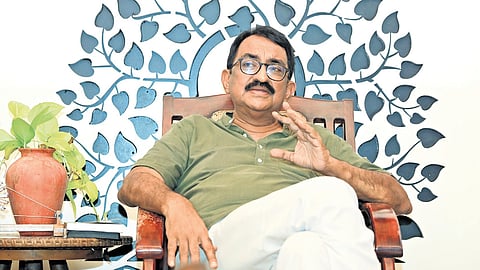

Building a house of one’s own perhaps defines the biggest dream of an average Malayali. In this endeavour, they would probably never have come across another friend like G Shankar, founder of Habitat Technology Group that propagates sustainable and affordable architecture. Sitting at ‘Siddhartha’, his famous mud house, the people’s architect opens up on his journey, the philosophy behind the “lovable, livable and sustainable’’ buildings he has built across the world, in a chat with TNIE.
Excerpts
It has been a long journey of close to five decades in architecture. How do you look at it?
I would term it the journey of an unfinished symphonist. I was born in Africa and later moved here. I had a lonely childhood. One of the turning points in my life was getting attracted to the Sasthra Sahithya Parishad, which gave me valuable lessons. That experience made me what I am today.
How did you get into architecture?
My journeys showed me the hard realities of life, abject poverty among fisherfolk. I decided that whatever I do should be for the betterment of society. During my college days, I accidentally came across a foreigner – Laurie Baker, I later realised – who argued vociferously in favour of construction of simple houses. My life at the Thiruvananthapuram Engineering College too was eventful with suspension and police arrest. I wanted to learn architecture that stood with earth and human beings, the kind of architecture that’s affordable for the common man in Indian conditions.
How did you get your first offer to construct a house?
Soon after my studies, I got a temporary job at the State Housing Board where I learnt how architecture should not be pursued. Then I started Habitat in 1985. That’s when a friend asked me to build a house for the first time. While at it, I happened to come across the British High Commission’s building division head, through whom I got an offer of scholarship to study at the Birmingham School of Architecture. It was Laurie Baker who gave me a recommendation letter. I still believe his was the right path.
After studies, though I got a prestigious job offer, I chose to come back to India as I think it’s a land of opportunities. In my entire life, I have constructed only such houses that align with my philosophy of bearing the torchlight for the poor. In the 1990s, I constructed the country’s first sustainable township at Coimbatore. Later, I got offers for alternative housing in Bhopal, Odisha, and in calamity-hit places across the country.
What are the lessons that you learnt from these places?
We should create habitat literacy. These are opportunities to drive in concepts like incremental housing, going for local solutions, community-based architecture, and resourceful housing. World over, I’m needed for disaster-resilient housing. Curiously, I have never figured in any post-disaster committee in Keralam (smiles). I’m concerned about Keralam. Even in the recent Nepal tragedy, I was part of the team. I never work on a template. I believe people should decide as per their requirements. For the past 15 years, I have built houses using only mud.
Can you elaborate on mud houses? It’s heard you taste the mud to check its suitability...
We are into making sustainable and low-cost structures using soil or mud. There are many yardsticks for choosing the medium – durability, strength, finish, resistance to moisture. Mud is actually a no-cost material that can be sourced from your backyard. But one should study the character of the mud, its constitution, and colour. We cannot use all kinds of mud for construction. There are four constituents of soil – sand, silt, clay, and gravel. While constructing houses in areas without testing facilities, we use the tasting method to ascertain the type of soil.
The mud in Keralam can be used, while it isn’t the case in places like Maharashtra. Keralam is a land of building resources, for instance, what you call ‘vettukallu’ is an excellent resource that hardens with time. Building with them is low-cost, energy efficient, insulative, eco-sensitive, durable. Stabilised mud-blocks or interlocking mud-blocks are stronger than the bricks used commonly.
But isn’t it costly?
It is not about cost. You can build with mud in four ways. The basic one is using fresh blocks of mud, what you call adobe. The second method is wattle and daub, where soil and organic binders are plastered on both sides of an organic core. It’s perfect for a disaster-prone area. The next is cob construction, where the soil is allowed to ferment and then used as balls, one on top of another and then smoothened to give the feel of a wall. The fourth is rammed earth, where soil is poured between two planks and then compacted using rammers.
This construction is prevalent across the globe. We promote technologies mainly for cost-effectiveness along with durability and eco-sensitivity. Without this, as far as Habitat or I am concerned, it doesn’t hold ground. For us, mud is a symbol of resistance that totally counters the argument that constructions using it aren’t durable. We package it aesthetically too. In Keralam, you find the best building resource variety, the most skilled workers... everything. It’s based deeply on mathematics, it is extremely eco-sensitive, it goes well with physical as well as social climate, the one that goes so well with our social constitution... a style that fits into all these, I have never seen so anywhere else in the world.
Could you explain that?
Take our age-old designs. There is something called ‘puramthinna’ or the outer verandah, then take the slanting roofs, the central courtyard... these are all to increase breathability. The central courtyard or ‘nadumuttam’ is not for aesthetics but for allowing the air inside the home to circulate and even vent out. It was for climate appropriation.
But the rooms of old Keralam homes are so dark...
Earlier, even the windows had wooden panes. When we talk of old homes, we usually talk about wind or air circulation. You take any old home; its outer wall never heats up, spacious courtyards... all these are the grace of our architecture. But the flip side is that a commercialisation has happened to undermine this kind of construction. Some unverified rumours were also circulated as part of this – that the architecture is inauspicious, there is less light, etc. This is the reason why we are distracted from our rich architectural traditions. I believe we should keep our traditional construction heritage flying high. Our land holds all the answers for our concerns.
But is it feasible for a commoner to build such a sustainable house today?
What we are accused of is that green buildings are costlier. This is 100% wrong. I propose green architecture for cost-effectiveness and not to hike up costs. There are several green technologies around. I believe technology has to go hand-in-hand with cost-effectiveness. So, Habitat aims at a technology that is cost-effective, even when it’s eco-sensitive and durable. Some claim ‘low-cost at any cost’. That’s a grossly incorrect understanding of our approach.
You spoke of vastu. Can you elaborate?
Vastu is about constructing in tandem with our surroundings, culture, and climate... in short, with the nature around and within us. It is an ideology based on this concept. There are tips in old texts of architecture, called ‘sutra’ and ‘marma’. It’s basic common sense too. If I have a window in the course of the wind, then there will be a passage for the wind and the place too will get enough air. That is the ‘sutra’ and that is the ‘marma’. Vastu is basically opening up the routes for light and wind to pass through a construction. These are explained in terms of beliefs. People like me try to comprehend the essence of the beliefs. But there is also commercialisation of these beliefs, which I am against.
Quite often, we hear about ‘kannimoola’...
It is a belief that construction has to begin at that particular spot. It is a sacred spot for those who believe. But if you go to Maharashtra or Tamil Nadu, they have different concepts. Some lay the foundation stone in the north-east, some in north-west.
Someone once told me that I should begin from the centre of the building space. All these are somewhere tied to beliefs too. My style is that if it’s the belief of an individual to adhere to a particular system, I factor it in. That’s because his happiness and peace are closely tied to such beliefs. And if someone insists it’s wrong, they may go through needless mental confusion and subsequent agony.
So vastu is about how close construction has to coexist with nature...
100%. Vastu’s biggest dynamic quality is that it is in accordance with the earth. I don’t know of any other methodology as eco-sensitive as vastu. Sadly, people don’t understand the essence of vastu and often do peripheral things.
Can you explain the creative process behind a house construction?
Creativity is blending, it has no parallels. It is a work in solitude. House is not just a structure with bedrooms, living, dining areas, and toilets. It is more than that... these are connected metaphysical activities. It should be a favourite place for us. The architect’s role comes in here. I still remember building a house for a journalist who wanted “a place where he can breathe the fragrance of letters”. I built a round structure with a library and other spaces around it.
You use materials, like bamboo, which are not common in modern house construction. Where do you get such ideas from?
When we go back to our history, a staggering 90% of houses in India were built using biomass materials like bamboo, timber, palm, and grass. It later changed with urbanisation. Why are we always looking to the West for answers? Keralam has diverse building materials. And has a history of buildings constructed in the most eco-friendly manner. That’s what we call organic architecture. It’s based on the properties of the earth in a given place. Humans don’t have any right to damage or distort the earth. I always tell young architects two things – one, to believe that earth is a living being. Then we won’t inflict pain on it. Two, to believe that the building is a living being. Houses should be built in accordance with the lifestyles and tastes of its inhabitants.
You have done many large-scale projects. Any special one?
A tribal rehabilitation project in Madhya Pradesh, which does not have any parallel in the world. Around 15,000 families at Singrauli were rehabilitated. The entire tribal belt was ruled by Naxalites. I built the project after taking the tribal community’s approval. When it was finished, they showered me with immense warmth. I still remember how they illuminated an entire hillside with traditional lamps in my honour. It remains one of the defining moments of my life. There are situations where you do not build a house, you rebuild a life.
Owning a house is widely regarded as the ultimate dream of an average Malayali. What are the primary expectations of those approaching you?
Universally speaking, anyone building a house naturally prioritises personal comfort. A home should be a sanctuary of peace. To me, a home isn’t just about fleeting happiness; it’s a space designed to offer peace, quiet contemplation, and deep contentment. I prioritise minimising costs, respecting the environment, and keeping things modest and economical. I continually discuss how to plan a home responsibly: how to incorporate indigenous local materials, design for natural energy efficiency, and curtail unnecessary construction expenses.
I share this almost like an earnest prayer: build homes that cause the least possible harm to the earth. As an old proverb humorously goes, “Fools build houses, wise men live in rented houses.” There’s a deeper wisdom to that saying. In our state, people often build indiscriminately, disregarding how naturally stunning our landscape already is. A home should engage and soothe all our senses, leaving us with a genuine sense of contentment. That’s the kind of home people truly desire: sensible, low-cost, and in harmony with the natural environment.
How significant a factor is long-term durability when it comes to a home?
A building erected with proper scientific sensibility never gives way. I can say with absolute conviction: a properly-built structure, and cared for with regular maintenance, will endure indefinitely. A structure that receives timely maintenance will stand strong for centuries. Saying that these houses only last 15-20 years is complete nonsense. There is another perspective I often share, though people frequently misunderstand and distort it. Every building possesses a spiritual lifespan. A home is fundamentally built for a specific person or a family. When their time in this world draws to a close, a form of spiritual death takes place even with respect to the house. That is why I maintain that a house is not an heirloom to be passed down and hoarded across generations.
That is a dilemma. Once an individual’s lifetime ends, the house loses its original purpose as their children often choose to build elsewhere...
It is not merely a choice; it is a necessity. Our children’s needs and lifestyles differ entirely from ours. Look at how a single pandemic transformed our living habits. It taught us how to live, study, and work from within a single room for extended periods. When we talk about a home’s spiritual lifespan, critics twist the concept and equate it with physical decay. Furthermore, when people claim that low-cost housing lacks durability and longevity, it stems from sheer self-interest.
As an architect representing the common person, let me address this directly: the mainstream construction industry thrives on your helplessness and lack of technical knowledge. Our mission is to challenge that status quo. That is where we extend our support. That is precisely what Habitat Technology Group and similar organisations have championed for decades through an earnest, straightforward approach.
What are the key public projects you have undertaken in Keralam?
In Keralam, successive governments initially encouraged this approach. They commissioned cost-effective, decentralised buildings that conserved energy. Unfortunately, over the years, the system drifted away from this philosophy. Architecture shifted from being people-centric to contractor-driven. It is truly tragic that this happened in Kerala.
The state possesses the most fertile ground for such innovation; modern, sustainable technologies have found their greatest acceptance right here. That was why organisations like Nirmithi Kendra, Habitat, and COSTFORD were founded here. Unfortunately, the broader system eventually pushed that vision aside.
Malayalis are often obsessed with houses as a status symbol…
In the 1970s, there was a significant change in the economic system. There were huge financial investments in Keralam from Gulf countries, and that was reflected in households here. The trend started thus. Houses became symbols of power and arrogance. People needed a bigger house than their neighbours. There are big buildings across the state. Several buildings remain unfinished. Later, those were sold, and people went into debt. This is Keralam’s recent social history.
The idea we highlight is that houses should represent life’s happiness, simplicity, and peace; and size should not matter. Our individual requirements should be fulfilled. We are also becoming an isolated society. The number of houses with a single person is on the rise in Keralam. Parents unwilling to stay with children look for small spaces. There are many elderly people locked in big houses, and there are many senior living projects coming up. For the next 10-15 years, what we need the most is small houses for the elderly. Even when there are reports that the number of houses is less in the state, there are more than 10-13 lakh vacant houses. People consider a house an investment. Let me tell you, no matter how luxurious a house is, its value after 20 years is zero. When you try to sell a house after 20 years, you will not get the expected amount.
Nowadays, the state is witnessing increasing natural calamities. You focus on sustainable constructions. What should be the priority while building a house?
In Keralam, we need more awareness. Keralam is a vulnerable area. According to the central government’s mapping, the entire state belongs to Zone-3. We see people constructing houses irresponsibly. We are not building houses based on the peculiarities of the soil. We haven’t learnt any lessons from the Chooralmala or Puthumala tragedies. Despite studies and geographical mappings, we still build houses in vulnerable areas.
It is often said that building a house here costs Rs 75 lakh to 1 crore or more...
For an average Malayali family, a normal house will have two bedrooms, toilets, living space, dining room, kitchen, and veranda. I build such homes in 450-500 sq ft, which will, at the maximum, cost Rs 10 lakh. This house is not basic, but will have all requirements. For houses up to 1,500 sq ft, it will cost up to Rs 30-40 lakh, including finishing work and wiring. Some people say that costs may go up because of interiors: interiors are part of architecture.
Where do such high rates come from?
Even I don’t know. Back in the day, filmmaker Priyadarshan, actor Mohanlal and I used to play cricket together. During the beginning of my career, Priyadarshan asked me to build a house for Rs 25 lakh, which would be perhaps equivalent to Rs 2.5 crore today. I used to build up to 1,500 sq ft homes for Rs 3-6 lakh then. I told him I don’t know how to build a house with Rs 25 lakh. People are being cheated by terms like interior and false ceiling. The building industry survives on two factors: helplessness and ignorance.
Over time, how have people’s demands changed, especially among youngsters?
There’s a visible change, and I’m happy to see such a trend. Though ‘sustainability’ is a worn-out word, it has become a necessity and often mandatory for people nowadays. Youngsters are now conscious that spending too much money on houses is futile. They often approach us with proper figures and optimal space. None of them prefer 3,000-4,000 sq ft houses. They prefer 1,000-1,800 sq ft, with three bedrooms, three toilets, and even lounges, costing a maximum of Rs 40 lakh.
What’s your goal at this stage of your life?
I have lived all these while to transmit hope to other people. I’d like to continue in the same vein, albeit with more clarity and dedication.
What’s your philosophy regarding ‘home’?
Home is the place where you are at peace and comfort, just like your mother’s lap. You can’t find that peace in public places. If people consider houses as living beings, they will start behaving responsibly. Every person building a house has the responsibility of not making it a burden to society. The future calls for sustainable houses. As an activist-architect, I hope Keralam and the world get filled with such homes.
TNIE team: Cithara Paul, Anil S, Aparna Nair, Aswin Asok Kumar, Albin Mathew (photos)
