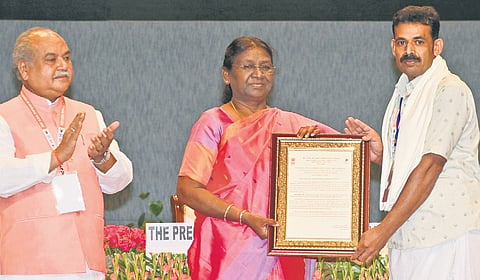

KALPETTA: For 48-year-old Pichan M Salim, forest is a library where every leaf, flower and seed has a story waiting to be read. Often described as a “barefoot scientist”, Salim is one of the state’s sought-after field para-taxonomists.
His journey in taking the rich records of Western Ghats biodiversity from remote forest trails to the pages of international journals has proved that sometimes the most important lessons in science are not learnt inside a classroom; but beneath the canopy of a forest.
With the discovery of 23 new plant species, more than 10 new geographical records and over 53 scientific publications, the Wayanad native has carved out a remarkable place in the world of plant taxonomy. Two rare wild species now carry his name: Seidenfadeniella salimii and Impatiens salimii.
“The international scientific community has honoured me by naming two rare wild species after me,” Salim says. “For me, it is not merely an honour. It is a testament to the contribution of field knowledge to global plant taxonomy.”
Among his notable achievements is the rediscovery of Campbellia aurantiaca, a species that had not been seen for more than 175 years. The finding was published in the prestigious Kew Bulletin.
At his homestead in Athimoola, he has established and maintained an in-situ and ex-situ bio-conservatory, turning his own garden into a living repository of native plant genetic resources.

The collection now has 614 traditional and wild plant varieties, including 174 wild ornamentals, 127 wild relatives, 130 rare, endangered and threatened species and 183 cultivated genetic diversity variants. Among the plants he carefully preserves are rare species such as the endangered orchid Bulbophyllum aureum and Medinilla malabarica.
“My homestead is a living repository of our native genetic wealth. Every plant conserved here is a small effort to ensure that its genetic heritage survives,” Salim says.
His journey into the world of taxonomy began in 1997, when he was among 20 local youths selected for a parataxonomy training programme conducted by the M S Swaminathan Research Foundation in Wayanad. He joined MSSRF the following year and went on to master more than 2,000 botanical names, trekking through forests across Keralam and assisting researchers in identifying plants and their habitats.
For Salim, every discovery is a warning and a responsibility as a species that remains unnamed or undocumented can easily disappear unnoticed. His work eventually earned him one of the country’s most significant recognitions in plant conservation. In recognition of his contribution to the conservation of India’s plant genetic wealth, in 2021, the President of India presented Salim with the National Plant Genome Saviour Award.
Unlike conventional botanists, Salim ended his formal education before pursuing higher studies. For him, the forest is his university and plants are his textbooks.