
THIRUVANANTHAPURAM: A district that has preserved traces of cultures stretching from the Neolithic age to the medieval period is now set to get its first comprehensive archaeological mapping, with the archaeology department planning a survey of Kasaragod to document its scattered and largely unexplored heritage.
The survey, expected to be formally launched in the last week of September, will identify archaeological remains across the district and assess them for protection, conservation and possible excavation. The project is estimated to cost around Rs 50 lakh.
“Kasaragod is generally an archaeologically rich district. But relatively fewer archaeological explorations have taken place there compared with other regions of Keralam,” said E Dinesan, director, state department of archaeology.
He said that the objective of the survey is to create a comprehensive archaeological record of the district. “The intention is to comprehensively document the archaeological remains in Kasaragod district - to collect all the details and document them. Once the documentation is completed, places with scope for protection will be taken up for conservation and protection. If sites with scope for excavation are identified, excavation will be taken up at those locations,” Dinesan said.
Kasaragod’s archaeological landscape is unusually diverse. Its laterite terrain contains hundreds of reported megalithic remains, including rock-cut caves and umbrella stones. Sites have been identified at Ummichipoyil, Karinthalam, Cheemeni-Pothamkandam, Kuttikol, Irikanni, Chithari, Panayal, Bedadukka, Perladukka and other locations.

The district has also produced significant evidence of the Neolithic period. A 22-cm-long, 1.488-kg stone axe discovered at Thimiri in Kayyur-Cheemeni is considered the largest such axe found in Keralam. Another stone tool was discovered during the department’s 2023 excavation at Ariyittapara-Pothamkandam.
Its prehistoric rock engravings add another layer to the archaeological significance of the district. The Cheemeni-Ariyittapara site contains human figures, bulls and a deer, while animal figures and footprint engravings have been identified at other locations.
Kasaragod also has state’s only known Brahmi inscription engraved directly on a laterite surface, at Karadukka. Dating to around the second or third century AD, the inscription has been interpreted as possibly preserving an ancient name for Kasaragod.
The district’s later history is equally prominent, reflected in the Vattezhuthu inscription at Kodavalam and the early murals at the Ananthapura Mahavishnu Temple in Kumbla.
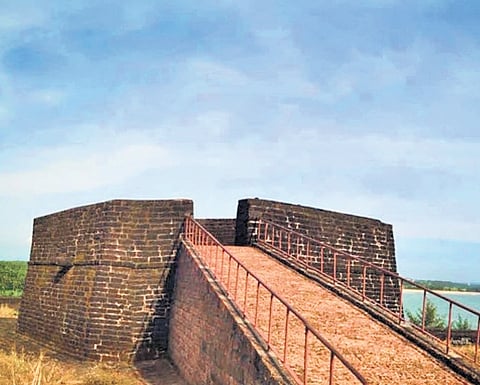
And then there are the forts - Bekal, Hosdurg, Chandragiri, Kumbla and Bantadukka - which testify to the region’s strategic importance under the Ikkeri Nayakas.
“Among the monuments protected by the State Archaeology Department, forts are the most prominent. Bekal Fort is separately protected by the Archaeological Survey of India,” he said.
Despite this wealth, the department acknowledges that Kasaragod has not received the level of archaeological exploration and regular attention seen in several other parts of Keralam.
“Generally, in Kasaragod district, monuments are in a somewhat neglected condition. We don’t have sub-offices, and because of that, it does not always receive day-to-day attention. This naturally has its drawbacks when it comes to monument protection and related matters,” he said.
The department has so far conducted only a limited number of archaeological excavations in the district, including at Ummichipoyil, Chithari, Kuttikol, Manimoola, Chandragiri and Kumbla.
Neolithic remains
The district has also produced significant evidence of the Neolithic period. A 22-cm-long, 1.488-kg stone axe discovered at Thimiri in Kayyur-Cheemeni is considered the largest such axe found in Keralam. Another stone tool was discovered in 2023 at Ariyittapara-Pothamkandam