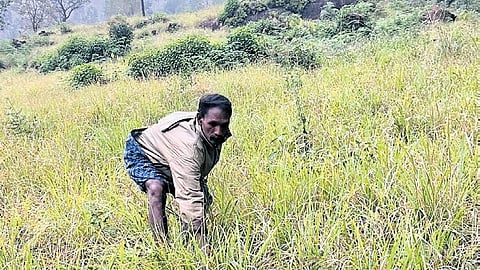

IDUKKI: What do you grow when the forest is your neighbour, wild animals can destroy a harvest overnight, and transporting vegetables to the market costs thousands of rupees? For tribal settlers in the forest-fringe hamlets of Kanthalloor, the answer is becoming increasingly simple — lemongrass.
The fragrant grass is quietly transforming the farmlands of tribal settlements, offering farmers a crop that needs little water and care, can be harvested every three months, and importantly, is less vulnerable to wildlife damage. What began as a small shift has now grown into large-scale cultivation across the settlements.
Nearly 250 acres in Ollavayal Kudi are currently under lemongrass cultivation, said ward member and tribal settler Lakshmanan. Chempatti and Theerthamala settlements have also taken up lemongrass cultivation on nearly 150 acres combined.
“Most families have taken up the crop as it requires low maintenance, less water and offers stable prices,” Lakshmanan said. The steep terrain of the tribal settlements has also encouraged farmers to choose lemongrass. With irrigation difficult to establish and maintain on sloping land, farmers said the crop’s low water requirement makes it easier to cultivate.
For those who once depended heavily on vegetables, lemongrass has brought another advantage: they can process the crop close to their homes instead of sending bulky produce to long distances in search of buyers. Once harvested, the grass is taken to traditional extraction units near the fields, where it is processed into oil.
“Around three bundles, or nearly 80 kg of lemongrass are needed to produce one litre of oil,” farmer Veeranchi said.

The process takes about two hours for a litre, while teams of farmers working continuously can produce up to eight litres in 24 hours. A litre of lemongrass oil now fetches around Rs 2,200 in the local market.
The settlements cultivate tall, medium and dwarf varieties, but farmers mostly prefer the dwarf type, which they said produces more oil than the taller varieties.
The crop has also reduced one of the biggest uncertainties of farming along the forest edge — wildlife damage. Unlike many conventional crops, lemongrass is less vulnerable to raids by wild animals, making it a safer choice for families whose fields lie close to the reserve forest.
However, farmers say the market support they once enjoyed has disappeared.
Sivakumar, a farmer from Keezhanthoor, said a society that earlier procured lemongrass oil from tribal farmers had helped ensure better returns.
The society later stopped functioning amid fluctuations in market prices, leaving farmers to sell their oil directly to private buyers. But getting the produce to the market remains a challenge. Poor roads mean farmers have to depend on jeeps to transport the oil to Pious Nagar, adding to their expenses.
“Vegetables require transport to Madurai at a cost of nearly Rs 12,000, as there are no traders procuring them from Keralam,” Veeranchi said. “Compared to that, lemongrass is easier for us to cultivate and market,”he said.
WHY lemongrass?
Most families have taken up the crop as it requires low maintenance, less water and offers stable prices
The crop can be harvested every three months
250 acres in Ollavayal Kudi, 10 acres in Chempatti and Theerthamala settlements combined are currently under lemongrass cultivation