
THIRUVANANTHAPURAM: In a major overhaul aimed at bringing down fatalities caused by poor driver judgment on roads, Keralam is set to become the first Indian state to introduce a computer-based Hazard Perception Test for driving licence applicants, bringing local standards on a par with several western nations.
The new computer test evaluates an applicant’s ability to spot road hazards in real time before they cause real-world crashes. Transport Commissioner Nagaraju Chakilam has made the test mandatory statewide from December 1.
The decision stems from the recognition that conventional yard and road tests fail to simulate critical risk scenarios. Key safety factors such as navigating sharp curves, driving through heavy downpours, dealing with night-time glare and reacting to sudden pedestrian or animal movement-cannot be safely or reliably recreated during a standard road test.
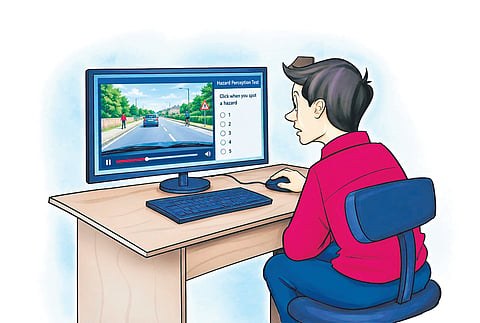
Under the new format, candidates will sit before a computer screen to watch 10 video clips, each a minute long, featuring up to two potential real-world hazards. Much like an interactive simulation, applicants must click a mouse or tracker the instant they spot a developing hazard, such as a child chasing a ball into the street or a vehicle abruptly pulling out of a side lane.
Out of 100 total marks, full points will be awarded for quick, timely click-responses, while delayed reactions will lead to deductions.
Candidates will have to secure at least 60% (60 marks) to qualify for the practical driving round. The test will expand the state’s driving evaluation into a four-part sequence: online learner’s test (Part I), the 30-day waiting period, computer-based Hazard Perception Test (Part II), and finally ground (Part III) and road tests (Part IV).
The initiative has been in the works for the last two years under the transport commissioner’s leadership as part of the MVD’s ‘Mission Zero’ campaign, which was launched in 2024 and targets high-risk groups, including pedestrians, motorcyclists and heavy vehicle drivers, to achieve zero road fatalities by 2040.
To ensure a smooth transition, the department will give people adequate time to adapt to the system. Authorised motor driving schools across the state have been directed to begin hazard perception training using open-source tools. Regional transport officers (RTOs) and joint RTOs will launch statewide inspections on October 1 to ensure driving schools have installed the necessary computer setups.
Interactive simulation
Under the new format, candidates will sit before a computer screen to watch 10 video clips, each a minute long, featuring up to two potential real-world hazards
Much like an interactive simulation, applicants must click a mouse or tracker the instant they spot a developing hazard
Out of 100 total marks, full points will be awarded for quick, timely click-responses, while delayed reactions will lead to deductions
