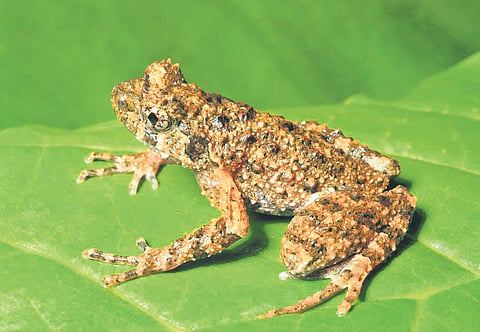

THIRUVANANTHAPURAM: A five-year study by a team of Indian and American scientists, including renowned Malayali batrachologist S D Biju, has led to the discovery of five new species of tiny to medium-sized frogs with horn-like skin flaps in Arunachal Pradesh. The study has also recorded the first known snail-eating frog in India.
The species belong to the genus Jingophrys, commonly known as Diminutive Horned Frogs. The findings have been published in the latest issue of the journal Royal Society Open Science.
The research was conducted by a team from the University of Delhi and Harvard University following extensive field explorations across Eastern Himalayas in Northeast India.
Sonali Garg, who led the research as a Biodiversity Postdoctoral Fellow at Harvard University’s Museum of Comparative Zoology, said: “The findings underscored the importance of sustained field research and advanced laboratory techniques in documenting biodiversity in poorly studied regions.”
Three of the newly identified species have been named after local communities, languages and geographical regions. The Tanii Horned Frog (Jingophrys taniitatii) is named after the Tanii tribe of Arunachal Pradesh.
Another species, Jingophrys tanogogo, has been named after the Apatani word for snails. Using three-dimensional micro-CT imaging, researchers found entire land snail shells in its gut. This makes it the first known snail-eating frog recorded in India and the first documented instance of snail-eating behaviour in the family Megophryidae.

The Siang Horned Frog (Jingophrys siangensis) is named after the Siang region of Arunachal Pradesh.
The remaining two species, Jingophrys hrdy and Jingophrys wularsoni, recognise the contributions of long-time supporters of herpetological research and conservation biology at Harvard University.
The five researchers – Sonali Garg, S D Biju, Tage Tajo, Radhakrishna Upadhyaya K and James Hanken – braved temperatures as low as minus 4 degrees Celsius while exploring the mountainous terrain of Arunachal Pradesh.
“These were nocturnal species. Hence, the group had to work at night, with absolutely no place to stay,” Biju said.
The study also provides fresh insights into the evolutionary history of horned frogs in the Eastern Himalayas. DNA-based analysis suggests that their diversification coincided with the rise of the Himalayan mountain ranges and the intensification of the Asian monsoon system millions of years ago.