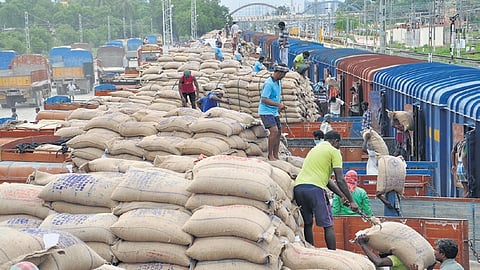

BHOPAL: Large quantities of rice dispatched from a Food Corporation of India (FCI) warehouse in Madhya Pradesh's Balaghat district to an ethanol plant in neighbouring Chhindwara are suspected to have been diverted to rice mills across the state's Mahakoshal region, prompting a widening investigation by a Special Investigation Team (SIT).
Four people have been arrested so far, while around 40 others, including rice millers, transporters and ethanol plant personnel, have been questioned in connection with the alleged diversion.
"So far, four persons, including truck drivers, a person associated with the concerned ethanol plant and a transporter, have been arrested. At least 13 trucks have also been seized," a senior police officer associated with the SIT told The New Indian Express on Friday.
The alleged diversion first came to light in the first week of June when three truckloads of government rice dispatched from the Food Corporation of India (FCI) warehouse at Navegaon in Balaghat for AVJ Ethanol Plant in Chhindwara failed to reach their destination.
On June 3, one of the trucks was traced to a rice mill in Balaghat's Waraseoni area instead of the ethanol plant, while the remaining two vehicles also failed to reach the Chhindwara facility.
A joint team comprising the tehsildar, naib tehsildar and junior supply officer subsequently conducted a surprise inspection at the rice mill. The truck was found parked deep inside the premises, carrying 490 bags containing 242.55 quintals of government rice. Officials confirmed that the consignment had been loaded from the FCI depot at Navegaon and was intended for supply to the ethanol plant.
Following the inspection, the district administration informed the Balaghat police, which registered an FIR and constituted an SIT to investigate the alleged diversion.
Investigators have since expanded the probe beyond Balaghat after seizing 13 trucks, with searches and inquiries extending to the adjoining districts of Seoni and Chhindwara. Officials suspect the rice may have been diverted not only to the Balaghat mill where the first truck was found but also to several other rice mills in the region.
"Possibility of individuals associated with some other ethanol plants in the state being part of the nexus cannot be ruled out," a police officer said.
The investigation has also raised concerns that the diverted stock may have included fortified rice enriched with essential vitamins and minerals, which is meant for children, pregnant women and adolescent girls to help tackle anaemia and malnutrition.
According to investigators, the diverted rice may have been repacked by millers and supplied back to government warehouses as freshly produced Custom Milled Rice (CMR) under existing milling contracts, instead of being used for ethanol production.
The SIT is examining whether the alleged diversion extends far beyond the consignments detected so far. Investigators suspect that as much as 5 lakh metric tonnes of government rice worth over Rs 1,000 crore, allocated for ethanol production, may have been diverted and routed back into government stocks rather than being converted into ethanol.
Under the Centre's ethanol blending programme, surplus and broken rice from the FCI is supplied to registered distilleries through the Open Market Sale Scheme to support India's target of achieving 20 per cent ethanol blending in petrol. The rice is sold at a subsidised rate of Rs 2,320 per quintal, although its economic cost to the FCI exceeds Rs 4,000 per quintal.
