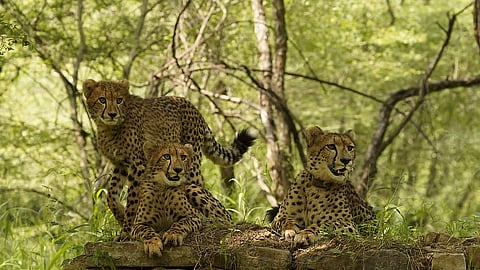

BHOPAL: Back on September 17, 2022, Prime Minister Narendra Modi marked his 72nd birthday with the launch of the country’s ambitious Cheetah Reintroduction Project, by releasing eight Namibian cheetahs at the Kuno National Park (KNP) in Madhya Pradesh’s Sheopur district.
Three-and-a-half years later, the state’s CM Dr Mohan Yadav marked his 61st birthday by laying the foundation for the cheetahs' third home in the country in MP’s largest tiger reserve Veerangana Durgavati Tiger Reserve (VDTR) on Wednesday.
He performed the Bhoomi Pujan (ground-breaking ceremony) for the special soft release Boma (enclosure) to be constructed for the release of cheetahs in the tiger reserve.
The Mohli Range of Nauradehi Sanctuary in the VDTR is getting ready to become the third home of cheetahs in India (after the KNP in MP’s Sheopur district and the Gandhi Sagar Sanctuary in MP's Mandsaur district) by June 2026.
The cheetahs will be housed in the soft release boma, to be built in a 4.5 sq km area in the Mohli Range.
With the birth of five cubs to Namibian cheetah Jwala at the KNP, the country’s cheetah count touched 53 recently, including 20 adults from Namibia, South Africa and Botswana and 33 Indian-born cubs of the South African and Namibian cheetahs.
Spread across 2,339 square km, the VDTR is the largest tiger reserve in Madhya Pradesh and covers three districts of Bundelkhand region -- Sagar, Damoh and Narsinghpur.
Also known as the Land of Wolves, which are thriving here, VDTR will be the first place in the country where cheetahs will cohabit with two big co-predators including around 32 tigers and a large population of leopards.
Its terrain is similar to what is found in South Africa. The Nauradehi Sanctuary at VDTR is also home to 240 bird species which serve as a major attraction.
The MP CM also released 14 turtles – brought from River Chambal – into the Bamner River at the VDTR. The turtles belong to two distinct species: six turtles of the Tera Prince species and eight turtles of the Sundari species. According to experts, these species play a crucial role in maintaining the cleanliness of the river and preserving the balance of aquatic biodiversity.
On the occasion, the CM said, “Serving nature and wildlife constitutes true service to God. The release of turtles—along with the ongoing strides in cheetah rehabilitation—will further and more effectively position Madhya Pradesh on the global map of wildlife tourism and conservation." Emphasizing the ecological significance of turtles within the ecosystem, he called for the conservation of water bodies and structures.
Earlier in the day, Yadav inaugurated the MP Tourism’s Café Culture House at the Ravindra Bhavan complex in Bhopal, while engaging in a pleasant interaction with Divyang children on his birthday. The children cut a birthday cake for the CM and sang Happy Birthday to You, besides gifting him a painting.
One of the children, Sahiyana Tiwari, felicitated the CM by reciting a poem on his birthday. She also presented a poem highlighting the struggles of Lord Ram. The CM announced Rs 5 lakh as encouragement for the Divyang children and separately declared Rs 21,000 for Sahiyana Tiwari for her poetry recital. He said that every possible effort will be made to encourage the talents of such children.
The Café Culture House, developed with themes of cultural and rural life, is an important initiative to promote the state’s cultural richness and tourism. It will serve as a strong platform for promoting art, culture and local traditions.
It is a unique project of the Madhya Pradesh Tourism Board, blending nature, culture and a variety of special cuisines. Located within Bhopal’s Ravindra Bhavan complex, it has a seating capacity of about 85 people and offers visitors a calm and relaxing environment. The café’s menu reflects the state’s rich regional cuisine, featuring dishes such as Bhutte Ka Kees, along with innovative preparations that promote Shri Anna (millets), including Ragi Balusha and Kodo Arancini.
Designed as a landscape-based café, it integrates lush greenery and natural textures with a modern architectural structure, offering a unique experience for visitors to Rabindra Bhavan. From hand-carved wooden seating to specially crafted terracotta, stone, wood, bamboo, and jute artworks, the café showcases the creativity of artisans from the state. The interior décor is adorned with local handicrafts and artworks, making the dining experience even more memorable. The space has been developed as a creative hub for cultural engagement.
