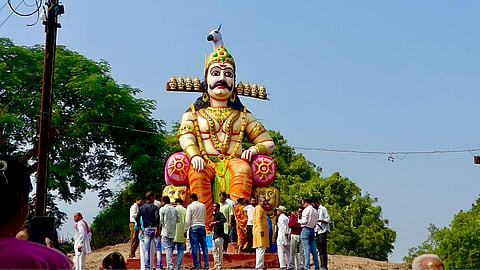

BHOPAL: On the festival of Dussehra, much of India prepared to watch towering effigies of Ravana go up in flames, celebrating Lord Ram’s victory over the king of Lanka.
But in some parts of Madhya Pradesh, the festival unfolded to a different script. Here, Ravana is not merely the embodiment of evil awaiting destruction. He is a figure of faith, a revered ancestor of local traditions, a fulfiller of wishes and, in one community’s telling, a son-in-law deserving of respect even on the day of his death.
In these pockets of the state, the familiar ritual of burning Ravana reportedly gave way to worship, offerings and prayers, demonstrating how local beliefs can add unexpected dimensions to an epic whose moral symbolism is widely understood across India.
In Bhatkhedi village in Rajgarh district, the distinction was particularly striking. For generations, villagers have gathered on Vijayadashami not to set Ravana’s image alight, but to adorn and worship statues of Ravana and his brother Kumbhakarna. The practice, believed locally to date back around 150 years, has earned the village its association with Ravana.
The old statues, said by residents to have been made from mud and lime, remain objects of devotion beyond the annual festival. Villagers turn to them with requests for the fulfilment of wishes and, when rainfall is scarce, pray for rain.
Some believe that rainfall arriving on the day of worship is an answer to their appeals. With no definitive historical record establishing the statues’ origins, the tradition survives principally through community memory and faith. Residents have also called for the structures to be preserved.
Around 230 kilometres away, in Mandsaur district, reverence took on a more intimate character. Members of the Namdev community regard Ravana as their son-in-law because they believe Mandodari, his wife, was their daughter. The relationship transforms the atmosphere surrounding his annual death: before Lord Ram’s army arrives for the customary enactment, devotees seek Ravana’s forgiveness and ask him to continue blessing them.
A 41-foot statue in the city’s Khanpur area served on Tuesday, as the focal point of these observances. Worship continued through the day, while women covered their heads as they passed before the image. According to local belief, tying a thread around Ravana’s right foot can help ward off illness and other difficulties.
For the community, the ritual was not simply an endorsement of Ravana’s actions in the Ramayana. It was an expression of kinship and obligation: even when a son-in-law faces his destined end, he must be approached with respect.
A different relationship with the epic emerged in Kaladev village in Vidisha district of central MP, where Dussehra became a symbolic contest rather than a conventional effigy-burning ceremony. Participants representing Ravana’s army hurled stones towards those playing Ram’s army, who advanced towards a flag planted near Ravana’s imposing statue. Villagers maintain that local participants are protected from being struck, a belief they associate with Lord Ram’s power. The custom continues despite uncertainty about when it began.
In Manawar, in Dhar district, Ravana occupied an altogether more playful place in local life. A mock battle between Ram’s forces and Patal Ravana’s army mixed theatrical confrontation with humour. Children taunted the young man portraying Ravana, who chased them with a wooden plank. Some families also brought children who cry excessively at night to receive blessings from the performer, believing the encounter may ease their fears.
Taken together, these traditions complicate the neat division between hero and antagonist that commonly defines Dussehra celebrations. They do not erase Ravana’s place as Ram’s adversary; instead, they reveal how communities have fashioned their own relationships with the character through inherited beliefs, ritual and folklore.
As flames rise over Ravana’s effigies elsewhere, these communities preserve another kind of Vijayadashami story, one in which the vanquished king is still offered prayers, accorded familial respect and remembered as a presence in everyday life.
