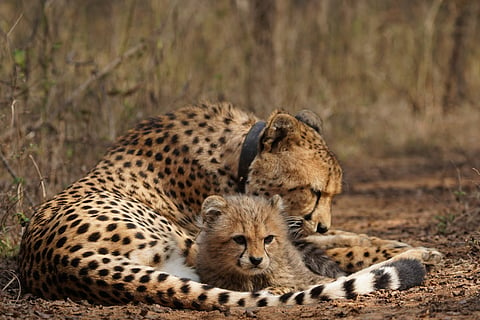

BHOPAL: As Project Cheetah completes four years on Thursday, Madhya Pradesh's Gandhi Sagar Wildlife Sanctuary is awaiting the arrival of a fourth African cheetah, with a South African female or a younger Botswana female likely to be translocated from Kuno National Park in the coming days.
The choice is between six-year-old South African female Nirwa and one of the younger Botswana females, aged around three years, a senior Madhya Pradesh Forest Department official told TNIE on the sidelines of a Cheetah Chaupal programme for schoolchildren at Van Vihar National Park in Bhopal.
"It will either be Nirwa, which is aged around six years, or else one of the Botswana females, who are aged around three years, which will soon be translocated from the Kuno National Park to Gandhi Sagar Wildlife Sanctuary," the official said.
"It is still not decided, but a female cheetah will be sent to Gandhi Sagar Sanctuary soon. The female cheetah translocation was earlier planned for Thursday, but it has now been postponed for a few days," the official added.
Gandhi Sagar Wildlife Sanctuary, spread across Mandsaur and Neemuch districts in western Madhya Pradesh and bordering Rajasthan, currently houses three South African cheetahs in two separate enclosures.
Young South African males Prabhas and Pawak were shifted from Kuno National Park to Gandhi Sagar on April 20, 2025, and released into one of the large soft-release enclosures. South African female Dheera was subsequently translocated to another enclosure, around eight km away, in September 2025.
The fourth cheetah will be housed in another enclosure, located around 6-8 km from the two existing enclosures, sources said.
Meanwhile, Veerangana Durgavati Tiger Reserve (VDTR), spread across three districts in the Bundelkhand region, is also awaiting its first cheetahs.
The reserve has completed construction of a large soft-release boma comprising five sub-enclosures, each measuring around 80-85 hectares, in the Mohli Range of Nauradehi Wildlife Sanctuary.
"At present, we are awaiting clearance from the national Cheetah Project Steering Committee for sending the cheetahs to VDTR," a Madhya Pradesh Forest Department official said.
Once cheetahs are introduced there, VDTR, Madhya Pradesh's largest tiger reserve, will become the first tiger reserve in India to house cheetahs. The introduction will also mean that, for the first time, cheetahs in India will share a landscape with tigers as co-predators.
The next phase of the cheetah restoration programme involves expanding suitable habitat and establishing a long-term cheetah meta-population in India.
The country's cheetah population has now reached 52, including 32 animals born in India, an official said.
The establishment of breeding females and the survival of the second generation of cubs are being viewed as significant developments in the fourth year of the programme.
"We are focusing on multiplication of the cheetah population through successful breeding. With the genetic makeup of cheetahs being fragile, consequently making them vulnerable to various ailments, we are particularly looking at breeding new populations from cheetahs of different nations and genetic makeups to broaden the genetic profile of future cheetah populations in India," the official said.
"That is the reason a Botswana female may be sent to Gandhi Sagar Wildlife Sanctuary in the coming days," the official added.
