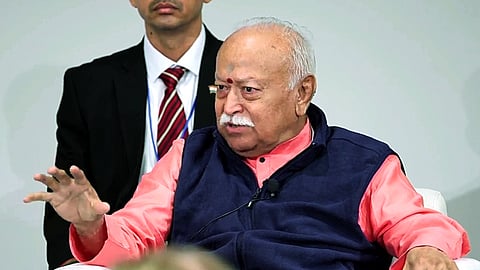

BHOPAL: A day before Leader of Opposition Rahul Gandhi is scheduled to address the mega Chhatron ki Goonj event in Indore, RSS chief Mohan Bhagwat on Friday spoke against “arrogance and ego” while addressing the Yuva Dharma Sansad in the adjoining holy city of Ujjain.
In his address, the RSS chief said, “A person who acts out of ahankar (arrogance) believing that everything is under their control because of the ego, carries the misconception in mind that everything should happen according to their own will. But that is not so.”
“Man has nurtured an ego and arrogance that we are the supreme beings of creation. This is because humans possess intellect, and considering all other creatures weak, they have become the rulers of all because of their intellect. God says that protecting dharma is your duty, and you must protect dharma through your sacrifice.”
While saying it was heartening to see Gen Z discussing Dharma, Bhagwat said he was happy to be at the Yuva Dharma Sansad in Ujjain., “Thought of young people engaging with Dharma is rarely heard these days. If we talk about dharma, people say that all this is a matter for old age. The Bhagavad Gita, Ramayana, and so on are scriptures to be read after retirement. But that is not so. This dharma remains, at the very least, from the beginning of existence to the end of existence. And everything proceeds according to it. Whether you believe in it or not. There are such things in the world, for example, the sun, its rising and setting are certain, it will happen that way, whether you believe it or not.”
“According to Bharat Savitri (a short, powerful hymn composed by Maharishi Ved Vyasa that captures the core moral essence and sum total of the Mahabharata), the material comforts you seek in life are attained through dharma, practice that dharma, for it alone will give you all the comforts of life and it alone will lead you toward moksha. Do not abandon dharma to fulfil any desire, out of fear, out of greed, or to save your life. Happiness and sorrow keep coming and going, dharma remains eternal,” Bhagwat said.
Quoiting famous Indian scholar-philosopher Gurudev RD Ranade, the RSS chief said, “Religion is not Dharma. Dharma is the religion which is on top of every religion. If all religions function as per their eternal Dharma, everything will work smoothly. When religions follow dharma, they lead human beings to liberation. But when religions abandon dharma, communal conflict arises, and all kinds of atrocities are committed in the name of religion.”
“Dharma resides in our conduct and duties, such as Putra Dharma (duty of a son), Raj Dharma (duty of a king) and Manav Dharma (duty of humanity). It determines the duties of each thing and living being according to its nature. According to me, that which keeps everyone united, uplifts everyone, prevents them from falling apart from one another, and determines the duty of all beings and things towards the world according to their nature, so that everyone may benefit from material and spiritual progress, is the discipline that is called dharma. Dharma lies in conduct, not in lectures, not in books; even if it is there, it is for our knowledge, to give us clarity.”
Just a few weeks after he addressed the Indian Diaspora (particularly business and industrialist fraternity) in New York, Toronto and London, the RSS chief said, “World is experiencing unbalanced growth and development. Bharat (India) was the dominant global force economically for 1600 years. Becoming economically and militarily powerful must just be padavs (halts) and not India’s gantavya (destination). Our goal is to strive to make the whole world a world of happiness and peace. It is dharma that empowers the youth of India in the material and spiritual spheres. It is dharma that enables the youth of India to become successful and purposeful throughout the world.”
Advocating for the dharma of religious tolerance, Bhagwat said, “We remain steadfast in the worship we have chosen, which is suited to our nature, and which has been given to us by our guru or by our tradition. We respect others' forms of worship just as much. We also consider others' forms of worship to be good. But we do not convert; we remain steadfast in our own form of worship.”
