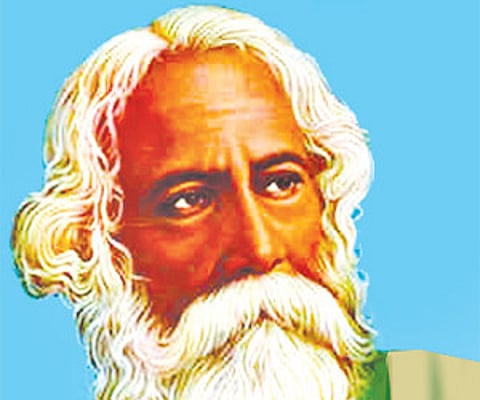

When I was barely 8 years old, I often walked past Vanguard Photo Studio which was opposite my house at Thakurdwar in Mumbai. On the front wall hung life-size photographs of three great sons of India - Mahatma Gandhi, Rabindranath Tagore and Netaji Subhas Chandra Bose. My father told me what they have done for our country and how deeply people love them. Whenever I passed by the studio, I folded my hands and bowed to the three great men.
In my young days, I was an avid reader. The poet who influenced me the most was Rabindranath Tagore and the work, Gitanjali.
Poet, musician, painter, writer and educationist, Rabindranath Tagore was born on May 7, 1861 in a wealthy family in Kolkata. Son of Sarada Devi and Debendranath, Rabindranath lost his mother when he was a child. He did not like the conventional education and started studying at home under the guidance of private tutors. In 1883, he got married to Bhabatarini Devi, who was later known as Mrinalini Devi.
Rabindranath wrote volumes of poems, plays, novels, short stories and non-fiction. His poem collections include Kabi Kahini (1878), Manasi (1890), Sonar Tari (1894), Gitanjali (1910) Gitimalya (1914) and Balaka (1916).
Among the novels, Nastanirha (1901), Chokher Bali (1903),Gora (1910), Ghare Baire (1916) and Jogajog (1929) are famous. In his novels, Tagore presents a picture of the contemporary Bengali society which was in transition in the early twentieth century. The impact of Western education on the Indian society is also quite evident in his works.
Tagore had talent in music and drama. At the age of 16, he played the lead role in Jyotirindranath’s adaptation of Molière’s Le Bourgeois Gentilhomme. His plays include Chitrangada(1892), Dak Ghar (1912), Raktakarabi (1926) and Chandalika (1933).
In 1913, Tagore became the first Asian to win the Nobel Prize for Literature. In 1915, he was knighted by the King George V. However, in 1919, he repudiated his Knighthood in protest of the massacre at Jalianwalabag.
1n 1921, Tagore founded Viswa Bharati University at Shantiniketan. Tagore gave all his money from Nobel Prize and the royalty he received from his books to this university. Viswa Bharati today is an internationally acclaimed university, with the Prime Minister of India as its Chancellor. Its illustrious alumni include Indira Gandhi and Amartya Sen. In 1940, Oxford University arranged a special ceremony in Santiniketan to honor the poet with Doctorate of Literature.
Tagore had travelled widely in Europe, Asia and America and gave talks at many places. He also visited many places in India. He came to Orissa several times. In 1891, he visited his Pandua estate in Jagatsinghpur. It is believed that he penned his immortal dance drama Chitrangada based on Pandava prince Arjun’s visit to Manipur and his marriage to Princess Chitrangada here.
In 1893, Tagore came to Puri. He also visited the temples of Bhubaneswar and the Khandagiri cave. In 1939, Tagore visited Orissa on the invitation of the then premier of the province, Biswanath Dash. He passed away on 7th August 1941 in his ancestral home in Kolkata. Tagore was an all time great poet and writer. Two of his songs - Jana gana mana and Amar sonar Bangla - are now the national anthems of two countries, India and Bangladesh respectively. His books have been translated into several languages and read by people across the world.
In 1989, when I was flying from San Francisco to Tokyo, a Japanese gentleman was sitting next to me reading a book. When I asked him “Who is your favourite author?’, he replied, “Rabindranath Tagore and showed me the book. It was Gitanjali.
In India, school children read - and some of them even memorise - the lines of Tagore’s famous poem ,” Where the mind is without fear and the head is held high/ Where knowledge is free… …Into that heaven of freedom, my Father, let my country awake.” Gurudev Rabindranath Tagore will continue to inspire generations to come. I pay my homage to this great son of Mother India.
(Murlidhar C. Bhandare is Governor, Orissa)