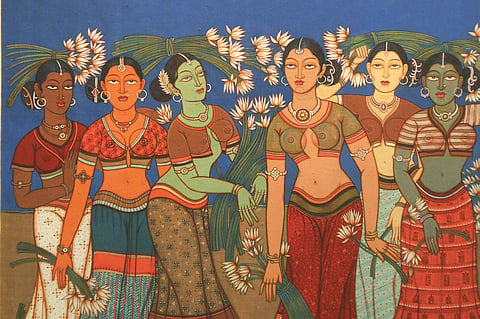

Being with artist Sailabala Nayak in her studio, decorated with exquisite creations on canvas, makes one experience the poetry and passion of India’s traditional art forms.
For her, painting has been a soul-fulfilling artistic journey for over four decades. At a time when artists elsewhere are taking to modern themes to make their presence felt in the art market, Sailabala continues to pursue and nurture Indian traditional art form with incredible talent, imagination and an unerring eye for sheer visual beauty.
Traditional Icons
Her repertoire of, and mastery over, traditional art forms is mind boggling. Each of her paintings is based on an in-depth study of the iconography, mythology, texture, classical and folk literature, use of colours and many more.
In fact, the artist, who has worked with the traditional technique of tempera on silk for almost 40 years, is one among the few painters of Odisha who has established the relevance of this style of Indian painting in the contemporary art scenario.
Sailabala has dabbled in subjects that are folk, traditional, feminist and narrative. All of them are easy to comprehend and beautiful to look at. The blend of clear outline, vivid shapes and bright shades at once appear appealing to the eye and could compel an onlooker to dwell on them. She believes in giving modern touches to traditional concepts and draws from the treasure trove of Odisha’s traditional painting.
Mythological Texts
“Portraying rare scenes from the mythological texts is something I have been doing for a long time, but with a difference. The Indian traditional style of painting have always been two dimensional and grammar, the same. What I try to do is change the form of the subjects to give it a contemporary touch. Even as every where you find Devi Durga killing the demon in a certain angle, in my paintings, the angle is straight,” says the artist, who teaches Indian Painting at the B K College of Art and Craft, Bhubaneswar.
She feels tempera technique lends a charm to such figurative paintings.
So while her Radha-Krishna series - Mahamilana, The Invocation, Bound of Divine Love, Awakening of Radha - evokes the sensual lyricism of Gita Govinda, she also dwells on the livelihood aspects of women in rural parts of the country.
For example, her work ‘Water Lily with Lovely Women’ speaks about women who eke their livelihood by collecting water lilies and selling them at the local market. Another such work is ‘To the Fair’ when dusky tribal women are shown going to a weekly haat to sell their wares.
The social and mythological elements in her paintings include charming costumes, joyous moving eyes, the river Yamuna with lotus, blue sky, low green mountains and colourful birds. A majority of her traditional paintings show Krishna playing his ‘bansuri’ along with Radha in idyllic surroundings.
Love for the Medium
The medium of tempera, she says, is close to her heart and she has reasons for it. “The tempera technique of art on silk requires skill and expertise but the paintings created in this traditional way have a brilliant effect and texture. Even though modern media for painting might have replaced it, the colours are more durable,” she says.
Of late, she has started doing some work with acrylic on canvas and some of them were exhibited at Mayukha exhibition in New Delhi recently.
Sailabala was inspired into the traditional style of painting by her father Rabinarayan Nayak, a renowned painter of Odisha, and underwent training in the form at Khallikote Art College and Berhampur University. She also learnt Pattachitra from Guru Bhagabata Maharana.
“I treat every painting as a project and a thesis in itself going into its mythological, historical, and ‘local’ details, In the process I have learnt a lot,” Sailabala smiles.
The 58-year-old, who recently participated in the national art camp at Raj Bhavan here, says her approach to art is colourful. “My paintings are an expression of happiness. I create them to celebrate bliss.”
