
In keeping with its tradition of presenting engrossing theatre shows, the Odisha Sangeet Natak Akademi showcased a rich fare of five theatrical productions at its first National Contemporary Theatre Festival.
Theatre lovers had a treat of plays from Jammu and Kashmir, Maharashtra, Madhya Pradesh, West Bengal and Odisha, which had society as the central theme, at the Rabindra Mandap.
Curtains on the festival went up on Friday with a Dogri play by Balwant Thakur who is credited of bringing Dogri theatre to limelight. Twenty-three actors of his troupe - Natrang - staged ‘Bawa Jitto’, written by Ram Nath Shastri, which portrayed the 15th century society of Jammu.
Set in rural backdrop, the story of ‘Bawa Jitto’ portrayed the age-old saga of exploitation of landless farmers by landlords. “With a piece of land as cause of disagreement, Bawa Jitto, a hard working farmer is forced to leave his village. Accompanied by his nine-year-old daughter, he takes shelter in the house of a friend in Shamachak, a nearby village. The efforts of his friend Rullo results in a land grant from landlord in Shamachak and one fourth of the produce is fixed as land revenue. The sweat and toil of Jitto turns a barren land into prolific treasure. This makes avaricious landlord back out on his word and he asks for a major share of the crop. Helpless Jitto, unable to endure injustice, kills himself. The agony becomes boundless when Gauri, his little daughter immolates herself on her father’s pyre,” explained Thakur.
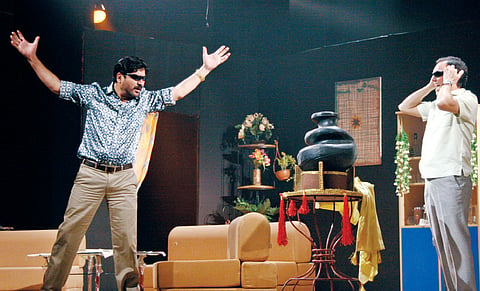
Nadira Zaheer Babbar’s ‘Yaar Bana Buddy’ saw a full house on Saturday. Based on the theme of changing equations of friendship between three friends, the play had moments of laughter and melodrama which at times seemed accentuated.
The story revolved around three friends, with Mithilesh and Kartik trying to persuade their third friend Jaideep to leave his pseudo lifestyle. Jaideep claims to be an art lover and spends extravagantly on objects of art.
The Rang Vidushak troupe led by celebrated director Bansi Kaul presented a colourful play ‘Sidhi Dar Sidhi Urf Tukke Pe Tukka’ on Sunday. With clown costumes and heavily painted faces the actors created an aura of amusement, though according to the director the underlying message and social satire was not lost altogether.
A brightly coloured stage, clownish costumes and painted faces of the performers in the play aroused questions - does the troupe give priority to colours? Is that why they call themselves Rang Vidushak (painted wise men, who pretend to be buffoons)?
The sexagenarian director said he was impressed to see the many forms of theatre in different corners of India during his job as a travelling director in the early 1970s, under a project run by National School of Drama (NSD). And from such impressions, he started to incorporate the form that his troupe follows nowadays.
“We take ideas from tribal and agrarian communities and try to incorporate these elements in our plays. We do not follow the forms, rather we follow the energy and the philosophy to deal with things,” said Kaul.
Directed by the veteran Meghnad Bhattacharya, the play ‘Pinki Buli’ explored the innocent yet complex relationship between a master and a servant. It unfolded in an urban Bengali household, where speaking in English is considered a status symbol. The family - a businessman, Samaresh Mukherjee, his wife, their convent-going teenage daughter, Pinki and month-old son Bumba - recruits a domestic help-cum-babysitter, Buli, who hails from a village, Swapanpur. An adolescent and the eldest of five siblings, Buli is poles apart from Pinki. Pinki’s mother warns Buli about “class distinction” but despite their cultural differences, Pinki and Buli become best friends. The two teenagers bond over ‘bhooter galpo’, ‘phuchka’, music and books. Gradually, Pinki loses interest in studies, while Buli picks up English words. She also manages to memorise the poems that Pinki struggles to remember!
The host organisation saved the best for the last. Curtains came down on the festival with Odia play, ‘Suna Panjuri’, by artistes of Annapurna Theatre Group A, Puri. Set in the 60s, ‘Suna Panjuri’ dealt with exploitation of women.
“Response to the festival was overwhelming. Budding theatre actors and directors from different parts of the State attended the festival. It was not a glamorous event in which big stars or guests of honour made fleeting appearances. On the contrary, it acted as an instrument to develop theatre movements,” said Chitta Ranjan Mallia, Secretary of Odisha Sangeet Natak Akademi.
Another highlight of the festival was the interactive sessions on theatre-making and behind-the-scenes works in theatre.
Odisha Natya Sangha and EZCC were the co-organisers of the festival that concluded on Tuesday.
