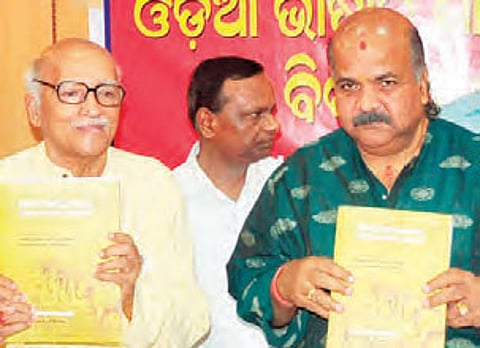

State Government is ready with a 500-page report on its demand for classical status to Odia language. The report, compiled by an 11-member committee constituted by the Government comprising eminent litterateurs, linguists and historians, will be submitted to the Union Government soon for scrutiny and necessary approval for classical status to Odia.
The expert committee, headed by noted litterateur and founder director of Central Institute of Indian Languages Debi Prasanna Pattanayak, was formed on January 16 this year. It submitted the report to Culture Minister Maheswar Mohanty on Sunday for onward submission to the Culture Ministry. A linguist experts committee appointed by the Culture Ministry will examine merits of the demand and recommend if Odia fulfils the criteria laid down by the Union Government for recognition as classical language. If approved, Odia will join the exclusive club of Malayalam, Telugu, Kannada, Sanskrit and Tamil which have already been accorded classical language status.
To be classified as a classical language, a language must fulfil four criteria laid down by the Government. Among them are that the language must have a recorded history of 1,500-2,000 years and its literary tradition must be original and not borrowed from any speaking community.
Odia language has all the features, claimed the committee members. “The report has established the status of Odia as a classical language with the help of documentary evidence relating to its high antiquity and continuing literary traditions,” said Culture Minister Mohanty.
Head of the committee Pattanayak said, “Odia is the only language in the country which contains 49 letters. It stands apart from other Indian languages. The ancient scripts that resemble with that of Odia have been discovered from rock inscriptions of King Kharavela and King Ashoka. It proves Odia language is traced back to an era between 1,000 to 1,500 years. Thus, we hope it will obtain classical status.”
Securing classical language status for Odia has been high on the agenda of successive governments and socio-cultural organisations in Odisha. In fact, the State has been making the demand ever since Tamil was recognised as a classical language in 2004.
Apart from the symbolic value attached to it, securing classical language tag would ensure opportunities for scholars to undertake widespread research in the origin and history of the language with an effort to fill in gaps and missing links. It will also result in flow of resources and recognition of scholars and writers of eminence in Odia.
