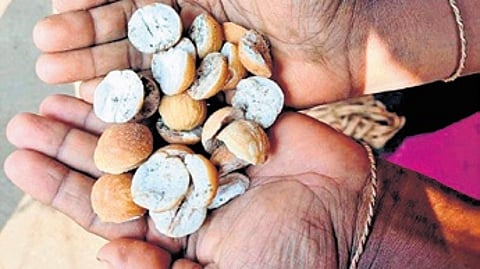

BHUBANESWAR: The All India Institute of Medical Sciences (AIIMS), Bhubaneswar has initiated a research on Cycad, an ancient ornamental nut tree locally called ‘Veru’ or ‘Aruguna’, over concerns that the plant contains BMAA, a potential neurotoxin.
Scientists have identified the neurotoxin in several species of the Cycad tree found in the forests of the state, raising an alarm as certain sections of the population continue the traditional practice of consuming the plant products, especially its nut, as part of their diet and rituals.
The research led by dean of School of Life Sciences at North-Eastern Hill University (NEHU), Prof SK Barik and HOD of neurology at AIIMS-Bhubanewar, Prof Sanjeev Kumar Bhoi is intended at working out a clear roadmap, enhancing community awareness and fostering interdisciplinary collaboration aimed at understanding and mitigating the significant health risks associated with Cycad consumption.
Doctors in the neurology department of the institute said cycad species, often used as ornamental flora, have been found to contain potent toxins including Cycacin, BMAA (β-N-methylamino-L-alanine) and MAM (methylazoxymethanol). These toxins have been strongly associated with debilitating neurodegenerative diseases such as Parkinsonism, motor neuron disease and dementia in other global regions, especially in the Guam peninsula in the USA and the Kii peninsula in Japan, where the plant has been an indigenous part of traditional diets.
A workshop on ‘Cycad-Related Neurological Disorders: A Multi-Dimensional Approach to Its Remediation’ was recently organised by the department of neurology, AIIMS-Bhubaneswar, and the North-Eastern Hill University (NEHU), Shillong involving national and international scientists and medical experts during which serious health risks associated with Cycads were highlighted. The ancient plant species is believed to have coexisted with dinosaurs for over 300 million years.
A field visit was also organised in which experts toured Dhuannali in Khurda, and Gangamunda and Suaginali of Kamakhyanagar in Dhenkanal where local tribal populations remain largely dependent on the Cycas plant as a traditional food source.
