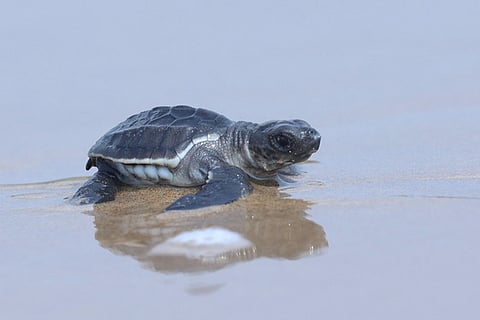

BHUBANESWAR: Olive Ridleys arriving at the Odisha coast for their annual mass nesting are exhibiting extensive migratory capabilities and survival instincts, with some covering distance beyond 1,600 km in Bay of Bengal, a fresh satellite study has revealed.
The study, jointly undertaken by the Wildlife Institute of India (WII) and the state Forest department, has found crucial insights regarding the nearshore behaviour and post-breeding migration pattern in the species.
PCCF (wildlife) Prem Kumar Jha said as part of the Olive Ridley tracking project, a total of eight turtles were satellite-tagged at Gahirmatha and Rushikulya rookeries in the state in December 2025. The process involved attaching satellite transmitters to the turtles’ shells, enabling real-time tracking of their movements across vast oceanic distances.
Initial findings show that during the breeding season, the turtles remained largely in nearshore waters, typically within five km of the coastline, though some ventured up to 35 km offshore.
Inter-rookery movement was also found during the nesting period, with one female travelling between Gahirmatha and Rushikulya, highlighting ecological connectivity between the two key nesting sites of the state. As the season progressed, a distinct migration pattern emerged, Jha said.
He said male turtles which began migrating earlier, moved into deeper offshore waters between mid-February and early March. Several turtles have already travelled a distance of over 1,200-1600 km into the Bay of Bengal.

“The tracking data from the Platform Transmitter Terminals (PTTs) also revealed that these turtles frequently explored depths beyond 100 metre, with some reaching up to 300 metre, highlighting their adaptability to diverse oceanic conditions. Female turtles, however, remained closer to the shore for longer durations, likely due to ongoing nesting activity,” the PCCF said.
As the satellite tags continue to transmit data, the wildlife officials and researchers are expecting to gain deeper insights into the species’ migration routes, habitat use and behavioural ecology, Jha added.
He said traditional monitoring methods used earlier were largely limited to nesting beaches and nearshore observations, leaving a major gap in understanding their offshore migratory behaviour. Satellite telemetry, however, has bridged this gap by enabling scientists to follow individual turtles across vast oceanic distances in real time.
“Current findings on Olive Ridleys highlight the importance of Odisha’s coastal waters not just as nesting grounds but also as critical breeding and congregation habitats. The findings are expected to play a vital role in identifying migratory corridors and strengthening conservation measures in marine protected areas along the state’s coastline,” the PCCF said.