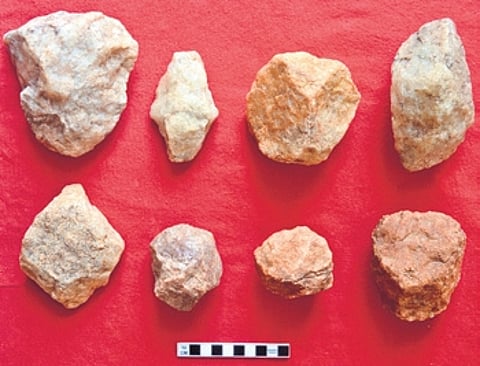

SAMBALPUR: In a significant discovery, a joint research team from Government Autonomous College, Sundargarh and the Puri Circle of the Archaeological Survey of India (ASI) has documented Middle Palaeolithic stone tools and artefacts from Deogarh district, pointing to human activity in the region nearly 70,000 years ago.
The discovery was made at the foothills of a small hillock near the OSRTC bus stand in Reamal tehsil of Deogarh, where soil excavation was underway for a bypass road project. Workers engaged in construction of the project first noticed unusual stones, which later drew the attention of experts.
A team led by ASI superintendent DB Gadnayak along with researchers Sakir Hussain and Jayashankar Naik examined the site and confirmed that the stones belong to the Middle Palaeolithic period. “The artefacts were found both embedded within stratified layers and scattered across the surface, likely exposed due to the removal of laterite soil,” the experts said.
The collected materials include handaxes, evallois cores and flakes, awls, scrapers, picks, discoids, and other sharp-edged tools used for hunting, cutting meat, and digging. Experts noted that these tools bear close resemblance to typical Middle Palaeolithic assemblages, indicating a well-developed tool-making culture.
The findings suggest that human presence and activity in the region began far earlier than previously documented, adding a new dimension to Odisha’s prehistoric timeline. Archaeologists believe the site holds immense potential for further exploration, which could shed light on early human diet, survival strategies, and settlement patterns.
Gadnayak said this was a chance discovery during routine construction work, but it opens up a significant window into the deep past of the region. Such findings indicate that the landscape around Reamal was once inhabited by prehistoric communities, and systematic exploration could reveal valuable insights into their lifestyle.
“During our ongoing excavation work at Naktideul in Rairakhol, we have come across several rock art sites and a cave, with materials that appear to date back at least 10,000 to 15,000 years, indicating links to the Stone Age. With the new findings at Deogarh, we are now hopeful of establishing a cultural and chronological connection between the two regions. This could help us map a much wider prehistoric landscape, suggesting that human activities were not isolated but spread across a vast expanse in western Odisha, reflecting patterns of movement, habitation, and adaptation over thousands of years,” he added.
Officials noted that the discovery enhances Deogarh’s importance not only as a region of natural beauty but also as a site of archaeological significance, with potential to attract wider academic and research attention in the coming years.
