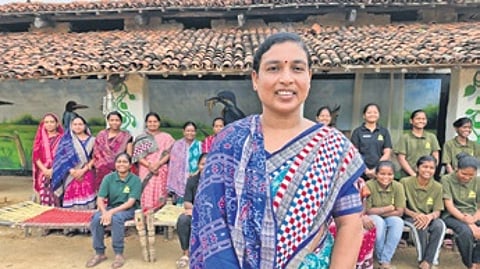

SAMBALPUR: The story of Maithilee Bhue, a tribal woman from Dhodrokusum village on the fringes of Debrigarh Wildlife Sanctuary who moved from forest-dependent livelihood to conservation-linked employment, found a mention in Prime Minister Narendra Modi’s 137th episode of Mann Ki Baat on Sunday.
Citing the grassroots efforts that have brought about social change during his monthly radio programme, PM Modi spoke about Maithilee’s journey and the transformation in her relationship with the forest after she joined Debrigarh eco-tourism. He said until a few years ago, she would visit the forest almost every day to collect firewood, mahua flowers, kendu leaves, bamboo shoots and other forest produce that met several needs of her family and other local households.
“Then Maithilee ji became associated with Debrigarh eco-tourism. This marked a shift in her relationship with the forest, taking it towards a new direction,” the PM said, adding that forest conservation had now also become a means of her livelihood.
The Prime Minister’s Office later shared a post on X highlighting Maithilee’s journey from dependence on forest produce to eco-tourism and noting that it had inspired several women to contribute to forest conservation. The official Mann Ki Baat snippets also highlighted the participation of more than 60 women in conservation activities, including wildlife protection, grassland development and eco-tourism.
Maithilee’s story was first reported in The New Indian Express on August 2, detailing how her transformation had encouraged women in nearly 20 fringe villages around Debrigarh to embrace conservation-linked livelihoods.
The 40-year-old became the first tribal woman from Dhodrokusum to join Debrigarh eco-tourism in 2023. After formal training, she began working at the Zero Point restaurant. The steady livelihood helped her support her family, educate her two children and meet the healthcare needs of her ailing mother-in-law.
Her transition also became a catalyst for others. Nearly 40 women shifted from forest extraction to conservation-based livelihoods, while more than 60 became directly associated with various conservation initiatives, including eco-tourism, wildlife protection squads, meadow development and other activities.
Maithilee subsequently took up community mobilisation, encouraging villagers to avoid felling green trees, collect only dry firewood and reduce dependence on forest produce. Her efforts also contributed to Dhodrokusum being recognised as a Green Village. The village was later selected for women-managed tribal homestays.
