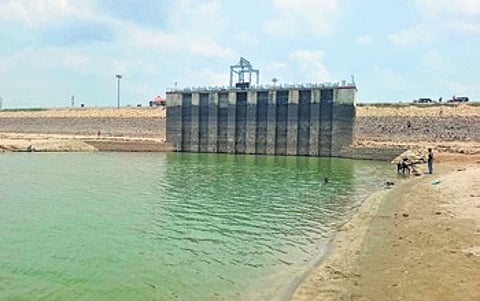

SAMBALPUR: Although monsoon has already gained pace in the state, the deficit rainfall in the upper catchment of Mahanadi river has delayed release of the season’s first floodwater from the Hirakud dam, raising concerns over irrigation, industrial use and drinking water crisis.
Last year, the sluice gates of the dam had been opened on July 6. The delay this year comes amid a sharp decline in the reservoir’s water level compared to last year. As per sources, the water level in the reservoir by June this year stood at 600 feet as compared to 612 feet during the corresponding period last year.
The low storage has prompted authorities concerned to be cautious with water management. Official said to conserve water, they have curtailed the release to the power channel, leading to reduction in hydropower generation at the Burla and Chipilima power stations. “Priority is being given to maintaining adequate storage for irrigation and drinking water rather than maximising electricity generation,” they said.
Till Saturday morning, the water level stood at 601.23 ft. The average inflow was 39,666 cusec and outflow 1,745 cusec with only 1,485 cusec water for irrigation and 260 cusec for industries. Only around 5,077 cusec water was released to the power channel once post afternoon. The situation has been the same for the last one week.
Former chief engineer of Hirakud dam Rabindra Panda said the rain deficit has necessitated conserving the reservoir water. He said releasing 30,000 cusec water through the power channel would bring down the reservoir level to around 590 ft, which would severely impact irrigation requirements. Accordingly, only limited water is being released for power generation.
Hirakud reservoir is the lifeline of western Odisha, providing irrigation to vast stretches of agricultural fields in Bargarh, Sambalpur, Subarnapur and neighbouring districts. As the kharif crop season is currently underway, the low level of reservoir water has raised concerns that it would impact agriculture activities.
Farmer leaders said if the rainfall in the upper catchment of Mahanadi river does not improve in the coming days, pressure on irrigation could increase during the peak cultivation period. Farmer organisations have urged the state government to closely monitor the situation and ensure that irrigation and drinking water needs are met.
Several farmers are reportedly waiting for consistent rainfall before taking up large-scale transplantation, hoping that improved inflows into the reservoir will ensure adequate canal water during the cropping season.
