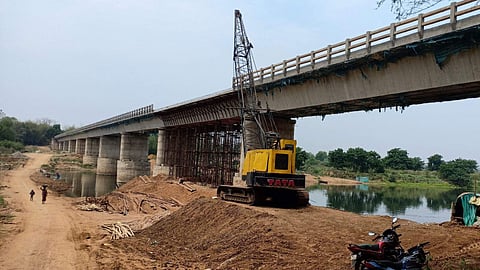

BHUBANESWAR: The state government has launched an ambitious five-year bridge-cum-weir scheme with an outlay of Rs 600 crore to enhance rural connectivity as well as water conservation structures across the districts.
The scheme, to be implemented from 2026-27 to 2030-31, will convert existing bridges into structures that not only provide uninterrupted road connectivity but also impound water for irrigation, groundwater recharge, livestock and domestic use.
Sources in the Rural Development department said that 670 bridge-cum-weir projects will be taken up during this period. The programme will cover 106 new projects and completion of 162 spill-over projects in 2026-27 at an estimated cost of Rs 55 crore. They will be followed by 100 projects each year from 2027-28 to 2030-31, with an allocation of Rs 545 crore. The total investment over the five-year period will be Rs 600 crore.
To ensure safety and long-term sustainability, the government has prescribed stringent technical criteria for project selection. Only structurally sound bridges with open or raft foundations will be considered. Preference will be given to bridges where rigid floor protection is already in place and in good condition.
Sources said the guidelines stipulate that selected bridges should be located across streams with moderate to low water currents, where the velocity generally does not exceed three metres per second. The streams must have stable and well-defined embankments capable of safely storing impounded water without flooding adjoining areas. Preference will also be given to sites with mild to moderate stream-bed slopes to minimise scouring and structural damage. The scheme requires that the bridge-cum-weirs directly benefit nearby habitations, agricultural fields and livestock by providing dependable water storage.
At the end of the scheme period, a third-party evaluation will be carried out to find out the socio-economic and environment impact to enable the government to decide its continuation.
