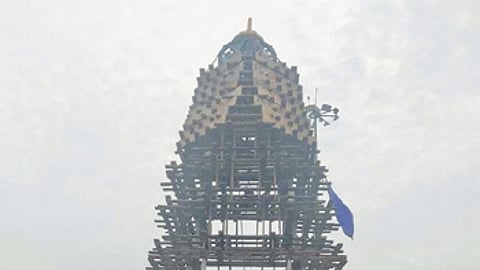

KENDRAPARA: The Indian Institute of Technology (IIT)-Bhubaneswar has identified structural deficiencies in the wooden chariot of the famed Baladevjew temple in Kendrapara and recommended a series of engineering measures to ensure its safe movement during the annual Rath Yatra on July 16.
Following a comprehensive engineering assessment, IIT-Bhubaneswar has submitted recommendations to the temple authorities, including structural stabilisation, conservation strategies and digital documentation of the 67-foot-tall Brahma Taladhwaja chariot.
The study was initiated after last year’s Rath Yatra, when cracks developed in some of the chariot’s wheels, causing it to tilt. Following the incident, the temple management had sought IIT-Bhubaneswar’s technical expertise to improve the chariot’s structural stability.
The IIT’s recommendations include strengthening the chariot’s braking mechanism using sandbags, wooden stoppers and dry sand during braking and turning operations, reinforcing the connection between the superstructure and the base, precision machining of wheel hubs and axles for better load transfer, modifying the rope anchorage system for improved load distribution, and enhancing the wheel-axle lubrication system.
The institute also suggested that the two-km Grand Road (Bada Danda) should be geometrically improved for safer movement of the chariot and drainage system along the route be upgraded.
Assistant professor in School of Mechanical Sciences, IIT-Bhubaneswar Manas Ranjan Pattnayak described the wooden chariot as one of Odisha’s finest examples of living cultural heritage, reflecting centuries-old indigenous knowledge of timber construction, traditional craftsmanship and structural engineering. He said built every year by hereditary artisans, the chariot plays a central role in the Rath Yatra but has never been comprehensively documented using modern engineering tools.
“We have carried out a detailed engineering assessment of the chariot and proposed immediate stabilisation measures, a long-term conservation strategy and a consultancy plan for digital documentation to ensure its safe journey,” said Pattnayak.
Executive officer of Baladevjew temple Balabhadra Patri said the shrine administration has already implemented several recommendations made by IIT-Bhubaneswar. “We have modified the chariot’s design, upgraded its braking system, improved the geometry of the Grand Road and strengthened the drainage system to ensure safe movement of the chariot during the Rath Yatra,” he said.
Located at Ichhapur in Kendrapara town, the Baladevjew temple is known as ‘Tulasi Khetra’. It was built by Kujang king Raja Gopal Sandha during the Maratha rule in Odisha in 1761.
